
For over a decade, SEO followed one dependable rule: rank higher, earn more clicks, grow traffic, generate leads.
That rule no longer holds on its own. Search engines have stopped acting only as directories of links they now generate answers directly, and that single change is reshaping how visibility works for every business we work with.
What the AI Search Era Actually Means
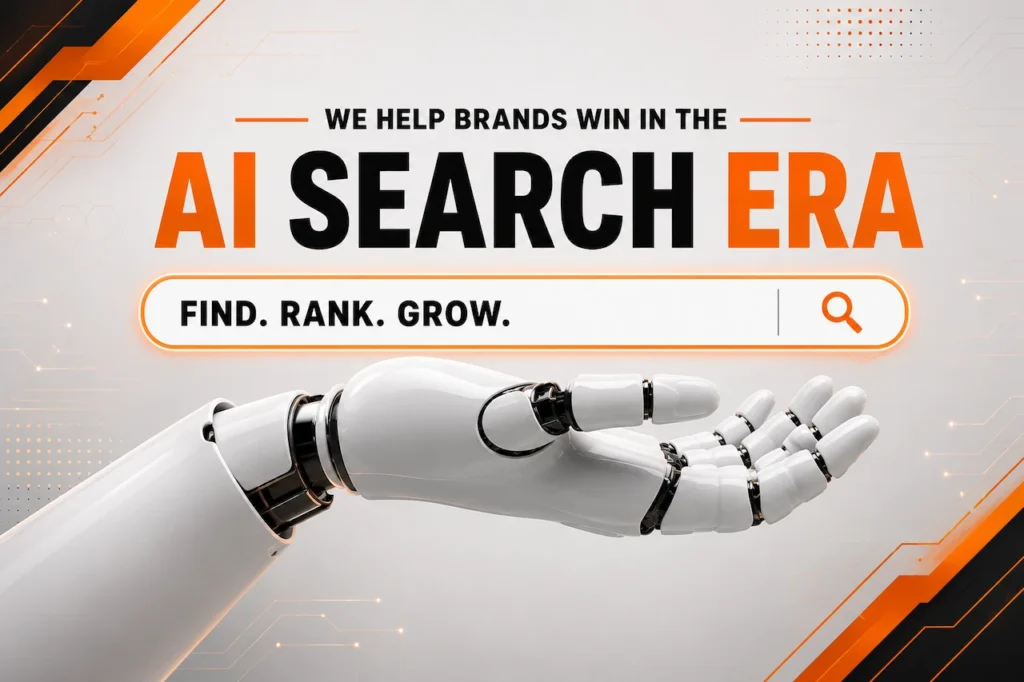
This shift is playing out inside Google AI Overviews, ChatGPT Search, Perplexity, Gemini, and Bing Copilot. In each of these systems, websites are no longer the final destination for a search query. They are becoming the raw material an AI model pulls from to construct its answer.
We call this shift the AI Search Era, and it is already active across every industry we monitor not a future possibility, but a present condition. A user can now ask a question, receive a complete answer inside the search interface, and never click through to a website at all. The website still did the work of producing the information. It simply doesn’t get the visit.
This creates a problem most business owners haven’t noticed yet, because it doesn’t show up as a ranking drop. It shows up as a traffic decline on pages that are still ranking exactly where they always have.
What makes this shift different from past algorithm updates is that it doesn’t punish bad SEO it bypasses good SEO. A page can follow every best practice from the last ten years and still lose visibility, simply because the answer it contains got absorbed into a summary the user never had to click past.
This is why the businesses asking “why is my traffic dropping despite stable rankings” are asking the right question for 2026, even if the answer isn’t one traditional SEO reporting was built to explain.
Why Rankings No Longer Guarantee Traffic
Traditional SEO trained businesses to chase three things: keyword rankings, backlinks, and published content volume. Those three things still matter, but they no longer guarantee a click.
We’ve seen this firsthand across client accounts a page holding position one or two in Google, with stable rankings and healthy impressions, while its click-through rate quietly erodes month over month. The reason is almost always the same: an AI Overview or a direct-answer box now sits above the organic results, answering the query before the user ever scrolls down.
One pattern we track closely is the gap between impressions and clicks in Google Search Console. A page that used to convert ten percent of its impressions into clicks can drop to four or five percent over a few months, with the ranking position barely moving. That gap is the AI Search Era showing up in your own data, whether or not anyone on your team has labeled it that way yet.
This means a business can rank perfectly and still lose visibility. It can maintain steady technical performance and still see fewer conversions. The layer that determines whether a click happens has moved up, and it now depends on how well a page’s content can be extracted, summarized, and trusted by an AI system rather than just how well it ranks.
Getting that layer right starts underneath the surface. If a site has crawl errors, slow load times, or unclear site architecture, no amount of content quality will fix what a technical SEO audit is built to catch first.
SEO vs AEO vs GEO: What Each One Actually Does
These three terms get used loosely, so it’s worth separating them clearly.
- SEO (Search Engine Optimization) focuses on ranking your pages in traditional Google search results the classic blue links.
- AEO (Answer Engine Optimization) focuses on getting your content selected for direct-answer boxes and featured snippets, where the goal is being the answer itself.
- GEO (Generative Engine Optimization) focuses on being cited or referenced inside AI-generated responses from tools like ChatGPT and Perplexity, where there is no traditional results page at all.
None of these three replace the others. We always advise clients to treat them as layers stacked on top of one another rather than competing strategies. SEO builds the foundation of crawlability and authority. AEO structures that content so it can be lifted directly into an answer. GEO extends that same discipline into AI platforms that don’t operate on a search-results page format at all.
A business investing in only one of these three is optimizing for a shrinking slice of how people now find information. A page that ranks well in classic SEO terms but ignores answer-first formatting will lose the featured snippet to a competitor who structured their content correctly, even with weaker overall authority.
We built our own AI search optimization service around this exact overlap, because treating them separately produces gaps competitors can walk straight through.
How AI Systems Decide What to Cite
AI models don’t select sources at random, and they don’t reward the same signals Google’s classic algorithm rewarded twenty years ago. Based on the audits we’ve run, five factors consistently determine whether a page gets pulled into an AI-generated answer.
Entity understanding comes first. This means the AI system can clearly identify who you are, what you offer, and how that fits into your broader industry not just from one page, but from consistent signals across your entire site and any third-party mentions of your brand.
Content clarity matters just as much. A direct answer needs to be extractable from your page without requiring the AI to interpret vague or scattered language. If your key point is buried three paragraphs into a rambling introduction, the model is more likely to pull the answer from a competitor who stated it plainly in the first sentence.
Authority signals go beyond backlinks. Consistent mentions, citations, and trust markers across the web carry more weight now than a handful of links pointing at a single page, because AI systems are cross-referencing your brand’s presence, not just counting inbound links.
Structure quality determines whether a machine can parse your content without guesswork. Clean headings, logical hierarchy, and answer-first formatting all make it easier for an AI model to lift a clear, accurate excerpt.
Technical accessibility is the gatekeeper for everything else. If bots can’t crawl, render, and interpret your site cleanly, none of the other four factors get evaluated at all.
If your content is vague, unstructured, or buried behind technical friction, AI systems skip past it in favor of a competitor whose page answers the same question more directly. This is the practical difference between a business that gets cited and one that doesn’t, regardless of how much content either one has published.
How to Measure Your AI Search Visibility
Most analytics dashboards weren’t built for this shift, so measuring it takes a slightly different approach than tracking classic rankings.
Start with Search Console’s impression-to-click ratio on your top pages. A widening gap between impressions and clicks, with rankings staying flat, is one of the clearest early signals that AI Overviews are absorbing clicks that used to land on your site.
Next, manually test your own target queries inside ChatGPT, Perplexity, and Google’s AI Overview. Search the exact questions your content answers and note whether your brand gets mentioned, cited, or ignored entirely. This single exercise tells you more about your AI visibility than any automated tool currently on the market.
Finally, track branded search volume over time. Businesses that are being cited consistently inside AI answers tend to see a rise in direct brand searches, because users remember the name even when they don’t click through immediately.
What Happens If You Ignore This Shift
Ignoring this shift doesn’t mean nothing happens — it means the damage happens quietly. You may still rank in Google’s traditional results. Your dashboard might not show an obvious red flag. But clicks that used to come from that ranking start going to whichever competitor’s content the AI Overview or ChatGPT response decided to surface instead.
Over time, this shows up as a slow, hard-to-diagnose decline in traffic and leads, even while rankings stay flat. It’s one of the more frustrating patterns we walk clients through, because the instinct is to assume rankings equal health and for the first time in over a decade, that assumption is no longer reliable on its own.
The businesses handling this well right now are the exception, not the rule. Our case studies show a consistent pattern: the accounts that adjusted their content structure and technical foundation early are the ones showing up inside AI answers today, while competitors in the same industry are still running last decade’s playbook.
What We Recommend Businesses Do Now
The fix isn’t a full rebuild — it’s a set of specific, sequenced adjustments layered onto what already exists.
- Fix the technical foundation first. Crawl errors, slow rendering, and poor indexing block AI systems before content quality even becomes a factor.
- Build clear entity authority. Make sure your brand, services, and area of expertise are unambiguous across your site and any third-party mentions.
- Restructure content around direct answers. Lead with the answer, then support it — rather than building up to a conclusion the way older SEO writing habits taught us to.
- Develop topic clusters, not isolated pages. A single strong page rarely carries enough topical depth on its own anymore; connected, interlinked coverage does.
- Optimize specifically for citation, not just ranking. Write content that an AI system can lift cleanly, attribute correctly, and trust enough to reuse.
We prioritize this exact sequence with every new client engagement, because skipping the technical step first tends to waste the content investment that follows it. Our SEO services are built around this order rather than treating each piece as a standalone add-on.
FAQs
What is the AI Search Era?
It’s the shift from search engines that list websites to AI systems that generate direct answers instead. Google AI Overviews, ChatGPT, and Perplexity now often resolve a query without sending a single click to any website.
Is traditional SEO still worth investing in?
Yes. SEO remains the foundation everything else builds on. AEO and GEO extend that foundation into direct-answer boxes and AI-generated responses they don’t replace the groundwork SEO provides.
Why is my traffic dropping even though my rankings haven’t changed?
AI Overviews and direct-answer boxes increasingly answer the query before a user reaches the organic results. Your page can hold its position and still lose the click that used to come with it.
What does GEO mean in practice?
Generative Engine Optimization is the work of structuring content so AI platforms like ChatGPT and Perplexity can extract it, trust it, and cite it inside their generated responses.
What does AEO mean in practice?
Answer Engine Optimization is the practice of formatting content so it gets selected for featured snippets and direct-answer boxes, where the goal is becoming the answer itself rather than one of several ranked links.
What matters most for getting cited by AI systems?
Content clarity, structured formatting, and consistent entity authority carry the most weight, based on what we’ve measured across our client audits. Technical accessibility has to be solid before any of the other three get evaluated.
How is 2026 SEO different from SEO five years ago?
Five years ago, ranking well was usually enough to earn traffic. In 2026, ranking is necessary but no longer sufficient content also needs to be structured for extraction by AI systems sitting above the organic results.
Can a brand-new website compete for AI citations?
Yes, and often faster than it could compete for classic rankings. AI systems reward clear entity signals and well-structured content early, since there’s less established competition in AI citations than in traditional search results right now.
How long does it take to see results from AI search optimization?
Technical and structural fixes can influence AI visibility within a few weeks. Building the entity authority and content depth that sustain long-term citations typically takes a few months of consistent work.
How do I know if my business is already being cited in AI search?
Search your own target queries directly inside ChatGPT, Perplexity, and Google’s AI Overview, and check whether your brand appears. This simple test tells you more than any automated tracking tool currently available.
Why Choose Dexora Digital
We built our process specifically around the overlap between traditional SEO and AI search visibility, rather than treating AI optimization as an afterthought.
- Direct access to the founder throughout your engagement, not a rotating account manager
- A technical-first sequence that fixes crawl and indexing issues before content work begins
- Verified case studies with real numbers, not generic testimonials
- Entity and structure work built into every content deliverable by default
- A free SEO audit that scores your AI search readiness alongside traditional SEO health
If you want a clear picture of where your business stands right now, you can book a strategy call and we’ll walk through your current AI search visibility together.

Local SEO and AI Search (AEO & GEO) Specialist.
Building search visibility that converts into qualified demand.
Today, businesses need visibility on Google Maps and AI powered search and websites that actually convert visitors into leads. I am a Local SEO, AI Search & Conversion Rate Optimization (CRO) Specialist with 5+ years of hands on experience helping businesses turn underperforming websites into high converting growth engines. My work combines Local SEO, Technical SEO, Semantic SEO, GEO/AEO, and conversion focused landing page optimization to ensure brands are discoverable and profitable.
My Experience
I have delivered SEO and web growth projects across the US, UK, Australia, Canada, Finland, Germany, and the Czech Republic, working in industries such as local businesses (electrician, hvac, cleaning, Real estate, healthcare, B2B, eCommerce, SaaS, and environmental services.
Some Results
>> 200+ websites audited globally
>> specifically worked with 100+ local business (80% from USA)
>> 80+ websites improved through technical SEO & schema fixes
>> 20+ businesses featured in Google AI Overviews (SGE)
>> Multi million impression growth for eCommerce & SaaS brands
Book Free Consultation: calendly.com/dexora/30min