




Most SEO case studies show you a graph that trends upward over six months and ask you to trust the process. This one shows you a Google Search Console screenshot, a 28-day comparison window, and the exact numbers behind a 56% click growth in less than a month.
No projections. No agency averages. One website. One 28-day period. Real data.
Syed Haider Shah, founder of Dexora Digital, recently documented a campaign that moved a site from 444 monthly clicks to 694, from 63,800 impressions to 115,000, and from average position 13.2 to position 9, all within a single measurement window inside Google Search Console. This post breaks down exactly what happened, why it worked, and what it means for any business trying to improve its organic search performance in 2026.
The Starting Point: What the Data Looked Like Before
Understanding an SEO result starts with understanding the baseline. Here is where things stood in the “Previous 28 Days” period:
- Total clicks: 444
- Total impressions: 63,800
- Average CTR: 0.7%
- Average position: 13.2
An average position of 13.2 places a site squarely on Google’s second page. That matters enormously when you look at how click distribution actually works. Research consistently shows that the first organic result on Google earns somewhere between 27% and 35% of all clicks for a given query. By position 10, that number drops to around 2.5%. Position 13 is effectively invisible to most searchers.
The 0.7% average CTR confirms this invisibility. The site was appearing in Google search results more than 63,000 times per month, yet fewer than 1 in every 143 impressions resulted in a click. High impressions with low CTR is the classic symptom of a site that Google recognizes but has not yet trusted enough to push into the positions where real traffic flows.
This is also the clearest signal of organic traffic growth opportunity in Google Search Console. When impressions are healthy and CTR is low, the problem is not content volume. The problem is ranking depth and snippet quality.
The Results After 28 Days of Focused SEO Work
Here is what the “Last 28 Days” column showed:
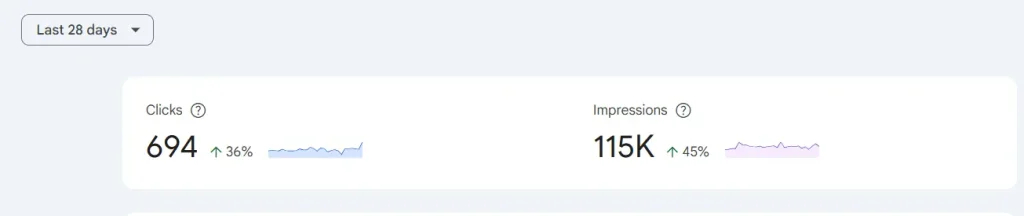
- Total clicks: 694 (up 56.3% from 444)
- Total impressions: 115,000 (up 80.3% from 63,800)
- Average CTR: 0.6%
- Average position: 9 (improved by 4.2 positions from 13.2)
These four numbers tell a complete story about how to increase organic traffic through position improvement rather than content volume alone.
The 4.2-position average improvement is the engine behind everything else. Moving from position 13 to position 9 means crossing from page two to the bottom of page one on Google. That single shift changes click behavior dramatically. Pages that were invisible to most searchers suddenly become reachable, and the impression count nearly doubling reflects Google expanding the site’s visibility across a broader range of queries as it recognized the improved quality signals.
The slight CTR movement from 0.7% to 0.6% deserves an honest explanation rather than being glossed over. When a site’s impressions grow 80% in a short window, it is often because Google starts surfacing the site for new, broader queries it was not appearing for before. These new queries tend to have lower individual CTR initially because the pages have not yet been optimized for those specific snippet opportunities. This is a normal and expected pattern during rapid growth phases. As the new rankings stabilize and meta titles get refined for the expanded query set, CTR climbs. The absolute click number growing 56% while CTR held near flat confirms the growth was genuine and broad-based.
The SEO Strategy Behind These Google Search Console Results
Gains of this scale in a single 28-day window reflect deliberate strategy, not a lucky algorithm update. The daily trend lines in the Search Console graph show gradual, sustained improvement across the measurement period, which is the fingerprint of legitimate SEO execution rather than a single piece of content going viral.
Several interconnected pillars drove this result.
Identifying Position Breakthrough Opportunities
The most reliable way to increase Google Search Console clicks quickly is to find keywords already ranking in positions 8 through 20 and push them onto page one. These are pages Google already considers relevant for a query. They need a targeted push, not a rebuild from scratch.
At an average starting position of 13.2, the site had a significant cluster of these near-page-one rankings. When you improve content depth, add internal links pointing to those pages, and tighten meta titles to better match search intent, Google often responds with rapid position improvements. Those improvements then cascade into click growth because each position gained on page one multiplies CTR.
Technical SEO Foundation
Before any content or link work produces visible results, the site needs to be crawlable, indexable, fast, and mobile-friendly. Page speed is a confirmed ranking factor for both desktop and mobile. Research shows that 53% of mobile users abandon sites that take longer than three seconds to load. Core Web Vitals compliance, clean internal linking structure, and proper canonical tags are the invisible infrastructure that allows content optimization to take effect.
On-Page Optimization and Search Intent Alignment
One of the most effective and underused ways to improve CTR in Google Search Console is optimizing meta titles and descriptions to directly match the intent behind each target query. A page ranking for an informational query needs a title that promises an answer. A page targeting a commercial query needs a title that signals value and specificity.
Pages that had high impressions but low CTR became the primary optimization targets. The approach: rewrite titles to include the specific phrase the searcher was using, lead with the benefit rather than the topic, and write meta descriptions that answer the implicit question behind each query.
Internal Linking and Topical Authority
Content that lives in isolation ranks poorly even when well-written. By strengthening internal links between topically related pages, the site built interconnected content clusters that help Google understand the site’s authority on specific subjects. Research from HubSpot’s well-documented topic cluster strategy shows that this approach to building topical authority can dominate search results far more effectively than disconnected individual posts.
Consistent Execution Over the Full 28 Days
This is the element most SEO case studies underplay. The gradual upward trend in the Search Console graph reflects daily execution, not a single optimization session. Each improvement compounds on the previous one, and Google’s crawl cycles mean that changes made on day one begin showing results by day seven or eight, stacking with changes made in days two through seven.
Why Moving from Position 13 to Position 9 Is Just the Beginning
The 28-day results documented here are significant, but the more interesting conversation is about what comes next. Average position 9 sits at the very bottom of page one on desktop and is often pushed off page one on mobile by SERP features like People Also Ask boxes, featured snippets, and local packs.
Moving from position 9 to positions 5, 4, and 3 will likely push CTR from the current 0.6% toward 2%, 3%, and higher. With 115,000 monthly impressions already established, a CTR improvement to just 2% would produce roughly 2,300 clicks per month, more than triple the current figure. To 3%, and that number reaches 3,450 monthly clicks from the same impression base.
That is the compounding mathematics of SEO done right. Impressions build the foundation. Ranking improvements convert those impressions into traffic. CTR optimization then multiplies the traffic from every ranking you already hold.
The 2025 and 2026 SEO Context That Makes This More Impressive
This case study lands at a genuinely challenging moment for organic search. Google AI Overviews now reach 1.5 billion users monthly across more than 200 countries. Research covering more than 25 million organic impressions found that organic CTR dropped 61% for queries where AI Overviews appear, falling from 1.76% to 0.61%.
Growing clicks and impressions in that environment requires superior execution. The brands navigating AI-era search successfully are not just chasing rankings. They are building genuine topical authority, creating content that earns citations inside AI responses, and optimizing for the specific questions searchers actually ask. Brands cited in AI Overviews earn 35% more organic clicks than those that are not.
The Dexora Digital approach to SEO strategy already incorporates these realities. The focus on search intent alignment, structured on-page optimization, and building interconnected topical content clusters positions sites to perform not just in traditional organic results but in the AI-powered search landscape that is becoming the new standard.
What This Digital Marketing Case Study Means for Your Business
If your website sits at an average position between 10 and 20, your situation mirrors the starting point in this case study. You have impressions. Google already knows your site exists. The gap between where you are and where you need to be is real but closable.
These are the specific signs that your site is in a similar position to where this campaign began:
- Search Console shows thousands of impressions per month but fewer than 1,000 clicks
- Average CTR is below 1%
- Average position sits between 10 and 20
- Traffic has been flat for three or more months despite regular content publishing
If that sounds familiar, the issue is not content volume. It is that your existing content has not been optimized to convert impressions into clicks, and your rankings have not yet crossed the position threshold where click behavior shifts in your favor. That is a solvable problem. The data above shows what solving it looks like.
About Syed Haider Shah and Dexora Digital
Syed Haider Shah Co-founded Dexora Digital with a specific operating philosophy: SEO results should be visible, measurable, and tied directly to outcomes that matter to business owners. Not impressions as a vanity metric. Not “brand awareness.” Actual traffic, actual engagement, actual revenue potential.
The methodology that produced this SEO case study combines deep Google Search Console analysis to find position breakthrough opportunities, technical SEO auditing to remove crawl obstacles, on-page optimization focused on search intent alignment, meta title and description testing, content gap analysis to identify high-value queries the site should rank for, and strategic internal linking to distribute authority effectively.
This is not a shortcut. It is disciplined, data-driven SEO executed with precision and measured against real numbers.
Frequently Asked Questions About This SEO Case Study
How long does it take to see SEO results like this?
The 28-day comparison shown here represents the visible payoff of SEO work that began building before the measurement window opened. Meaningful position improvements typically begin appearing 6 to 12 weeks after optimization work starts, depending on site authority, competition level, and how quickly Google crawls the changes. The 4.2-position average improvement documented here is the kind of result that reflects 2 to 3 months of consistent effort, becoming clearly measurable within this specific 28-day window.
Why did impressions grow faster than clicks in this case study?
When a site moves up in rankings and begins appearing for new, broader query sets, impressions often scale faster than clicks. Even a small CTR percentage shift can make absolute clicks appear to grow more slowly than impressions. For example, 1% CTR on 1,000 impressions yields 10 clicks, while on 10,000 impressions even a 0.5% CTR yields 50 clicks. Absolute clicks here grew 56%, confirming genuine growth. The slight CTR percentage dip is a normal and expected pattern when impression pools expand rapidly during a growth phase.
What is a good CTR in Google Search Console?
CTR benchmarks vary significantly by ranking position. A first-position result can earn CTR above 28% for some queries, while position 10 typically sees around 2 to 3%. For most sites averaging across all ranked queries, a CTR below 1% signals that either rankings are too low for clicks to materialize at volume, or meta titles and descriptions need optimization to compete with nearby results. The 0.6% average CTR in this case study is reasonable for a site averaging position 9, with significant upside as positions improve.
How do Google AI Overviews affect organic CTR in 2025?
Research covering 25.1 million impressions found organic CTR dropped 61% for queries where AI Overviews appear. However, brands cited inside AI Overviews earn 35% more organic clicks than those not cited. This means modern SEO strategy must include building the topical authority and content quality that earns AI citations, not just traditional ranking positions. The Dexora Digital approach to content structure and intent alignment directly supports this goal.
Can a small business replicate these SEO results?
Yes, with the right strategy and realistic timelines. Newer sites or those with less established domain authority will face longer timelines, but the underlying methodology works at any scale. The key advantage demonstrated in this case study is identifying keywords already ranking in positions 8 through 20 and pushing them onto page one, which produces click growth without requiring the time investment of ranking brand new content from scratch.
What is the single most important SEO fix if your CTR is below 1%?
The highest-leverage starting point is auditing your meta titles and descriptions for search intent alignment. Each page should have a title that directly reflects the specific query it is targeting, not just the broad topic. Beyond that, identifying your highest-impression, lowest-CTR pages in Google Search Console and rewriting their titles to include emotional direction, specific benefit language, and the exact keyword phrase the searcher used produces measurable CTR improvements in weeks, not months.
Related reading
- SEO Case Study: How Awayzing.no Grew from 7 to 79 Referring Domains and Doubled Organic Impressions in 12 Months
- How to Use Google Search Console for SEO — The Reports That Actually Matter
- Google Search Console Now Tracks Social Media: Platform Properties Explained (2026)
Want help putting this into practice? See our technical SEO services or book a free consultation.