
Local SEO for HVAC companies and contractors helps heating and cooling companies appear when nearby customers search for AC repair, furnace repair, heat pump installation, and other HVAC services. It combines Google Business Profile optimization, location-focused website content, customer reviews, local citations, and technical SEO to improve visibility in Google Maps and organic search.
For HVAC companies, local visibility can directly influence how many service enquiries reach the business. A homeowner whose air conditioner stops working during a Texas heat wave may search for “AC repair near me.” Someone in Chicago with a failing furnace may search for “emergency heating repair.” Both want a nearby company they can contact quickly.
Your HVAC business needs to be visible at the moment those searches happen.
This guide explains how local SEO for HVAC companies works, what to prioritize, how to measure results, and how to build a strategy that supports repair calls, replacement enquiries, and maintenance bookings.
Why Local SEO Is Different for HVAC Companies
HVAC companies operate in a market where location, urgency, seasonality, and trust all influence customer decisions.
Unlike an online store that can sell nationwide, an HVAC contractor usually serves customers within a defined geographic area. Ranking for a broad term such as “air conditioning repair” has limited value if most searchers are outside the company’s service territory.
A stronger strategy targets the services and locations that the business can actually serve.
1. HVAC searches often involve immediate needs
Some homeowners research HVAC equipment for weeks. Others need help within hours.
Consider these searches:
- “Emergency AC repair in Houston”
- “Furnace repair near me”
- “24-hour HVAC contractor”
- “Heat pump installation Charlotte”
- “Air conditioning maintenance Tampa”
Each represents a different customer need.
Emergency searches require clear contact information, accurate operating hours, and an easy way to request service. Installation searches often require detailed information about equipment, financing, warranties, and the contractor’s experience.
Effective HVAC local SEO accounts for these differences rather than treating every search as identical.
2. HVAC demand changes throughout the year
Heating and cooling demand follows seasonal patterns, although those patterns differ significantly across the United States.
In Florida, air conditioning and humidity-control services can remain relevant throughout much of the year. In northern states, furnace repair and heating maintenance become especially important before and during winter.
HVAC companies should prepare relevant pages before seasonal demand increases.
For example, a contractor should not wait until the first major heat wave to create an AC repair page. Publishing and improving that content earlier gives search engines time to discover and evaluate it.
3. Customers compare trust signals before calling
Homeowners often evaluate several companies before choosing one.
They may look at:
- Google reviews and recent customer experiences
- Service availability and business hours
- Licensing and insurance information
- Brands and equipment serviced
- Service-area coverage
- Website quality and ease of contact
- Clear explanations of repairs and installation options
Local SEO should make accurate, useful information easy to find, not simply increase keyword rankings.
4. Different HVAC services have different commercial value
An emergency repair, annual maintenance visit, and complete system replacement are different types of enquiries.
A contractor may want more maintenance-plan customers to create recurring revenue, while another company may prioritize high-value installation work.
Your SEO strategy should reflect these commercial priorities.
That means measuring the services customers enquire about, not just how many people visit your website.
How Google Decides Which HVAC Company Appears in the Map Pack
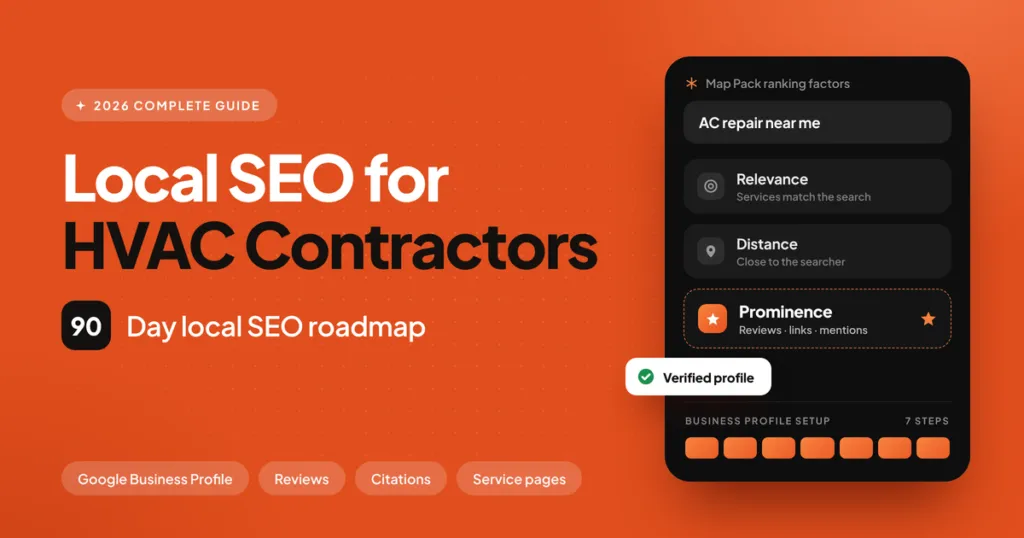
Google’s local results are primarily influenced by three factors: relevance, distance, and prominence.

Understanding these factors helps HVAC businesses focus on improvements they can influence without relying on misleading ranking promises.
Relevance: Does your company match the search?
Relevance measures how closely a business matches what someone is searching for.
A Google Business Profile that accurately describes heating, air conditioning, furnace repair, and other services helps Google understand the company.
For example, an HVAC contractor that provides heat pump installation should include that service in the appropriate Business Profile fields and explain it clearly on its website.
However, adding irrelevant services or repeating keywords excessively does not make a business more legitimate or useful.
Distance: How close is your business to the searcher?
Distance considers the relationship between the business and the searcher’s location.
An HVAC company based in Dallas may have strong visibility near its actual business location but weaker visibility in distant suburbs.
Adding more cities to a service-area list does not automatically make the company rank equally across those locations.
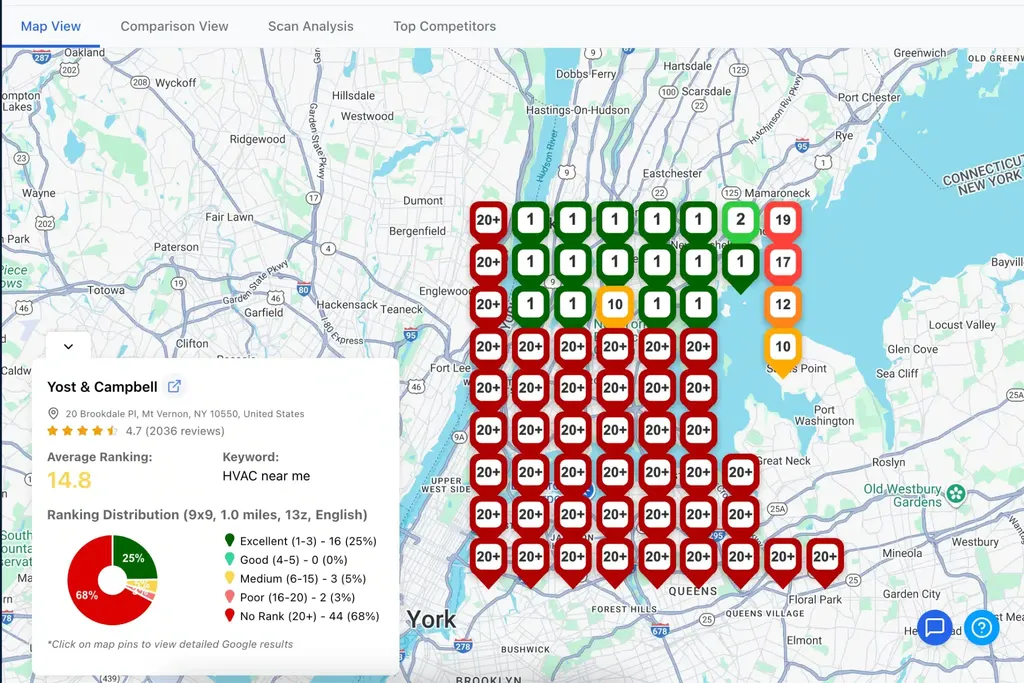
For contractors serving several cities, local visibility should be measured across the actual service territory rather than from a single search location.
Prominence: How established and credible is the business?
Prominence relates to how well-known a business is, including signals such as links, reviews, and information available about it across the web.
A company with a credible website, genuine customer feedback, relevant local mentions, and consistent business information may have stronger supporting signals than a competitor with little online presence.
No legitimate SEO provider can guarantee a particular position in Google’s local results.
The goal is to improve the quality, relevance, and credibility of the business’s online presence.
Google Business Profile Optimization for HVAC Contractors
A properly maintained Google Business Profile is a foundational part of local SEO for HVAC contractors.

It helps customers find business information in Google Search and Maps and can provide direct ways to call, visit the website, or request directions where applicable.
Step 1: Claim and verify your profile
Start by confirming that your HVAC business has an authorized, verified Google Business Profile.
Check the company name, contact details, website, business location, and ownership access.
If a profile already exists, avoid creating an unnecessary duplicate.
Companies with multiple legitimate staffed locations may qualify for separate profiles, but simply serving several cities does not justify creating a profile for each city.
Step 2: Choose accurate business categories
For many heating and cooling companies, “HVAC contractor” is an appropriate primary category.
Additional categories may be relevant if they accurately describe the business’s actual operations.
Do not select unrelated categories simply because they contain valuable search terms.
Your primary category should reflect the company’s core business.
Step 3: Configure your service area correctly
Many HVAC contractors travel to customers rather than receiving visitors at an office.
If your company operates as a service-area business without a customer-facing storefront, configure the profile accordingly and hide the address where required.
Only list areas your business genuinely serves.
A company operating from one location should not create virtual offices across nearby cities to increase map visibility.
Step 4: Complete the services section
Add accurate descriptions of the services your company provides.
Examples include:
- Air conditioning repair and installation
- Furnace repair and replacement
- Heat pump installation and maintenance
- Ductless mini-split services
- HVAC maintenance and tune-ups
- Indoor air quality services
- Ductwork repair and installation
- Emergency heating and cooling repairs
Only include services the company actually offers.
The descriptions should explain what customers can expect rather than repeating city names or promotional claims.
Step 5: Keep operating hours accurate
Operating hours are especially important for businesses handling emergency repairs.
If your company genuinely provides 24-hour service, represent that availability accurately.
If emergency calls are answered outside regular office hours but appointments are limited, explain the distinction clearly on your website.
Update holiday hours and temporary closures whenever necessary.
Step 6: Add genuine HVAC project photos
Photographs help prospective customers understand the work your company performs.
Useful images include completed installations, technicians working on equipment, service vehicles, and actual projects.
Where appropriate, add descriptive captions explaining the service performed.
Avoid uploading misleading stock images that imply they show your company’s work.
Step 7: Review profile performance
Monitor available Business Profile performance data, including calls, website interactions, and other relevant actions.
Compare these results with actual bookings in your CRM or scheduling system.
An increase in profile interactions is encouraging, but the ultimate goal is qualified service enquiries and completed jobs.
Local Citations and Why NAP Consistency Matters
Local citations are online references to your business, often including its name, address, phone number, and website.

NAP stands for Name, Address, and Phone Number.
Consistent information helps customers identify and contact the correct business.
Where HVAC companies should maintain listings
Begin with relevant, legitimate platforms such as:
- Google Business Profile
- Bing Places
- Apple Business Connect
- Established business directories
- Relevant local chambers of commerce
- Manufacturer dealer directories, where eligible
- Industry associations and professional directories
Quality matters more than the number of listings.
A relevant manufacturer directory or local business association may be more valuable to customers than dozens of obscure directory submissions.
Common citation problems
HVAC companies often accumulate inconsistent listings after changing offices, phone numbers, or business names.
Typical issues include old telephone numbers, duplicate profiles, incorrect addresses, and outdated websites.
Audit important listings and correct inaccurate information.
If the business operates from a private address, follow each platform’s privacy and service-area requirements rather than publishing the address indiscriminately.
Do citations guarantee better rankings?
No.
Accurate citations support a consistent business identity and reduce customer confusion. They are not a substitute for relevant content, a properly configured Business Profile, genuine reviews, and a useful website.
The Keywords That Drive HVAC Service Calls
Understanding search intent is the foundation of an effective HVAC SEO strategy. Different searches represent different levels of urgency and intent.
| Keyword Type | Examples | Intent Level |
|---|---|---|
| Emergency searches | AC not working, furnace broke, no heat | Extremely high, call immediately |
| Service plus location | HVAC company Dallas, AC repair Phoenix | High, ready to book |
| Near me searches | HVAC repair near me, AC service near me | High, location ready |
| Problem searches | AC not cooling house, furnace making noise | Medium, researching |
| Seasonal searches | AC tune-up spring, furnace inspection fall | Medium, proactive |
Your local SEO strategy needs to capture all five categories across different page types and content pieces. Service pages capture emergency and service-plus-location searches. Supporting content captures problem and research searches. Location pages capture near-me intent.
Building HVAC-Specific Landing Pages That Rank
Your website should provide detailed information about the services you offer and the communities you genuinely serve.
For many HVAC companies, the biggest content opportunity is creating useful service pages rather than publishing large numbers of generic articles.
Create a dedicated page for each core HVAC service
A business offering multiple services should consider individual pages for major customer needs.
For example:
| Service page | Primary search intent |
|---|---|
| AC repair | Customers needing cooling-system repairs |
| AC installation | Customers researching new air conditioning systems |
| Furnace repair | Customers with heating problems |
| Heat pump installation | Customers comparing installation options |
| HVAC maintenance | Customers looking for tune-ups and preventative care |
| Emergency HVAC repair | Customers requiring urgent assistance |
Each page should explain the specific service, common problems, service process, relevant qualifications, and how to request help.
A strong AC repair page might address warm air, unusual noises, refrigerant-related issues, thermostat problems, and when professional diagnosis is necessary.
An installation page should instead focus on equipment selection, sizing considerations, installation steps, efficiency, and available financing or incentives where applicable.
Build city pages around genuine local value
Local landing pages can help explain service availability in different communities.
However, creating hundreds of near-identical pages with only the city name changed is a poor strategy.
A useful location page should contain information relevant to that area.
For example, an HVAC company serving Houston and Katy might have separate pages if each contains meaningful local information and the company genuinely operates in both markets.
Useful details may include:
- HVAC services available in the city
- Actual local projects or installation examples
- Relevant customer feedback
- Local climate considerations
- Accurate service availability
- Applicable equipment or rebate information
- Clear contact and booking options
Do not invent local offices, customer testimonials, or completed projects.
Connect service pages and location pages
Internal linking helps visitors navigate between related information.
A furnace repair page can link to the relevant heating maintenance page. A city page can link to the AC installation and repair services available in that area.
Use descriptive anchor text that explains the destination.
Avoid creating large blocks of repetitive keyword-rich links purely for search engines.
Make every important page easy to use on mobile
Many HVAC enquiries begin on smartphones.
A conversion-focused HVAC page should have readable content, fast-loading images, clear navigation, and a visible contact option.
Useful features include click-to-call buttons, short booking forms, service-area information, and clear explanations of emergency availability.
Test the experience on real mobile devices.
If customers cannot easily call or book, stronger rankings may not translate into more business.
Reviews, Ratings, and Their Role in Local Rankings
Reviews influence how customers evaluate local businesses, and Google identifies review quantity and positive ratings among signals that can contribute to local prominence.

For HVAC contractors, genuine customer feedback is especially important because homeowners are inviting technicians into their properties and often making expensive decisions.
Build a consistent review-request process
The best time to request a review is generally after a completed service when the customer has had an opportunity to evaluate the experience.
An HVAC business can incorporate review requests into its existing follow-up process.
For example, after a repair is completed, the company can send a polite message thanking the customer and inviting honest feedback.
Do not require a positive rating.
Do not offer incentives in exchange for reviews, selectively solicit only positive reviews, or pressure customers to mention specific keywords.
Respond professionally to reviews
Respond to both positive and negative feedback.
Thank customers for sharing their experience, and address concerns without exposing private information.
For negative reviews, avoid arguments or public disclosure of service records.
Where appropriate, invite the customer to continue the discussion privately.
Use reviews to improve operations
Reviews can reveal patterns that extend beyond SEO.
Repeated complaints about missed appointments, communication problems, or unclear pricing may indicate operational issues.
Similarly, consistent praise for punctuality, professionalism, and clear explanations can help identify strengths worth emphasizing in your website content.
Reviews should inform business improvements, not merely serve as marketing assets.
Technical SEO for HVAC Websites
Even a well-written HVAC website can struggle if search engines cannot crawl important pages or customers encounter technical problems.

Technical SEO helps ensure that valuable pages are accessible, understandable, and usable.
Check indexing and crawlability
Use Google Search Console to determine whether important service and location pages are indexed.
Investigate pages excluded because of accidental noindex directives, incorrect canonical tags, redirects, server errors, or other technical issues.
Not every excluded URL is a problem.
Duplicate, redirected, or intentionally non-indexable pages may be excluded for valid reasons.
Prioritize pages that should appear in search results but currently cannot.
Improve page speed and Core Web Vitals
HVAC websites frequently use large project photographs, video backgrounds, booking widgets, and third-party scripts.
These can affect loading speed and responsiveness.
Optimize image dimensions and formats, reduce unnecessary scripts, and test important landing pages with PageSpeed Insights.
Focus on actual user experience rather than chasing a perfect laboratory score.
Implement accurate structured data
Structured data helps search engines understand information about a business and its pages.
HVAC companies can use appropriate LocalBusiness structured data, including a relevant subtype where supported, to describe legitimate business details.
Service information, organization details, and breadcrumbs may also be represented using suitable schema types.
Structured data must match visible, factual page content.
It does not guarantee higher rankings or special search features.
Check conversion functionality
Technical SEO should also support lead generation.
Test contact forms, booking links, click-to-call buttons, and thank-you pages.
A broken enquiry form can waste traffic even when the website ranks well.
Creating an HVAC Content Strategy Around Seasonal Demand
HVAC content should answer questions customers ask before, during, and after a service need.

A practical editorial calendar connects customer intent with seasonal demand.
| Period | Suggested content priorities |
|---|---|
| February–April | AC tune-ups, cooling maintenance, installation planning |
| May–August | Emergency AC repair, cooling efficiency, system replacement |
| August–October | Furnace inspections, heating maintenance, heat pump preparation |
| November–February | Heating repairs, winter HVAC problems, furnace troubleshooting |
These periods are general planning examples. Local climate and service mix should determine the actual schedule.
Publish helpful content, not repetitive keyword articles
Good HVAC blog topics include:
- Why is my AC running but not cooling?
- How often should a furnace be serviced?
- Heat pump versus central air conditioning
- Signs an HVAC system may need replacement
- What affects the cost of an AC installation?
- How to prepare a heating system for winter
Answer the question directly, explain relevant safety considerations, and identify situations that require a qualified technician.
Avoid publishing generic articles that add little beyond what already exists on the website.
Connect educational content to services
An article about an AC system blowing warm air can naturally direct readers to an AC repair service page.
A guide comparing heat pumps and furnaces can link to relevant installation services.
These links should help readers take the next logical step.
Educational articles are most valuable when they support both customer understanding and the company’s service offerings.
HVAC Local SEO and AI Search Visibility
HVAC customers increasingly encounter AI-generated answers when researching repairs, replacement options, and local providers.


For example, a homeowner might ask an AI assistant whether a heat pump is suitable for a particular climate or how to compare HVAC contractors.
This creates another reason for businesses to maintain accurate, well-organized information.
Publish clear answers to real customer questions
Use direct headings and explain common HVAC problems in plain language.
Support technical advice with appropriate expertise, especially when discussing electrical systems, refrigerants, combustion appliances, and safety.
Make the company’s services, qualifications, coverage, and contact details easy to verify.
Maintain consistent business information
Accurate company information across the website, business listings, and relevant third-party sources can help people and automated systems understand the business.
However, no agency can guarantee that ChatGPT, Gemini, Google AI Overviews, or another AI system will recommend a particular contractor.
Measure AI visibility separately
If AI search visibility is a priority, track a consistent set of relevant questions and note whether the company appears in responses or cited sources.
Record the platform, date, query, and result.
Do not combine AI mentions with organic rankings or claim that a citation automatically represents a qualified lead.
Tracking Your Local SEO Results With GSC and Local Rank Tracking
The success of local SEO services for HVAC contractors should be evaluated through business outcomes, not rankings alone.

Google Search Console, Business Profile performance reports, website analytics, call tracking, and CRM data can each answer different questions.
1. Measure organic search visibility
In Google Search Console, review:
- Organic clicks
- Search impressions
- Click-through rate
- Average position
- Queries generating traffic
- Landing pages receiving search visits
Filter queries by relevant HVAC services and locations.
Compare periods carefully because heating and cooling demand can change substantially with the weather and season.
2. Track Google Maps rankings across the service area
A single ranking check from the company’s office does not show visibility across its entire territory.
Local rank-grid tools can help illustrate how rankings vary by search location.
For example, an HVAC contractor may appear prominently near its base but less frequently in neighboring suburbs.
Use consistent search terms, locations, and measurement dates to identify changes over time.
3. Measure calls and bookings
Track phone calls, contact-form submissions, and online bookings where possible.
Call tracking can help distinguish enquiries from different marketing sources, but it must be configured carefully to preserve accurate business contact information.
Connect qualified enquiries to actual appointments whenever the CRM supports it.
4. Track the services customers request
Not every lead has the same value.
Separate enquiries for emergency repairs, maintenance plans, and system replacements.
This helps identify which pages and keywords contribute to the business’s priorities.
5. Calculate customer acquisition cost
A simple SEO customer acquisition calculation is:
Customer acquisition cost = SEO investment ÷ New customers attributed to SEO
For example, if an HVAC company spends $1,000 on SEO in a month and attributes five new customers to that investment, the simplified acquisition cost is $200 per customer.
This is an illustrative calculation, not a performance benchmark.
A more complete analysis should consider attribution limitations, customer value, profit margins, recurring revenue, and the time required for SEO investments to generate results.
How Much Does Local SEO Cost for HVAC Contractors?
The cost of local SEO for HVAC companies depends on business size, competition, service-area coverage, website condition, and the amount of work required.

A single-location HVAC contractor targeting one primary market usually needs a different scope from a company serving several metropolitan areas.
Typical factors that affect pricing
The main cost drivers include:
- Google Business Profile management
- Technical website repairs
- Service and city landing-page development
- Citation cleanup and maintenance
- Review management processes
- Content creation and optimization
- Local link and authority development
- Conversion tracking and reporting
- Number of legitimate business locations
Dexora Digital HVAC SEO pricing
Dexora Digital’s HVAC SEO service offering lists a Local SEO Starter plan from $500 per month and a Local SEO Growth plan from $1,000 per month, with custom arrangements for multi-location businesses.
The Starter offering is designed around foundational local visibility work, while Growth covers broader service-area and content requirements.
Actual scope and pricing should be confirmed during the proposal process.
Paid advertising budgets are separate from SEO management fees.
For contractors comparing providers, the most important question is not simply which agency charges less. It is whether the proposed work addresses the company’s visibility problems and supports measurable business goals.
Learn more about local SEO services for HVAC companies and how Dexora approaches Google Maps visibility, service-area content, technical optimization, and lead measurement.
Common Local SEO Mistakes HVAC Contractors Should Avoid
Even established HVAC companies can limit their search visibility through avoidable mistakes.

Keyword stuffing in Google Business Profile names
Adding phrases such as “Best Emergency AC Repair Near Me” to a business name that does not legally or publicly use those words violates Google’s business representation guidelines.
Use the company’s genuine name.
Creating fake locations
Virtual offices, rented mailboxes, and unstaffed locations should not be used to manufacture Google Maps coverage.
Build visibility around legitimate business locations and actual service areas.
Publishing duplicate city pages
Changing only the city name on dozens of otherwise identical pages provides little useful information.
Create location pages when there is meaningful local content and a legitimate reason for the page to exist.
Ignoring conversion problems
A website may attract relevant visitors but lose potential customers through slow loading, confusing navigation, or broken forms.
Evaluate the full customer journey.
Measuring only keyword rankings
Rankings are useful diagnostic indicators, but booked appointments and profitable jobs are more meaningful business outcomes.
Expecting immediate guaranteed results
SEO results depend on competition, existing visibility, technical conditions, and implementation quality.
A credible provider should explain priorities, report progress, and avoid guaranteeing specific ranking positions or lead volumes.
A Practical 90-Day Local SEO Plan for HVAC Contractors
A structured implementation plan helps HVAC companies address foundational problems before expanding into more competitive opportunities.

Days 1–30: Audit and correct the foundations
Review the website, Google Business Profile, indexing status, major service pages, and existing citations.
Identify inaccurate business information, technical blockers, weak conversion paths, and missing service coverage.
Establish baseline performance metrics before making significant changes.
Days 31–60: Improve services and local relevance
Optimize priority service pages and the Business Profile.
Create or improve genuinely useful city pages where appropriate.
Begin a consistent, policy-compliant customer review process.
Prepare seasonal content based on upcoming demand.
Days 61–90: Measure, refine, and expand
Review organic traffic, local visibility, qualified enquiries, and completed bookings.
Identify pages that attract impressions but receive few clicks.
Improve content based on actual search queries and customer questions.
Expand into additional services or locations only when the business has the capacity and evidence to support that investment.
This is an implementation framework, not a promise of specific ranking improvements within 90 days.
Quick Wins You Can Implement This Week
Not everything requires a long-term campaign. Some actions have fast impact.
This week: Audit your Google Business Profile and complete every empty field. Check your NAP consistency across Google, Yelp, and Bing. Ask your last ten customers for a Google review today. Ensure your website has a clickable phone number at the top of every page. Search your main service and city on Google and document exactly where you appear.
These five actions cost nothing and fix some of the most common suppressors of local HVAC rankings.
How to Turn HVAC Website Calls Into Booked Jobs
Increasing phone calls is an important goal for many HVAC businesses, but not every call becomes a qualified lead or a booked service appointment.
A customer may click a phone number without completing the call. Another caller may reach voicemail, request a service outside the company’s coverage area, or contact several contractors before making a decision.
This is why HVAC lead generation should be measured beyond website traffic and phone clicks.
Businesses should understand the complete customer journey, from discovering a service to contacting the company and scheduling work.
Important conversion considerations include:
- Answered Calls: Identify whether incoming enquiries reach the appropriate team.
- Response Time: Review how quickly missed calls and online requests receive follow-up.
- Lead Qualification: Determine whether enquiries match the services and locations offered.
- Booking Process: Make it straightforward for customers to schedule repairs, consultations, or estimates.
- Conversion Tracking: Connect website and local search enquiries with actual appointments where possible.
For example, an HVAC company might receive numerous emergency AC repair calls during summer but lose opportunities because customers cannot reach someone outside normal working hours.
In that situation, improving call handling may generate more booked jobs without requiring a proportional increase in website traffic.
The objective is to connect local SEO performance with meaningful business outcomes, including qualified enquiries, scheduled appointments, and completed service opportunities.
Our website design services help businesses create user-friendly websites with clear service information, accessible contact options, and conversion-focused layouts that support customer enquiries.
Proof: What This Looks Like for a Real HVAC Company
We applied this process to a residential HVAC contractor in Austin, Texas that started with almost no organic presence. Over five months the site gained seven neighborhood-level location pages, Google reviews grew from 14 to 38 with a response to every one, and search impressions reached 44,700. Read the full Austin HVAC SEO case study to see the month-by-month work.
If you want the same plan applied to your company, see our HVAC SEO services or request a free HVAC SEO audit.
Frequently Asked Questions About HVAC Local SEO
What is local SEO for HVAC contractors?
Local SEO for HVAC contractors is the process of improving a heating and cooling company’s visibility in location-based Google searches and Google Maps. It includes Google Business Profile optimization, local website content, reviews, citations, and technical SEO.
How long does local SEO take for an HVAC company?
Timelines vary based on competition, website condition, existing business visibility, and the work completed. Some improvements may be reflected relatively quickly, while competitive search visibility can take several months or longer. No fixed timeline guarantees rankings or leads.
Is Google Business Profile important for HVAC SEO?
Yes. Google Business Profile helps customers find accurate business information in Google Search and Maps. A complete, compliant profile is an important part of an HVAC company’s local search presence.
Does an HVAC company need a page for every city it serves?
Not necessarily. City pages are useful when they provide meaningful information about genuine service coverage. Avoid creating repetitive pages solely to target location keywords.
Can HVAC contractors rank in several cities with one Google Business Profile?
A legitimate service-area business can serve multiple cities from one location, but visibility varies by search location and other ranking factors. Listing additional service areas does not guarantee rankings in those cities.
Are reviews important for local HVAC SEO?
Yes. Genuine customer reviews help prospective customers evaluate a business, and Google identifies review signals as part of local prominence. Businesses should request honest feedback without incentives or manipulation.
What are the best local SEO keywords for HVAC companies?
The most useful keywords depend on the services and locations involved. Examples include “AC repair near me,” “furnace repair in [city],” “heat pump installation [city],” and “HVAC maintenance [city].” Prioritize terms that match services the company actually provides.
How can an HVAC company measure SEO return on investment?
Track qualified organic enquiries, booked appointments, completed jobs, and revenue where attribution is available. Compare those outcomes with the cost of SEO while accounting for seasonality and customer lifetime value.
Can AI search optimization help HVAC contractors?
Clear, accurate service information, relevant content, and credible business references may help automated systems understand a company. However, appearing in AI-generated answers is not guaranteed, and AI visibility should be measured separately from Google rankings.
Conclusion: Build Local Visibility That Turns Into HVAC Service Calls
Local SEO for HVAC contractors works best when it connects search visibility with real customer needs.
A complete strategy combines an accurate Google Business Profile, useful service and location pages, genuine reviews, consistent business information, technical website improvements, and reliable lead tracking.
The objective is not to rank for every HVAC keyword.
It is to help the right customers find your business when they need repairs, installations, replacements, or maintenance—and make contacting your company straightforward.
For HVAC businesses looking to identify their biggest opportunities, Dexora Digital offers a free HVAC SEO audit.
The review can help identify important website, local visibility, and search optimization issues before you decide which improvements to prioritize.
Related Reading
- HVAC SEO services: packages, city pages and AI search
- SEO for Contractors: the complete 2026 guide
- Case study: Austin HVAC company, 44,700 impressions in 5 months
- Google Business Profile ranking factors in 2026
- Can a service-area business rank in nearby cities?
- Why your business ranks in one area but not another