
By Taqweem Ahmad, Founder of Dexora Digital
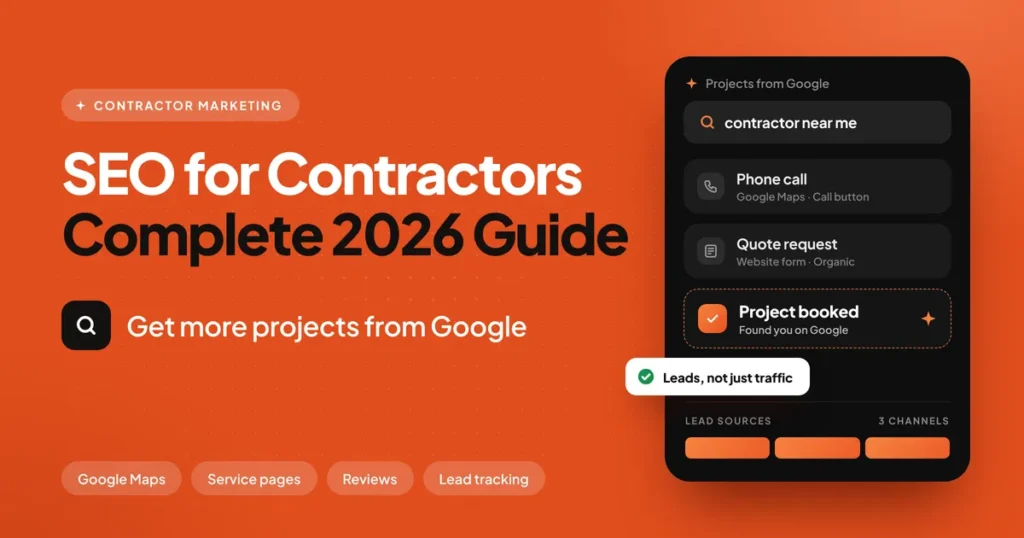
If you run a contracting business, getting more visitors to your website is not the real goal. You need homeowners, property managers, and business owners who are ready to discuss a project and request an estimate.
SEO for contractors helps your company appear when potential customers search Google for construction, remodeling, renovations, and general contracting services in your area.
A successful contractor SEO strategy combines Google Business Profile optimization, local keyword targeting, useful service pages, real project examples, technical website improvements, and a clear path to requesting a quote.
This guide explains how to build that strategy and measure whether it brings qualified project inquiries.
What Is SEO for Contractors?
Contractor SEO is the process of improving a construction or contracting company’s visibility in Google Search, Google Maps, and other relevant search experiences.
For example, a homeowner planning a kitchen renovation might search for “kitchen remodeling contractor in Austin.” A commercial property owner might search for “commercial general contractor near me.”
Your business needs relevant, trustworthy content that matches those searches.
Contractor SEO generally focuses on three outcomes:
- More local visibility: Help potential customers discover your business in the areas you genuinely serve.
- Better project inquiries: Attract people looking for services you actually provide.
- More trust: Show your experience through completed projects, customer feedback, qualifications, and clear business information.
Unlike a simple product purchase, construction projects often involve research, comparisons, site visits, and estimates. Your website should help potential clients throughout that decision process.
How Customers Find Contractors on Google
Not every contractor search has the same intent.
1. Service-based searches
These searches show that someone needs a specific service.
Examples include:
- General contractor near me
- Kitchen remodeling contractor in Dallas
- Home addition contractor in Orlando
- Commercial construction company in Houston
- Bathroom renovation contractors in Seattle
These keywords generally belong on dedicated service pages.
2. Research-based searches
People may research a project before contacting contractors.
Examples include:
- How much does a home addition cost?
- How long does a kitchen remodel take?
- Do I need a permit for a bathroom renovation?
- What should I ask a general contractor?
Helpful guides addressing these questions can introduce your business to customers earlier in their journey.
3. Comparison and reputation searches
Potential clients may search for the best general contractors in their area, compare customer reviews, investigate completed projects, or look for licensing information.
For these searches, a detailed portfolio, accessible contact information, and genuine third-party reviews can help customers evaluate your company.
The goal is not to rank for every construction keyword. It is to attract customers whose projects match your services and locations.
Keyword Research for Contractor SEO
Keyword research helps you identify what potential customers search for and which pages should answer those searches.
Start by listing your main services, project types, and actual service areas. Then combine them with terms such as contractor, company, builder, remodeling, renovation, and construction.
Examples of contractor SEO keywords
| Keyword | Search intent | Recommended page |
|---|---|---|
| General contractor in Denver | Local service | Main service/location page |
| Kitchen remodeling contractor | Commercial | Kitchen remodeling page |
| Commercial construction company | Commercial | Commercial construction page |
| Home addition contractor near me | Local service | Home additions page |
| Bathroom remodel cost | Informational | Cost guide |
| General contractor portfolio | Evaluation | Projects page |
Use Google Search Console to identify queries already generating impressions and clicks. Keyword research tools can provide additional opportunities, although estimated search volume should not be treated as guaranteed traffic.
Pay attention to search intent. A person searching for construction jobs is not necessarily a potential customer, even when the keyword includes the word “contractor.”
Google Business Profile Optimization for Contractors
Your Google Business Profile is an important part of local SEO. It helps customers find your business in Google Maps and local search results.
Choose accurate business categories
Select the category that best represents your company’s main business.
For a general contracting company, “General Contractor” may be appropriate. A company primarily specializing in remodeling may need a more specific category, depending on the options available.
Add a limited number of relevant secondary categories only when they accurately describe your business.
Avoid selecting categories simply because they contain keywords you want to rank for.
Complete your business information
Check that your profile contains accurate information:
- Business name and contact details
- Website URL
- Relevant primary and secondary categories
- Business hours
- Genuine business address or appropriate service-area configuration
- Services and business description
- Relevant project photographs
Your listed service areas should reflect where you actually work.
Upload real construction project photos
Construction is a highly visual industry.
Show actual completed work, before-and-after comparisons, project details, and appropriate in-progress photographs.
Use descriptive captions where suitable and obtain permission before publishing client property images.
Professional-looking photos help potential customers understand your workmanship and the kinds of projects you handle.
Build a consistent review process
Ask genuine customers to review their experience after completing a project or reaching an appropriate milestone.
Never purchase reviews or offer incentives in exchange for positive ratings.
Respond professionally to feedback and use recurring customer questions to improve the information available on your website.
For additional guidance, read our guide to ranking on Google Maps.
Build Dedicated Service Pages
One of the most common contractor website problems is putting every service on a single page.
A general contractor may provide kitchen remodeling, bathroom renovations, additions, new construction, and commercial work. Each of these services addresses a different customer need.
Create a dedicated page for every important service your business actually offers.
For example, a kitchen remodeling page can explain:
- The types of kitchen projects you handle
- Your remodeling process
- Relevant materials and design options
- Recent kitchen projects
- Factors affecting project cost
- Service locations
- How to request an estimate
Include clear headings, original photographs, relevant customer questions, and a visible call to action.
Avoid producing several nearly identical pages that simply replace the service keyword.
Local SEO and City Pages for Contractors
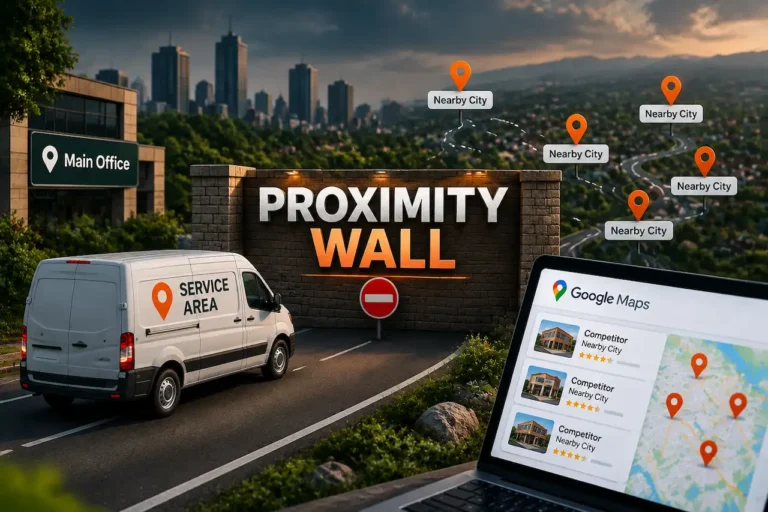
Contractors often serve several cities or neighborhoods.
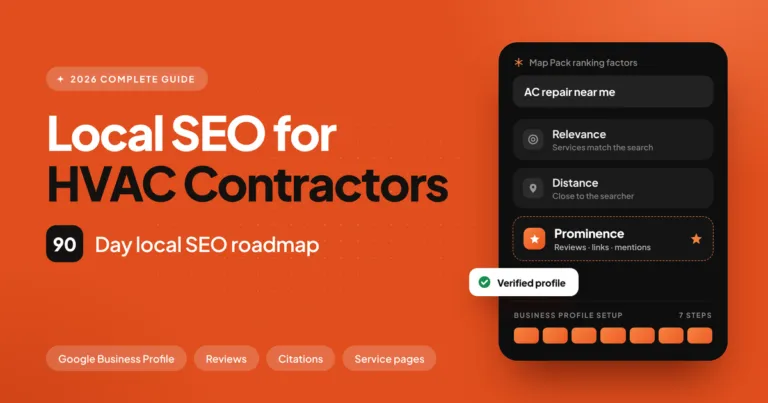
HVAC companies are a clear example, because emergency searches and seasonal demand make city-level pages and a well-managed Business Profile essential. See our complete guide to local SEO for HVAC contractors and the Austin HVAC case study for a real before-and-after.
Location pages can help explain your availability in those areas, but each page must provide genuine local value.
A useful contractor location page may include local project examples, services available in the area, relevant construction considerations, and practical information for customers.
For example, if your team has completed remodeling projects in a particular city, those examples can support the page.
Avoid creating dozens of city pages using the same paragraphs with different city names.
Also, do not create separate Google Business Profiles for every service area unless each profile represents a genuinely eligible business location.
Project Portfolio Pages: Show Your Experience
Your completed projects are among your strongest sources of original website content.
A project gallery is useful, but detailed project pages provide more context.
For each suitable project, consider including:
- Project type and general location
- Initial client requirements
- Scope of construction or renovation work
- Challenges and how they were addressed
- Materials or construction methods used
- Project duration, where verified
- Real photographs
- Final outcome
For example, instead of uploading a photograph labeled “Kitchen Remodel,” create a page explaining the kitchen renovation, the work completed, and the location at an appropriate privacy-safe level.
These pages give customers stronger evidence of your experience and create useful internal linking opportunities.
Portfolio content does not guarantee higher rankings, but it can make your service pages more useful, distinctive, and credible.
On-Page SEO for General Contractors
On-page SEO helps search engines and users understand what each page offers.
Write clear title tags and headings
The SEO title should describe the service and relevant location without keyword stuffing.
Example:
Kitchen Remodeling Contractor in Austin | Business Name
Use one clear primary heading on the page, followed by helpful H2 and H3 sections covering the main questions customers have.
Improve meta descriptions
Write a unique description that summarizes the page and gives potential customers a reason to visit.
Google may generate a different search snippet based on the user’s query, so meta descriptions should be accurate rather than treated as guaranteed display text.
Optimize photographs
Use descriptive file names, meaningful alternative text where appropriate, compressed image formats, and appropriately sized images.
Do not fill alt text with repeated city and service keywords.
Add useful internal links
Connect related service pages, location pages, project pages, and supporting articles.
For example, a kitchen remodeling guide can link to the kitchen remodeling service page and an actual completed kitchen project.
Internal links should help users find the next relevant resource.
Technical SEO for Contractor Websites
A visually attractive contractor website can still struggle in search if technical problems make pages difficult to crawl, index, or use.
Review the following areas.
Mobile usability
Many customers research contractors using their phones.
Make sure important text is readable, forms are usable, buttons are easy to select, and contact information is accessible without unnecessary scrolling.
Core Web Vitals and page speed
Large project galleries and unoptimized images can slow down construction websites.
Pay attention to:
- Largest Contentful Paint (LCP)
- Interaction to Next Paint (INP)
- Cumulative Layout Shift (CLS)
Use PageSpeed Insights and real-user performance data where available to identify problems.
Indexing and crawlability
Check that important service and location pages are accessible to search engines.
Review XML sitemaps, canonical tags, internal links, redirects, noindex directives, and crawl errors.
Use Google Search Console to inspect important URLs and identify indexing problems.
Forms and conversion tracking
A contractor website should make it easy to request an estimate.
Test forms on mobile and desktop, confirm submissions reach the correct destination, and track meaningful conversions where appropriate.
Useful events may include quote form submissions, consultation bookings, and qualified phone inquiries.
Schema Markup for Contractor Websites
Structured data can help search engines understand information about your business and pages.
Depending on the page and its content, useful schema types may include:
- LocalBusiness or GeneralContractor: Accurate business identity and location details
- Service: Descriptions of relevant services
- BreadcrumbList: The page’s position in the website structure
- Article or BlogPosting: Editorial content and authorship
- FAQPage: Visible questions and answers where appropriate
Not every schema type produces a Google rich result. FAQ rich results, in particular, have limited eligibility.
Avoid adding fabricated ratings, fake reviews, incorrect business addresses, or markup that describes content not visible to users.
Validate relevant structured data using Google’s Rich Results Test and other suitable schema validation tools.
Backlinks and Local Authority Building
Backlinks can help search engines discover your pages and understand their connections to other websites.
For contractors, relevant links may come from legitimate construction associations, suppliers, local chambers of commerce, business partnerships, and publications covering real projects.
Focus on relationships and references that make sense for your business.
For example, a local publication covering a major renovation your team completed may provide both a useful referral source and an editorial link.
Avoid buying large quantities of unrelated links, participating in artificial link exchanges, or publishing low-quality guest posts solely to manipulate rankings.
SEO for Contractors in AI Search
Potential customers can also use AI-powered search experiences to research contractors, compare companies, and understand construction requirements.
Your website should make important business information easy to find and verify.
Publish clear service descriptions, documented projects, relevant qualifications, customer questions, and accurate contact details.
Keep business information consistent across your website and trustworthy external profiles.
Use direct answers to common questions, but support important claims with real evidence.
There is no guaranteed method for getting recommended by ChatGPT, Gemini, or Google AI Overviews. Strong, accessible, trustworthy information gives people and search systems better material to evaluate.
Learn more about our AI search optimization services.
Turn SEO Traffic Into Contractor Leads
Rankings and traffic are only part of the process.
A contractor who receives 1,000 website visits but no qualified inquiries still has a conversion problem.
Make sure visitors can quickly understand:
- What construction services you offer
- Which locations you serve
- Whether you handle their type of project
- What evidence supports your experience
- How to request an estimate
Place clear calls to action on relevant pages.
Use straightforward wording such as Request a Project Estimate or Schedule a Consultation.
Keep inquiry forms practical. Ask for the customer’s contact information, project type, location, and a brief description rather than requiring too much information upfront.
Track form submissions and calls, but also review lead quality to understand which pages generate genuine project opportunities.
How to Measure Contractor SEO Results
Use Google Search Console, analytics data, Google Business Profile performance information, and your lead management records to evaluate progress.
Important measurements include:
| Metric | What it tells you |
|---|---|
| Organic clicks | Visits generated from Google Search |
| Search impressions | How often your pages appear in search |
| Keyword visibility | Which relevant searches show your website |
| Organic leads | Forms, calls, or bookings from organic traffic |
| Qualified project inquiries | Leads that match your service offering |
| Local visibility | How your business appears in relevant geographic searches |
| Lead-to-project conversion | Whether inquiries become actual work |
Do not judge an SEO campaign on keyword positions alone.
A smaller number of relevant, qualified leads may be more valuable than thousands of visitors searching for unrelated information.
Common Contractor SEO Mistakes
Some recurring problems limit contractor website performance:
- Targeting too many services on one generic page.
- Creating duplicate city pages without useful local information.
- Publishing stock photos without real project evidence.
- Ignoring Google Business Profile accuracy.
- Having slow or difficult-to-use mobile pages.
- Publishing vague content that never answers customer questions.
- Buying unrelated backlinks.
- Failing to track qualified project inquiries.
- Neglecting broken forms, missing calls to action, and indexing issues.
A successful contractor SEO strategy addresses technical usability, relevant content, local credibility, and lead generation together.
Contractor SEO Action Plan: First 90 Days
Days 1–30: Audit and foundations
Review your website’s technical condition, indexing, Google Business Profile, main services, current rankings, and conversion tracking.
Identify the pages most important to generating project inquiries.
Fix critical accessibility, indexing, and form problems first.
Days 31–60: Content and local improvements
Improve high-priority service pages, publish useful project examples, update business information, and strengthen internal linking.
Create location-specific pages only where there is enough genuine business relevance to support them.
Days 61–90: Authority and measurement
Continue adding verified project content, improve important customer information, develop legitimate local partnerships, and monitor lead quality.
Review performance data before deciding which services and locations deserve additional investment.
This is a planning framework, not a promise of rankings or results within 90 days.
Frequently Asked Questions About SEO for Contractors
Is SEO worth it for general contractors?
SEO can be valuable when customers use Google to research and compare contractors. Its commercial value depends on your local competition, services, project value, and ability to turn inquiries into work.
How long does contractor SEO take?
There is no fixed timeline. Technical fixes may be reflected in search results relatively quickly, while competitive local rankings and sustainable organic lead growth can take months. Results depend on the website’s starting position and competitive environment.
What are the best SEO keywords for contractors?
The most useful keywords usually combine your real services with local search intent, such as “general contractor in [city]” or “home addition contractor near me.” The best targets depend on your business and market.
Do general contractors need a Google Business Profile?
An eligible local contracting business can benefit from a properly maintained Google Business Profile. It provides another way for customers to find accurate information and contact the business.
Should contractors create a separate page for every city?
Not automatically. Create location pages where you have genuine service coverage and can provide distinct, useful information. Avoid near-identical pages created only to target city keywords.
Can SEO help construction companies get commercial projects?
Yes. Commercial contractors can target service-specific and location-specific searches, publish relevant project examples, and provide information that helps commercial buyers evaluate their capabilities.
Can AI search help customers discover contractors?
AI-powered search tools may influence how customers research contractors. Accurate business information, clear service descriptions, real project evidence, and trusted third-party references can make a company easier to evaluate, although AI recommendations are never guaranteed.
Get More Qualified Contractor Leads With Dexora Digital
Contractor SEO is about connecting your business with customers who need your services, not simply increasing website traffic.
Start with accurate local business information, dedicated service pages, real project evidence, and a technically sound website. Then use performance and lead-quality data to decide what to improve next.
At Dexora Digital, we help businesses improve their organic visibility through technical SEO, local search optimization, content strategy, and AI search optimization.
Explore our local SEO services or contact Dexora Digital to discuss your website and opportunities for improvement.