

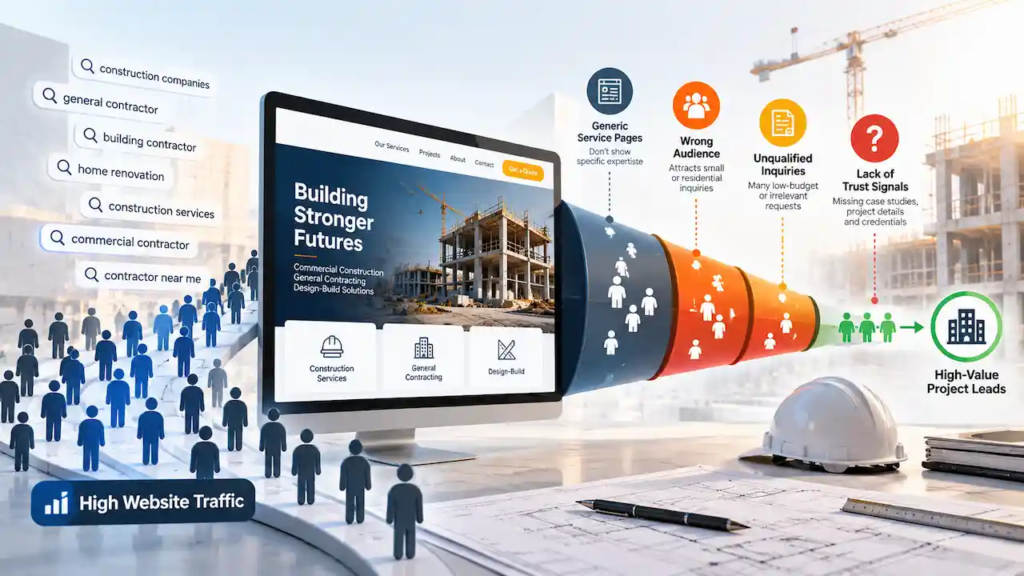
A commercial contractor leads can receive consistent website traffic, regular contact form submissions, and still struggle to find projects worth pursuing. The inquiries may involve residential repairs, small renovations, or work outside the company’s service area, while the commercial developments and larger construction contracts it wants rarely appear.
For construction company owners and business development directors, this creates a costly disconnect. Marketing reports may show increasing activity, but estimating teams spend time reviewing opportunities that do not match the firm’s capabilities.
The real challenge in commercial construction lead generation is not simply attracting more visitors. It is attracting project owners, developers, and procurement teams whose requirements align with the contractor’s expertise.
Why Commercial Contractor Websites Attract the Wrong Leads
Many contractor websites are built around broad terms such as “construction services,” “general contracting,” or “building contractors.” These descriptions may accurately represent the business, but they do not necessarily communicate the scale or type of projects the company pursues.
Search Traffic Does Not Always Reflect Commercial Buying Intent
Someone searching for a contractor to renovate a residential kitchen has different expectations from a developer evaluating firms for a medical office development. Both visitors might reach a general contracting website. However, only one may represent a suitable opportunity for a commercial construction company. This distinction becomes important when websites attract traffic through broad construction keywords without clearly identifying their target sectors.
A contractor specializing in industrial facilities, for example, should evaluate visibility for searches involving industrial construction, warehouse development, and relevant project delivery services rather than relying exclusively on generic contractor terms. An effective SEO strategy for contractors should connect search demand with the company’s actual project capabilities.
Weak Positioning Creates Unqualified Inquiries
A commercial contractor’s homepage might highlight quality workmanship, reliability, and years of experience without explaining the projects the firm handles. These statements offer limited guidance to a commercial property owner comparing contractors for a substantial renovation. Prospective clients need to understand the contractor’s relevant sectors, delivery capabilities, geographic coverage, and experience with comparable project requirements. When this information is missing, the website may attract unsuitable inquiries while failing to establish credibility with more valuable prospects.
The result can be unnecessary estimating work, slower qualification, and missed opportunities to enter the right procurement conversations.
How to Improve Commercial Construction Lead Generation
Improving lead quality requires coordinating search targeting, website positioning, project evidence, and inquiry qualification.
Build Website Content Around Commercial Project Types
A contractor serving multiple commercial sectors should consider dedicated pages for meaningful specialties. For example, a firm might offer healthcare construction, industrial facility renovations, office tenant improvements, and retail construction. Each sector involves different project considerations and buyer expectations. A healthcare construction page could discuss working within occupied facilities, scheduling constraints, and coordination requirements, provided these reflect the firm’s actual capabilities.
An industrial construction page might focus on facility modifications, equipment coordination, and operational continuity. This approach gives prospective clients more relevant information than a single generic services page. It also supports SEO services for contractors and architects by aligning website content with distinct commercial search intentions.
Make Commercial Project Experience Easy to Evaluate
Project portfolios should do more than display completed buildings. Commercial buyers often want to understand whether a contractor has managed similar construction scopes, operational constraints, and delivery responsibilities. Where client permissions allow, project pages should explain:
- Project type and scope: Facility category, construction work, and relevant responsibilities.
- Delivery considerations: Scheduling, coordination, occupied environments, or other documented challenges.
- Relevant capabilities: The experience that makes the project meaningful to prospective clients.
A commercial office renovation portfolio, for instance, becomes more useful when it identifies whether the contractor performed interior buildouts, managed phased work, or coordinated with building operations. These details help visitors evaluate project suitability before requesting a proposal.
Qualify Inquiries Without Creating Unnecessary Friction
A generic contact form asking only for a name, email, and message may provide insufficient information for commercial project qualification. Instead, contractors can request a few relevant details, such as project type, location, approximate scope, anticipated start date, and the inquirer’s role. Budget ranges may be useful for some firms, but making detailed financial information mandatory too early can discourage legitimate prospects.
The objective is not to reject every smaller inquiry automatically. It is to identify which opportunities align with the firm’s capacity and commercial priorities. A focused website design strategy for contractors can make these distinctions clearer through service navigation, project information, and appropriate inquiry pathways.
Avoid Treating Every Lead as Equally Valuable
Commercial contractors should define qualification criteria before judging marketing performance. A $5 million construction opportunity is not automatically suitable if it falls outside the contractor’s geography, licensing, experience, or delivery capacity. Similarly, a smaller project may be commercially attractive when it matches a profitable specialty or existing client relationship. A practical qualification process considers project fit, not contract value alone.
Marketing teams should also avoid reporting every form submission as a qualified lead. Supplier messages, employment inquiries, residential requests, and irrelevant solicitations should be classified separately.
Measure Qualified Opportunities, Not Just Website Traffic
Effective commercial contractor marketing connects website performance with the business development pipeline. Google Search Console can help identify which searches bring visitors to the website. Analytics can show which pages contribute to contact interactions, while CRM records can help distinguish inquiries from viable opportunities. Contractors should examine the progression from initial inquiry to qualification, bid invitation, proposal, and awarded work.
This matters because commercial construction procurement often involves several decision-makers and extended evaluation periods. A website may support early research even when the eventual opportunity arrives through a referral or direct conversation.
Dexora Digital can help commercial contractors evaluate these connections through SEO, content strategy, website optimization, and conversion tracking. Its conversion tracking services provide a relevant starting point for businesses seeking better visibility into inquiry performance.
Conclusion
A commercial contractor website should not be judged solely by how many visitors or inquiries it generates. The more meaningful question is whether it helps attract projects that fit the company’s capabilities, target sectors, and commercial objectives. Clear sector positioning, relevant project evidence, thoughtful inquiry forms, and opportunity tracking can make marketing performance easier to evaluate and improve.
Request a commercial contractor lead-quality audit. If your website attracts inquiries that rarely match your target projects, Dexora Digital can review your search targeting, service pages, and conversion pathways to identify where unsuitable traffic enters the process. Contact Dexora Digital to discuss a focused review of your commercial construction lead generation strategy.
Frequently Asked Questions
Why does my commercial construction website attract residential leads?
Broad construction keywords, unclear service descriptions, and generic website messaging can attract residential visitors. If your website does not distinguish commercial construction from residential work, prospective clients may misunderstand your services. Clarifying your project sectors and optimizing pages around commercial buyer searches can help improve relevance.
How can commercial contractors attract higher-value construction leads?
Start by identifying the project types, contract sizes, industries, and locations that align with your business. Develop sector-specific pages, showcase relevant completed projects, and improve search targeting. Use inquiry forms and CRM records to distinguish suitable commercial opportunities from general website submissions.
What is the difference between construction leads and qualified project opportunities?
A construction lead is an initial expression of interest. A qualified opportunity involves a project that meets the contractor’s criteria for scope, geography, capabilities, capacity, and commercial viability. Not every inquiry deserves a bid, and contract value alone does not determine whether an opportunity is worthwhile.
Should commercial contractors use SEO or paid advertising for lead generation?
Both can be useful, depending on business goals and market conditions. SEO supports discovery through relevant organic searches, while paid advertising can provide more immediate targeting opportunities. Neither automatically guarantees qualified inquiries. Contractors should evaluate traffic intent, conversion performance, and opportunity quality before expanding either channel.
How should contractors measure website lead quality?
Track the number of inquiries that progress into qualified opportunities, bid invitations, submitted proposals, and awarded projects. Connect website conversion data with CRM records where possible. This provides a more commercially useful measurement framework than relying exclusively on traffic, contact form submissions, or cost per lead.