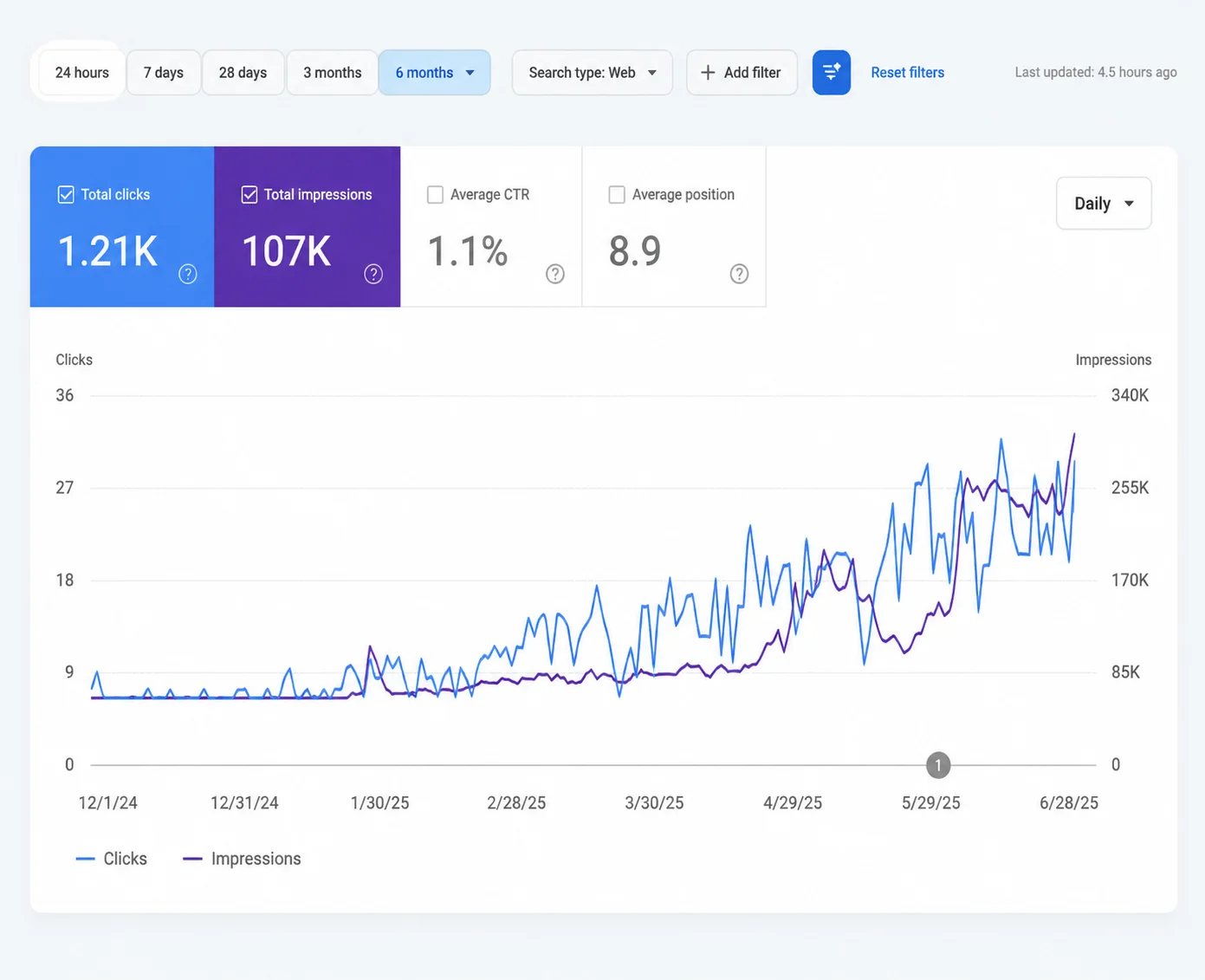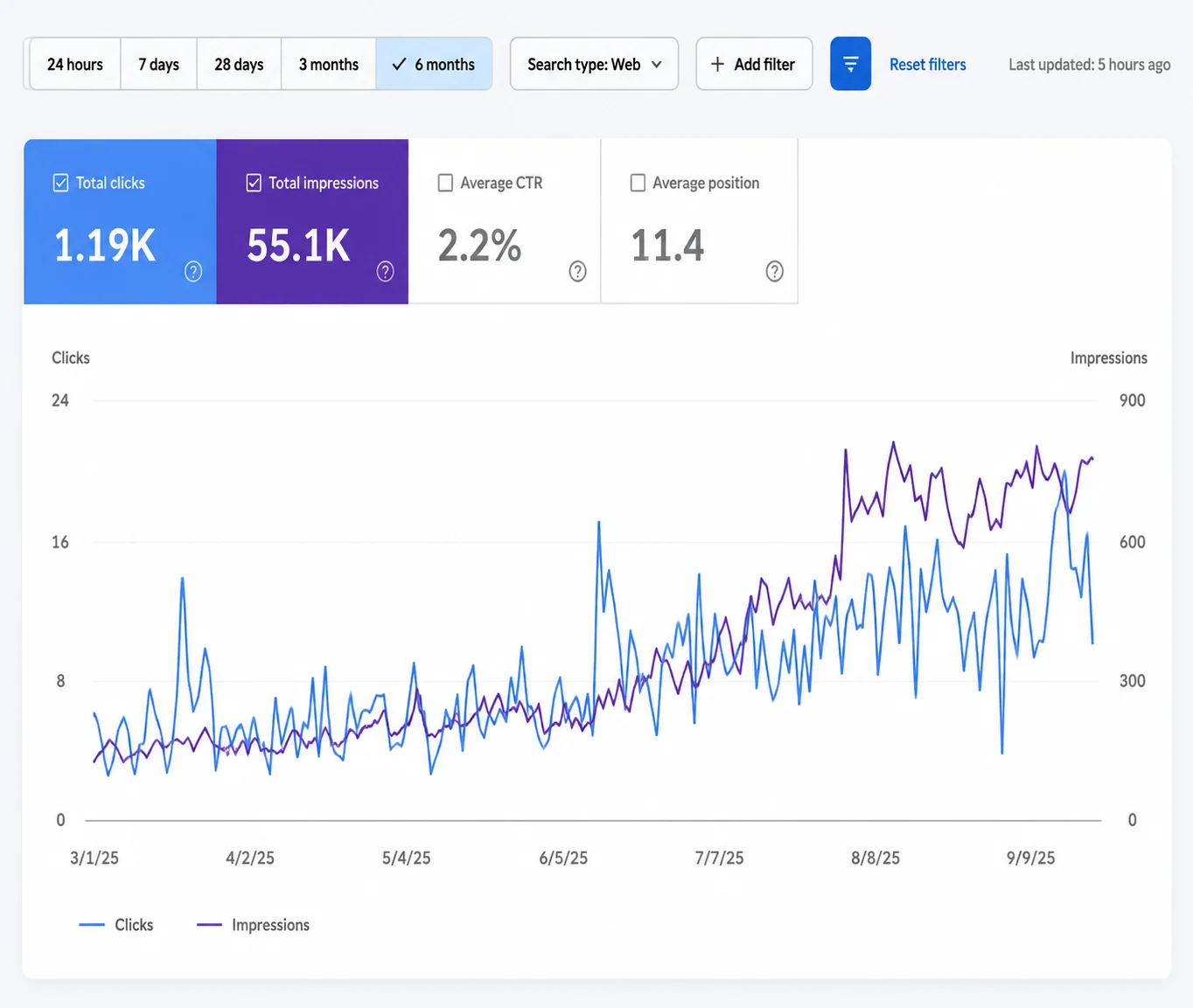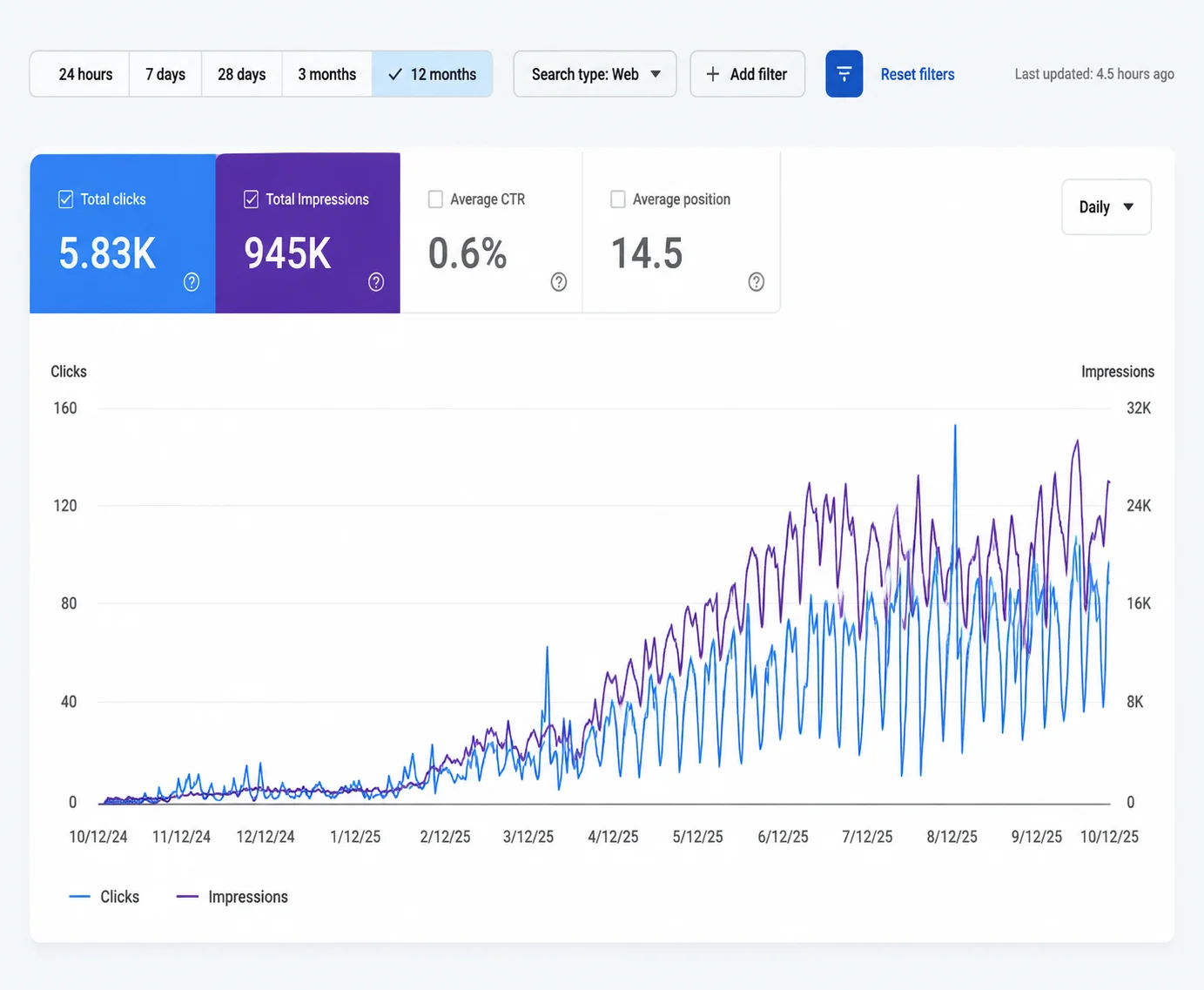
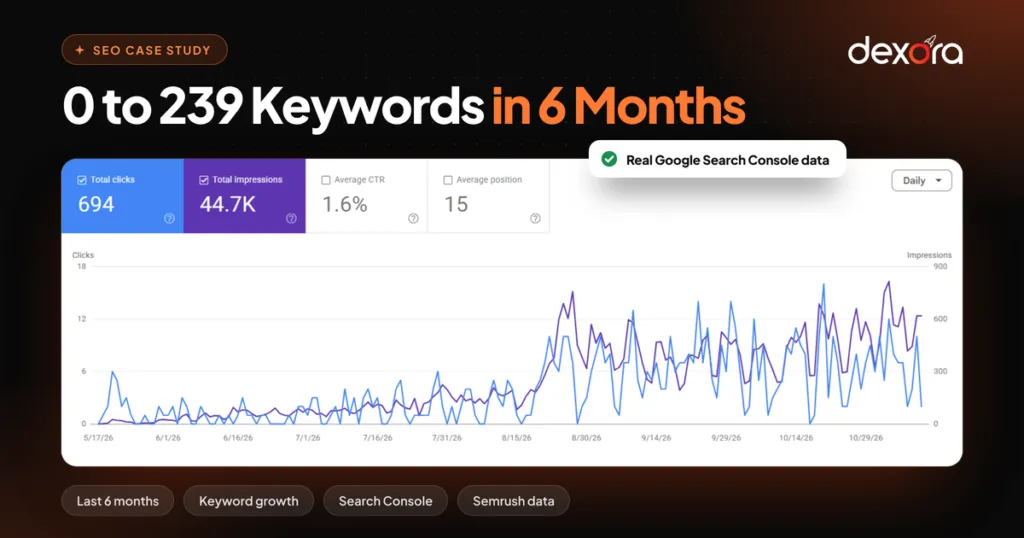
From near-zero to consistent growth in five months.
Source: Google Search Console and Semrush, May to November 2026.
The Starting Point
When this Austin HVAC company came to us, their website existed — but Google barely knew it did.
No rankings for their core service keywords. No structured local presence. The site had been live for over a year but was sitting in the dark. Zero organic traffic, zero local map visibility, and a business that was surviving entirely on referrals and word of mouth.
The owner had tried “doing SEO” with a previous agency. What they had to show for it was a blog they’d stopped updating, some directory listings with wrong phone numbers, and a Google Business Profile that hadn’t been touched in 14 months.
They came to us because their competitors were showing up for “AC repair Austin” and “HVAC company Austin” and they weren’t. That’s a simple problem. But it takes a systematic fix.
What We Found in the Initial Audit
Before writing a single piece of content or building a single link, we audited the site completely.
What stood out immediately:
The site had no location pages. One homepage mentioning Austin, and that was it. For a city the size of Austin — where someone in Cedar Park is not going to call a company they’ve only seen mentioned in connection with South Austin — this was a serious gap.
The Google Business Profile was claimed but neglected. Category was set too broadly. No service menu. No photos beyond the default logo. Zero review responses. Posts hadn’t gone out in over a year.
Technically, the site had three separate redirect chains on the homepage alone, a robots.txt that was blocking the CSS files, and page speed scores in the 30s on mobile. None of this was catastrophic, but all of it was friction — friction that slows rankings and drives users away when they do land.
Citation consistency was a mess. The business name appeared three different ways across directories. The suite number was missing on some listings and present on others. The phone number had a different area code on two Yelp entries that someone had created and abandoned.
This is where most HVAC companies are. It’s not a disaster. It’s just neglect — and neglect is fixable.
What We Did: Month by Month
Month 1 — Technical Clean-Up and Foundation
We don’t start with content. We start with making sure Google can actually find, crawl, and understand the site properly. Content published on a technically broken site ranks slowly if it ranks at all.
Month 1 was entirely foundation work:
Fixed the redirect chains and confirmed canonical tags were set correctly across the site. Repaired the robots.txt so CSS and JavaScript were crawlable. Compressed images and deferred render-blocking scripts — mobile page speed went from 31 to 74 in four weeks. Set up proper XML sitemap and submitted it to Search Console. Verified the site in both www and non-www variants.
Simultaneously, we completely rebuilt the Google Business Profile. Updated the primary category to “HVAC Contractor” with four secondary categories including “Air Conditioning Repair Service” and “Heating Contractor.” Built out the full service menu with descriptions and pricing ranges. Uploaded 23 photos including job site photos, before/after equipment installs, and team images. Set up a posting schedule (two GBP posts per week going forward). Responded to all 11 existing reviews — including two negative ones that had never been acknowledged.
By the end of month 1, impressions in Search Console were still near zero. That’s normal. The foundation doesn’t produce results the same week you pour it.
Month 2 — Local Page Build-Out and On-Page Optimization
Austin is a large metro. Someone in Round Rock is not the same searcher as someone in Pflugerville or Buda. We built seven location-specific landing pages targeting the neighborhoods and suburbs where this company actually serves:
- Austin (core)
- Round Rock
- Cedar Park
- Pflugerville
- Georgetown
- Buda
- Kyle
Each page was written with real local context — not keyword-stuffed filler but actual content about HVAC needs in that area, typical system ages, common issues with Texas heat in that suburb, and a clear service offering with a phone number and CTA.
We also rewrote the core service pages. The original “AC Repair” page was 180 words of generic text. We rebuilt it at 900 words covering what the diagnostic process looks like, what brands they service, how same-day booking works, and what homeowners in Austin should expect from a reputable HVAC company.
Internal linking was structured deliberately — every location page linked to the core service pages, every service page linked to the GBP review link and the contact page.
Schema markup went in across all pages: LocalBusiness, HVACBusiness, Service, and BreadcrumbList.
Month 3 — Content and Citation Building
This is where Search Console started moving.
We launched a content calendar — two blog posts per month focused on questions Austin homeowners actually search for:
- “How often should you service your AC in Texas?”
- “Why is my HVAC system short cycling?”
- “Austin AC replacement cost: what homeowners should expect in 2026”
- “Best HVAC brands for Texas heat”
These aren’t traffic monsters on their own. But they build topical authority. Google sees a site consistently publishing relevant, specific content and starts trusting it more across all its pages — including the service pages that actually convert.
Citation building ran in parallel. We cleaned the existing directory listings (consistent name, address, phone, correct suite number) and built 40 new citations across relevant directories: Angi, Thumbtack, Houzz, HomeAdvisor, Yelp, BBB, and 34 others. Every listing matched the GBP exactly.
Review velocity also started picking up. We set up a simple post-service text sequence asking for Google reviews — something the previous agency had never done. In month 3 alone, the company collected 11 new reviews. Total went from 14 to 25.
Month 4 — Rankings Start Moving, Impressions Spike
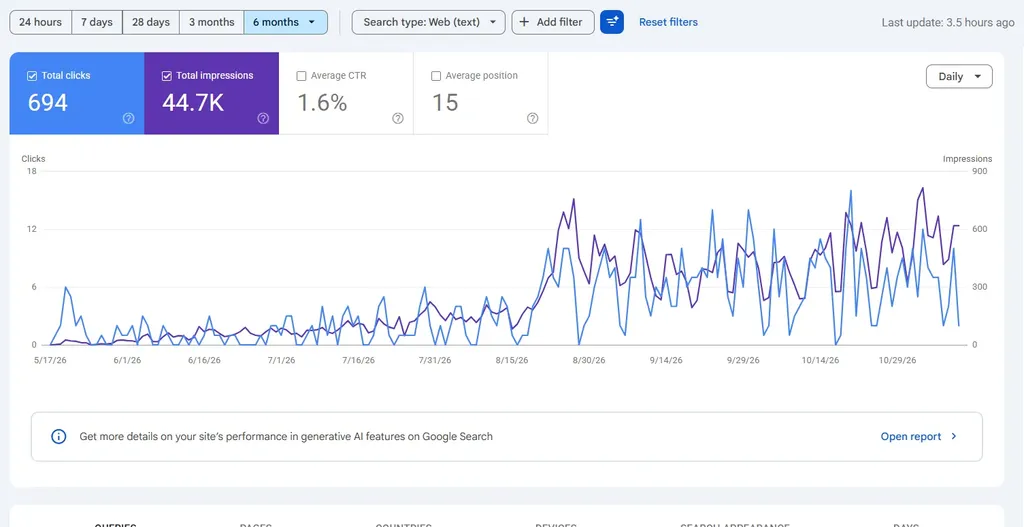
This is the chart moment. If you look at the Search Console graph, you can see exactly when it happened — around August 2026, impressions jumped significantly and clicks followed.
By month 4, the site was ranking:
- Position 8-12 for “HVAC company Austin” and variations
- Position 5-9 for “AC repair [neighborhood]” terms across four suburbs
- Appearing in the Google Maps 3-Pack for searches in Round Rock and Cedar Park
239 organic keywords were now indexed and ranking across positions 1-100 — up 15% from the month prior, and up from essentially nothing at the start of the engagement.
Organic traffic hit its first meaningful number: 1,100 monthly visits. That’s not a huge number in absolute terms, but for a company that had been getting zero traffic from Google six months earlier, it was the first real signal that the system was working.
Month 5 — Sustained Growth and Optimization
Month 5 was about compounding what was working and fixing what wasn’t.
The Cedar Park location page was outperforming everything — position 4 for “HVAC contractor Cedar Park.” We doubled down with a supporting blog post and built three additional internal links pointing to it.
The Georgetown page wasn’t ranking. We looked at the competitor pages holding positions 1-5, identified a content gap (they weren’t addressing commercial HVAC in Georgetown), and rewrote the page with a commercial angle. It moved from position 60 to position 22 in three weeks.
Review count hit 38. The GBP listing was now showing in the Maps 3-Pack for 11 search variations across Austin and surrounding suburbs.
Results After 5 Months
Google Search Console (6-month view, May–November 2026):
- Total clicks: 694
- Total impressions: 44,700
- Average CTR: 1.6%
- Average position: 15
- Trend direction: Consistent upward growth from August onwards, with daily impressions now regularly hitting 500–900

Semrush Domain Overview:
- Organic keywords indexed: 239 (+15%)
- Monthly visits: 1,100
- Referring domains: 275
- Backlinks: 484 (+5%)
- Authority Score: 6 (from zero — still building, but moving)

Keyword rankings:
- Keywords now ranking in positions 1–20: growing monthly
- Map Pack appearances: 11+ search variants across the Austin metro
- From 14 to 38 Google reviews in five months
Business impact:
The owner reported the first month where Google-sourced leads exceeded referral leads — a milestone they hadn’t hit in three years of running the business.

What Made This Work
Three things. Not ten. Three.
Foundation first. Every agency skips the technical audit because it’s unglamorous and clients can’t see it. We did it first, and it’s the reason content and links produced results on the schedule they did rather than six months later.
Specificity over volume. Seven location pages targeting real neighborhoods outperformed one homepage trying to rank for “Austin HVAC.” Google rewards relevance. A Cedar Park homeowner searching “HVAC company near me” is not looking for a generic Austin result — they’re looking for someone who serves Cedar Park.
Review velocity. This gets underrated constantly. The Maps 3-Pack ranking algorithm weighs recency and volume of reviews heavily. Going from 14 to 38 reviews in five months — with responses to every single one — was a direct contributor to the Map Pack appearances.
None of this is mysterious. It’s systematic, patient, consistent work. The same process works for any HVAC company starting from the same place.
Want to see what this looks like for your HVAC business? Get a free audit and we’ll show you exactly where your site stands and what a realistic 90-day plan looks like.
Related: HVAC SEO services | Local SEO for HVAC contractors: the complete guide | SEO for contractors: the complete guide