


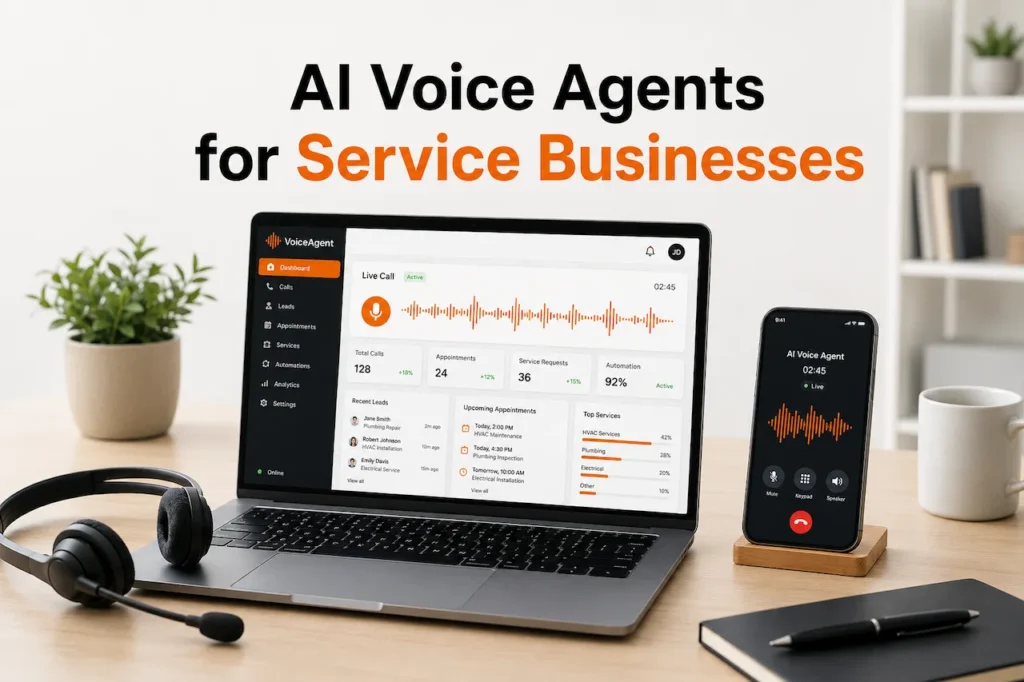
Every missed call for a service business is a lead that likely calls the next competitor within minutes, and that gap is exactly what AI voice agent services for businesses are built to close. We have evaluated voice agent deployments across home service and local business clients, and the results depend heavily on how the technology is implemented, not just whether it is used.
This guide breaks down what AI voice agents actually do, where they deliver measurable ROI for service businesses, and where live staff still outperform automation in 2026. We prioritize a strategy that treats voice agents as a tool matched to specific call volume and use cases, not a blanket replacement for every phone interaction.
What Is an AI Voice Agent?
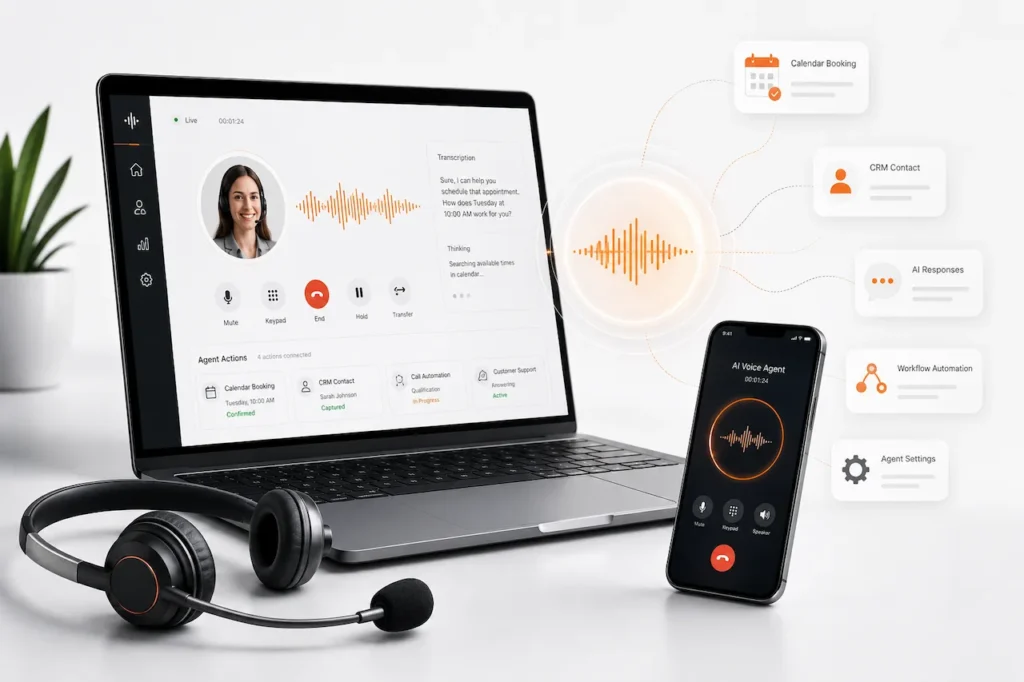
An AI voice agent is a system that answers, understands, and responds to phone calls using natural language processing, without a human on the line. Modern voice agents in 2026 handle multi-turn conversations, book appointments directly into scheduling systems, and route complex requests to a live team member when needed.
This differs meaningfully from older interactive voice response systems, which relied on rigid menu trees and keypad input. Current voice agents understand natural speech, handle interruptions, and can manage the kind of unstructured conversation a real customer has when calling about a service issue.
How AI Voice Agents Work for Service Businesses
A voice agent integrates with a business’s phone system, calendar, and customer relationship management platform to handle calls end to end. When a call comes in, the agent identifies intent, whether that is booking an appointment, asking about pricing, or reporting an emergency, and responds accordingly.
- Answers incoming calls immediately, eliminating hold times and missed-call risk
- Books, reschedules, or confirms appointments directly into the business’s calendar
- Answers common questions about services, hours, and service areas using business-specific information
- Escalates urgent or complex calls to a live team member with full conversation context
- Logs every call transcript and outcome for review and quality tracking
We always advise clients to review actual call transcripts during the first weeks of deployment, since real customer phrasing often reveals gaps the initial setup did not anticipate.
Real Use Cases Where Voice Agents Deliver Value
Not every call type benefits equally from automation, and the businesses seeing the strongest results target specific use cases rather than replacing their entire phone line at once. We have seen firsthand which scenarios consistently produce measurable returns.
- After-hours call coverage. Service businesses lose a significant share of leads to calls that come in outside business hours, and a voice agent captures and books these without added staffing cost.
- Appointment scheduling and confirmations. Routine booking and rescheduling calls are high-volume, repetitive, and well-suited to automation without sacrificing accuracy.
- Overflow during peak call volume. When call volume spikes beyond what live staff can handle, a voice agent prevents callers from hitting a busy signal or voicemail.
- First-touch qualification. Voice agents can gather job details, location, and urgency before a live team member ever picks up, reducing time spent on unqualified calls.
Cost vs. Benefit: What the ROI Actually Looks Like
The financial case for AI voice agent services for businesses comes down to comparing the cost of missed or delayed calls against the monthly cost of the platform. A single missed emergency service call can represent hundreds of dollars in lost revenue, and service businesses routinely miss a meaningful percentage of inbound calls during peak hours or after close.
Voice agent platforms typically operate on a monthly subscription plus usage-based call minutes, which is almost always lower than the cost of adding part-time or after-hours staff to cover the same call volume. The return becomes clearest for businesses with high call volume relative to staff capacity, where every additional missed call has a direct, measurable cost.
| Factor | Live Staff Only | AI Voice Agent |
| After-hours coverage | Limited or unavailable | Full coverage |
| Cost to scale call volume | Requires added staff | Scales without added headcount |
| Consistency of responses | Varies by staff member | Consistent, script-aligned |
| Handling complex or emotional calls | Strong | Limited, requires escalation |
| Setup and integration effort | None | Moderate, one-time |
Where AI Voice Agents Outperform Traditional Answering Services
Traditional answering services rely on live operators reading from a script without deep knowledge of the specific business, often resulting in generic responses and manual handoff delays. AI voice agents integrated directly with a business’s own scheduling and service data respond with more accurate, business-specific information in real time.
Voice agents also scale instantly during volume spikes without the staffing lag that answering services face when call volume exceeds operator capacity. For service businesses like plumbing, electrical, and HVAC companies where a missed emergency call often means a lost customer, this immediacy is where the technology shows the clearest advantage over both answering services and unattended voicemail.
Where Live Staff Still Win
AI voice agents are not a complete replacement for trained staff, particularly for emotionally sensitive calls, complex troubleshooting, or situations requiring judgment beyond a defined script. Customers dealing with a genuine emergency or a frustrating billing dispute often need the reassurance and flexibility that only a live person can provide.
The businesses that get the most value from voice agents design clear escalation paths, so the technology handles routine, high-volume interactions while live staff focus on the calls that genuinely require human judgment. Treating this as a hybrid system rather than a full replacement is where we consistently see the best outcomes.
AI Voice Agents vs. Chatbots
Voice agents and chatbots solve similar problems through different channels, and service businesses often need both rather than choosing one over the other. Voice agents handle phone-based interactions, which remain the primary contact method for many local service customers, while chatbots capture website visitors who prefer not to call.
We break down the practical differences in more detail in our comparison of chatbot development frameworks vs. live chat, and the same evaluation criteria around use case fit apply when deciding between voice and chat automation.
How to Evaluate a Voice Agent Provider
Not all voice agent platforms are built for the accuracy and integration depth that service businesses need, and evaluating providers on demo quality alone misses important details. We recommend testing any platform against real call scenarios specific to the business before committing.
- Confirm the platform integrates directly with the scheduling and CRM systems already in use
- Test how the agent handles interruptions, background noise, and non-standard phrasing
- Review how escalation to a live team member is triggered and how much context is passed along
- Ask for call transcript and outcome reporting, not just call volume metrics
- Clarify pricing structure, including whether costs scale with call minutes or per booked appointment
Why Choose Us
We help service businesses evaluate and implement AI voice agent services alongside a broader digital strategy, so automation supports lead generation rather than operating in isolation.
- Direct experience integrating AI voice and chat automation for local service businesses
- Implementation planning that targets specific high-value use cases instead of blanket automation
- Escalation workflows designed to route complex calls to live staff with full context
- Combined expertise in AI tools and automation alongside local SEO and lead generation
- A track record of measurable lead and conversion results, including our home repair Google Ads case study
If you are weighing whether an AI voice agent fits your call volume and service model, our AI tools and automation team can walk through the specific use cases that apply to your business.
Conclusion
AI voice agent services for businesses are worth it in 2026 for service businesses with high call volume, frequent after-hours calls, or repetitive booking needs, when implemented with clear escalation paths to live staff. They are not a full replacement for trained team members handling complex or sensitive calls. Matched to the right use cases, voice agents close the gap between missed calls and captured revenue.
FAQs
Are AI voice agent services worth it for small service businesses?
For businesses with meaningful after-hours or peak-volume missed calls, the cost of an AI voice agent is typically lower than the revenue lost to those missed calls. Smaller businesses with low call volume may see a longer path to measurable ROI. The right decision depends on comparing actual missed-call data against platform costs before committing.
How much do AI voice agent services cost for businesses?
Most platforms charge a monthly subscription plus usage-based pricing tied to call minutes or completed bookings. This structure is generally lower than the cost of adding after-hours or overflow staff to handle the same call volume. Exact pricing varies significantly by provider and the complexity of the required integrations.
Can AI voice agents actually book appointments correctly?
Yes, modern AI voice agents integrate directly with scheduling systems and can check availability, book, and confirm appointments in real time during the call. Accuracy depends on how well the platform is integrated with the business’s existing calendar and CRM. Reviewing early call transcripts helps catch and correct any booking errors quickly.
Do AI voice agents replace the need for live phone staff?
No, AI voice agents work best as a hybrid system that handles routine, high-volume calls while escalating complex or emotionally sensitive interactions to live staff. Businesses that try to fully replace live staff often see lower customer satisfaction on calls that genuinely need human judgment. Clear escalation paths are essential to getting this balance right.
What types of calls should route to a live person instead of a voice agent?
Emergency situations, billing disputes, and any call involving frustration or complex troubleshooting typically need a live team member. Voice agents handle scheduling, general questions, and after-hours capture reliably, but escalation triggers should be configured for anything requiring judgment beyond a defined script. Testing real call scenarios before launch helps set these triggers accurately.
How is an AI voice agent different from a traditional answering service?
Traditional answering services rely on live operators working from a general script without deep business-specific knowledge, often creating delays in handoff. AI voice agents integrated with a business’s own data can answer with accurate, business-specific information immediately and scale instantly during call volume spikes. This immediacy is typically where voice agents show the clearest advantage.
Do AI voice agents work well for emergency service businesses like plumbing or HVAC?
Yes, emergency service businesses often see the strongest ROI, since missed emergency calls represent high-value lost revenue and competitors are usually one call away. Voice agents provide immediate after-hours coverage that these businesses frequently cannot staff around the clock. Clear escalation to on-call staff for genuine emergencies remains essential.
How long does it take to implement an AI voice agent for a business?
Implementation typically takes one to three weeks, depending on the complexity of CRM and scheduling integrations and how much business-specific information needs to be configured. Testing against real call scenarios before full launch is critical to catching gaps early. Businesses with simpler scheduling systems generally see faster implementation timelines.
Can AI voice agents handle multiple languages for businesses with diverse customers?
Many current voice agent platforms support multiple languages, which is valuable for businesses serving diverse or bilingual customer bases. Language support and accuracy vary by provider, so this should be tested directly with real call scenarios in each required language. Businesses serving bilingual markets should confirm this capability before selecting a platform.
What is the biggest risk of implementing an AI voice agent poorly?
The biggest risk is deploying a voice agent without clear escalation paths, resulting in frustrated customers stuck in automated loops during calls that need human judgment. Poor integration with scheduling systems can also lead to booking errors that damage customer trust. Reviewing real call transcripts early and adjusting configuration quickly prevents these issues from compounding.
Automate call answering, lead qualification and appointment booking.

Local SEO and AI Search (AEO & GEO) Specialist.
Building search visibility that converts into qualified demand.
Today, businesses need visibility on Google Maps and AI powered search and websites that actually convert visitors into leads. I am a Local SEO, AI Search & Conversion Rate Optimization (CRO) Specialist with 5+ years of hands on experience helping businesses turn underperforming websites into high converting growth engines. My work combines Local SEO, Technical SEO, Semantic SEO, GEO/AEO, and conversion focused landing page optimization to ensure brands are discoverable and profitable.
My Experience
I have delivered SEO and web growth projects across the US, UK, Australia, Canada, Finland, Germany, and the Czech Republic, working in industries such as local businesses (electrician, hvac, cleaning, Real estate, healthcare, B2B, eCommerce, SaaS, and environmental services.
Some Results
>> 200+ websites audited globally
>> specifically worked with 100+ local business (80% from USA)
>> 80+ websites improved through technical SEO & schema fixes
>> 20+ businesses featured in Google AI Overviews (SGE)
>> Multi million impression growth for eCommerce & SaaS brands
Book Free Consultation: calendly.com/dexora/30min