



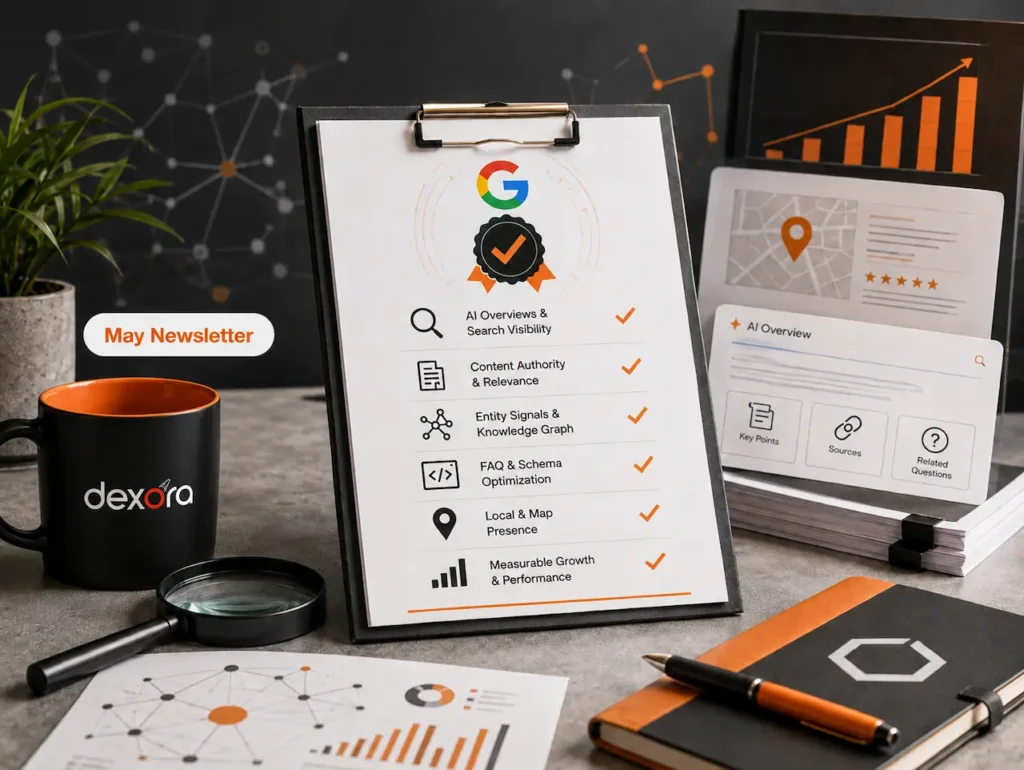
By Taqweem Ahmad | Founder, Dexora Digital | May 2026
Google published its first official guide to optimizing for generative AI features in Search on May 15, 2026. Profound released data showing 100 million people search with AI every day. This month, AI search moved from a trend to a documented, measurable, optimizable discipline and most businesses still have zero presence in it.
The Big Story: Google Makes AEO Official
On May 15, 2026, Google published its first comprehensive guide to optimizing content for appearance in generative AI features in Google Search. The guide was authored by John Mueller Google’s most senior public-facing search advocate and published on the Google Developers platform under Search Central. [1]
This is significant. It means AI search optimization is no longer a fringe discipline or a speculative practice. It is now documented, structured, and officially sanctioned by Google itself. If you have been waiting for a signal that this is worth your attention, this is the signal.
Google’s official AEO guide is the most important development in search optimization since the introduction of Core Web Vitals. It changes what it means to compete in Google Search in 2026.
What the Guide Actually Says
The guide covers five areas that Google says directly influence whether your content appears in generative AI features:
1. Valuable, unique, non-commodity content — Generic content does not get cited. Specific, expert, unique content does. Google explicitly says AI features prioritize content that provides something other sources do not.
2. Local, shopping, image, and video content — AI features are not just text. Google’s guide specifically calls out local business content, shopping feeds, image content, and video as eligible for AI feature inclusion.
3. Mythbusting AEO and GEO misconceptions — Critically, Google explicitly addresses misconceptions about AEO and GEO in the guide. The existence of this section confirms that these terms are now mainstream enough to require official clarification.
4. AI agent optimization — Google introduces guidance on AI agents, which they describe as an ’emerging and evolving space’. This is the next frontier: AI systems that take actions on behalf of users, not just answer questions.
5. SEO remains foundational — Google’s guide explicitly states that traditional SEO best practices ‘remain relevant and foundational to success with generative AI features’. This is not either/or. It is both.
Key point: The guide does NOT say to abandon traditional SEO. It says to build on top of your existing SEO foundation with AI-specific signals. The businesses already doing both are 2-3 years ahead of those starting now.
The Market Data: 100 Million Daily AI Searchers
While Google published its guide, the market data from Profound one of the leading AI search analytics platforms paints the scale of what is happening. As of May 2026:
100M+ people search with AI every day (Profound, May 2026)
85% of businesses have zero AI search optimization strategy
20%+ of US Google searches now show AI Overviews above all organic results
77% of Australians use AI tools monthly to find services (Telsyte, 2026)
Profound’s platform monitors what millions of people are actually asking AI systems, how AI represents brands in conversations, and whether brands are being cited or ignored. Their own data — from tracking 100 million daily AI search interactions shows that brands not optimized for AI search are being systematically excluded from the recommendations AI systems generate.
The competitive dynamic is clear: the businesses that establish AI search presence now are building citation authority that compounds. The businesses that wait are allowing competitors to establish that authority first — and first-mover advantage in AI search is significantly harder to overcome than first-mover advantage in traditional SEO.
What This Means in Practice — 3 Business Scenarios
Scenario 1: You Are a Local Service Business
When a homeowner in your city asks ChatGPT ‘who should I call for HVAC repair?’ — does your business come up? If you do not have FAQPage schema on your service pages, llms.txt at your domain root, and consistent entity signals across your Google Business Profile and website, the answer is almost certainly no.
The good news: local businesses have a significant advantage in AI search that most do not know about. Google Business Profile is the most authoritative local entity signal for AI systems. A well-optimized GBP combined with FAQPage schema and llms.txt puts a local service business in a position to appear in AI search recommendations within weeks.
Local SEO and AI Search for your business.
Scenario 2: You Run an E-commerce or Product Business
Google’s guide specifically mentions shopping content as an AI feature priority. This means product schema, shopping feeds, and product-specific FAQ content are now AI search signals not just traditional SEO signals. The Profound platform tracks AI recommendations in shopping contexts, and brands that structure their product content for AI extraction are appearing in ChatGPT and Gemini shopping recommendations.
The practical implication: your product descriptions, FAQ pages, and review content need to be structured for AI extraction self-contained, specific, and in schema markup that AI systems can read directly.
Scenario 3: You Run a B2B or Professional Services Business
This is where AI search has the most dramatic near-term impact. When a purchasing manager or business owner asks ChatGPT ‘who are the best [your category] specialists?’ AI systems are answering with specific company names. The companies appearing in those answers built their AI search presence months before the question was asked.
Keentel Engineering one of our long-term clients is generating 8,119 AI citations per month. This means 8,119 times per month, their content is being used by ChatGPT, Google AI Mode, AI Overviews, or Gemini to generate an answer. That is 8,119 moments of visibility that no advertising budget can replicate.
AI Search Optimization services AEO and GEO.
The 5-Action May 2026 Checklist — What to Do This Week
Based on Google’s official guide and the market data from Profound, here are the five most impactful actions you can take this month:
Action 1 — Check Your Generative AI Features Report in GSC
Open Google Search Console. Go to Performance. Look for ‘Generative AI features’ in the left navigation. This Beta report shows you how many times your content appeared in Google’s AI-generated search results in the last 3 months. If you have zero impressions, or a flat trend, your content is not currently participating in AI search. This report is the starting point for any AI search optimization campaign.
Action 2 — Create llms.txt at Your Domain Root
This is the single most overlooked AI search signal. llms.txt is a plain text file placed at yourdomain.com/llms.txt that tells GPTBot, ClaudeBot, and PerplexityBot what content exists on your site and how to prioritize it. Without it, AI crawlers make their own indexing decisions — which are often wrong. Creating llms.txt takes 30 minutes and produces measurable results within 4-8 weeks.
Action 3 — Verify AI Crawlers Are Not Blocked
Go to yourdomain.com/robots.txt and check for any Disallow rules affecting GPTBot, ClaudeBot, or PerplexityBot. If any of these crawlers are blocked, your content is completely invisible to those AI systems regardless of its quality. This is more common than you would expect many security plugins and hosting configurations block AI crawlers by default as part of bot management.
Action 4 — Add FAQPage Schema to Your Top 3 Service Pages
FAQPage schema in JSON-LD format is the primary content signal AI systems use when extracting information for generated answers. Write 8-10 FAQ questions for each service page in self-contained 40-80 word answer format. Each answer should be complete without requiring surrounding page context. Implement with FAQPage JSON-LD schema (not just HTML questions and answers — the schema markup is what makes them readable by AI systems). Validate with Google’s Rich Results Test before publishing.
Action 5 — Audit Your Organization Schema for Entity Signals
Your homepage should have Organization or LocalBusiness schema with sameAs links pointing to your Google Business Profile, LinkedIn profile, and any other authoritative external profiles. This entity consistency is what gives AI systems the confidence to recommend your business by name — they need to be able to verify that the business exists, operates where you say it does, and provides the services you claim. Missing sameAs links are the most common entity signal gap we find in audits.
Free AI Visibility Audit — check your current AI search presence.
Google’s Mythbusting — What AEO and GEO Are NOT
Google’s official guide includes a ‘mythbusting’ section specifically about AEO and GEO. This is unusual Google rarely directly addresses specific practitioner terminology in their official documentation. The fact that they felt the need to address misconceptions signals both how widespread these terms have become and how much misinformation exists in the market.
Myth 1: AEO and GEO Are a Replacement for SEO
Google’s guide is explicit: traditional SEO best practices ‘remain relevant and foundational to success with generative AI features.’ Content quality, page speed, mobile optimization, and link authority all continue to matter. AI search optimization adds a layer on top of this foundation it does not replace it. Businesses pursuing AI search optimization while neglecting technical SEO will underperform relative to businesses doing both.
Myth 2: You Need Special AI-Only Content
You do not need a separate content strategy for AI search. The same expert content that performs well in traditional search — specific, credible, structured, experience-driven also performs well in AI search. The difference is format: that content needs to be structured with schema markup and organized in a way that allows AI systems to extract discrete answers rather than requiring the full context of a page to make sense.
Myth 3: Getting Cited by AI Search is Random or Unpredictable
Google’s guide documents specific, actionable signals that influence whether content appears in AI features. This is the opposite of random it is a documented, implementable discipline. The businesses treating AI search as a predictable channel with specific optimization requirements are the ones generating measurable citation growth. The businesses treating it as luck are falling behind.
AI Search Readiness — How Different Business Types Compare
| Business Type | Typical Current Status | AI Search Opportunity | Highest-Impact First Action |
| Local Service (HVAC, Plumber, Roofer) | 0 AI citations — no llms.txt, no FAQ schema | Very high — GBP entity + FAQ schema = fast results | GBP audit + FAQPage schema on 3 service pages |
| Professional Services (Law, Dental, Finance) | Rare AI citations — some schema, no llms.txt | High — professional recommendation queries growing fast | llms.txt creation + Organization schema sameAs links |
| Engineering and Technical B2B | Variable — depends on content depth | Very high — ChatGPT used for vendor research | Deep FAQ content + entity signals + AI citation monitoring |
| eCommerce / Product Business | Low — product schema rare, no FAQ schema | Medium-high — shopping AI features expanding | Product schema + FAQ on category pages + Shopping feed |
| Digital Agency / SaaS | Some — blog content often extractable | High — agency and tool recommendations via AI common | Content restructuring + FAQPage schema + llms.txt |
Frequently Asked Questions
Q: What did Google publish about AI search optimization in May 2026?
A: Google published a comprehensive guide titled ‘Optimizing your website for generative AI features on Google Search’ on May 15, 2026. Authored by John Mueller and published on the Google Developers platform under Search Central, it covers five areas: valuable and unique content, local and shopping content guidance, clarification of AEO and GEO misconceptions, emerging AI agent guidance, and confirmation that traditional SEO remains foundational. This is the first time Google has officially documented AEO as a distinct optimization discipline.
Q: What is the difference between AEO and GEO?
A: AEO Answer Engine Optimization focuses on getting your content cited when AI systems generate answers to user questions. When someone asks Google’s AI Overviews ‘how much does HVAC repair cost?’ and the AI produces an answer, the websites that contributed to that answer are benefiting from AEO. GEO Generative Engine Optimization focuses on getting your business recommended by name when AI systems answer recommendation queries. When someone asks ChatGPT ‘who should I hire for HVAC repair in Phoenix?’ and the AI names specific businesses, those businesses are benefiting from GEO. AEO is about content citation; GEO is about brand recommendation. Both require the same foundational signals: llms.txt, FAQPage schema, and entity consistency.
Q: How many people are currently using AI search?
A: As of May 2026, Profound’s platform reports 100 million people search with AI every day. Google AI Overviews appear on more than 20 percent of all US Google searches. ChatGPT has 200 million-plus weekly active users globally. 77 percent of Australians use AI tools monthly to find products and services, according to Telsyte’s 2026 research. The scale is no longer niche AI search is a primary search channel for hundreds of millions of people.
Q: Does AI search optimization replace traditional SEO?
A: No. Google’s official May 2026 guide explicitly states that traditional SEO best practices ‘remain relevant and foundational to success with generative AI features.’ Technical SEO Core Web Vitals, schema markup, mobile optimization, page speed is the foundation that AI search optimization builds on. A site with poor traditional SEO will underperform in AI search relative to its potential even with good AEO signals. The correct framing is not SEO versus AI search optimization it is SEO as the foundation and AI search optimization as the layer built on top of it.
Q: What is llms.txt and why does it matter?
A: llms.txt is a plain text file placed at your domain root (yourdomain.com/llms.txt) that tells AI crawlers GPTBot for ChatGPT, ClaudeBot for Claude, PerplexityBot for Perplexity what content exists on your site and how to prioritize it. It functions as the AI-specific equivalent of an XML sitemap for traditional search engines. Without llms.txt, AI crawlers make their own decisions about what to index from your site — which are often incomplete or incorrect. Creating it takes 30 minutes and produces measurable improvement in AI impression data within 4 to 8 weeks for most sites.
Q: How do I check my current AI search visibility?
A: The primary tool is Google Search Console’s Generative AI features report (currently Beta). Navigate to Performance in GSC and look for Generative AI features in the left navigation. The report shows total impressions how many times your content appeared in Google’s AI-generated search results across a selected time range, plus a breakdown by page, country, and device. If you have zero impressions, your content is not currently being used by Google’s AI features. For non-Google AI systems (ChatGPT, Perplexity), the primary measurement tool is SEMrush AI Visibility, which tracks citation counts across platforms.
Q: What is FAQPage schema and how does it help AI search?
A: FAQPage schema is JSON-LD structured data that marks question-and-answer content on your pages in machine-readable format. AI systems use FAQPage schema as a primary signal for identifying content that is formatted for extraction they look for content that directly answers a specific question in a self-contained format without requiring surrounding context. Writing 8-10 FAQ questions for each service page in 40-80 word self-contained answers, implemented with FAQPage JSON-LD schema, is the highest single-impact action for increasing AI search citations. Validate all schema with Google’s Rich Results Test before publishing.
Q: Is there verified data showing AI search optimization produces results?
A: Yes. Keentel Engineering, a US-based engineering firm, is generating 8,119 AI citations per month across ChatGPT, Google AI Mode, Google AI Overviews, and Gemini tracked and verified in SEMrush AI Visibility. SitePlansFl.com grew from near-zero Generative AI impressions in May 2026 to 20-30 impressions per day by August 2026 tracked in Google Search Console’s Generative AI features report. A Queensland digital agency achieved 30 pages cited in ChatGPT and 45 total AI citations. These results are not estimates they are verifiable data from the tools named above.
Q: What does Google say about local businesses and AI search?
A: Google’s May 2026 guide specifically mentions local content as a priority for AI features. For local businesses, this means: Google Business Profile data directly feeds local AI search recommendations, location-specific FAQ content on service pages is prioritized for local AI queries, and LocalBusiness schema with consistent NAP (name, address, phone) across all platforms is the entity signal that gives AI systems the confidence to recommend a specific local business by name. The businesses that appear when someone asks ChatGPT ‘who is the best plumber in [city]?’ have built these signals consistently.
Q: What is the right first step for a business new to AI search optimization?
A: Start with a free audit that shows your current status across the six primary AI search signals: llms.txt (does it exist and is it correct), robots.txt AI crawler access (are GPTBot, ClaudeBot, and PerplexityBot allowed), FAQPage schema (do any service pages have it), Organization schema entity signals (are sameAs links pointing to GBP and LinkedIn), content structure (is content formatted for AI extraction), and your current Generative AI features data in GSC. Understanding your starting position takes 48 hours and costs nothing — and the audit itself often reveals the single highest-impact action to take first.
Google’s Official AI Optimization Guide
ahmad@dexoradigital.com · dexoradigital.com · Serving USA and Australia
Written by Taqweem Ahmad, Founder, Dexora Digital · AI-First SEO Agency · 7+ Years · 1000+ Audits