
April 2026 Newsletter
SEO Is Not What It Was 12 Months Ago
Over the past few months, we’ve seen a clear structural shift in how search works.
This is no longer just about rankings, keywords, or backlinks.
Search is now driven by AI interpretation, entity validation, and technical trust signals.
And most websites are not built for this.
What We’re Seeing Across Real Campaigns
Across multiple audits and active SEO projects, the data is consistent:
- Impressions are increasing, but click-through rates are declining
- AI Overviews are capturing a larger share of visibility
- Local rankings are increasingly tied to trust and consistency signals
- Websites with strong technical foundations are outperforming larger, content-heavy competitors
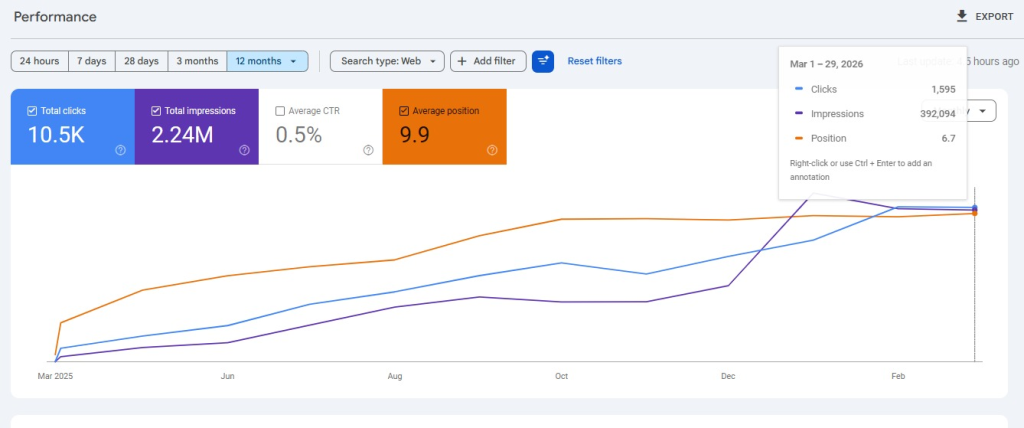
This aligns with what Google is prioritizing: 👉 clarity, structure, and trust
AI Search Has Changed the Game
Users are no longer exploring multiple pages.
They:
- Ask a question
- Get a summarized answer
- Make a decision
This is why traditional SEO alone is no longer enough.
To stay visible, websites must align with:
- Answer Engine Optimization (AEO)
- Generative Engine Optimization (GEO)
These frameworks focus on making your content usable by AI systems, not just search engines.
To better understand how this shift is impacting modern SEO, it’s important to explore how Generative Engine Optimization (GEO) is redefining visibility in AI-driven search environments, along with the growing role of AI and LLM-based SEO frameworks in structuring content for machine interpretation. We’ve broken this down in detail in our comprehensive guides on what generative engine optimization is, how AI and LLM SEO works in practice, and why SEO, AEO, and GEO together form the foundation of modern search strategy.
Local SEO Is Now a Validation System
Google Maps and local search results are no longer influenced only by optimization.
They now rely heavily on:
- Business legitimacy
- Consistent entity signals
- Website and GBP alignment
We’ve seen real cases where:
- Minor inconsistencies caused ranking drops
- Weak website structure affected map visibility
If you’re operating in local markets, this matters significantly.
To further understand how local rankings are evolving, it’s important to look at how Google Maps optimization now works in practice, the updated local SEO ranking factors, and how AI systems validate and interpret business entities.
Technical SEO Is Driving Performance
One of the most important shifts:
Content alone is no longer enough to compete.
Most underperforming websites we audit have issues such as:
- Weak internal linking structure
- Poor crawlability
- Missing schema implementation
- Inefficient indexing
These issues prevent both Google and AI systems from properly understanding the website.
To fully address these technical gaps, it’s important to focus on a structured approach that combines crawlability, indexing, and schema implementation, following a step-by-step technical SEO audit checklist, properly implementing schema markup for SEO, and aligning your website with modern search and AI systems using a complete technical SEO and GEO checklist.
Case Study: Technical SEO + Structure = Immediate Impact
We recently worked with a Shopify-based eCommerce website that had multiple foundational issues.
Initial challenges:
- No structured data (schema)
- Thin and unoptimized product content
- No internal linking system
- Weak metadata setup
Strategy implemented:
- JSON-LD structured data
- Optimized meta titles and descriptions
- Content expansion aligned with search intent
- Internal linking structure
- Sitemap optimization and submission
Results within days:
- Clicks increased from 40 → 46
- Impressions increased from 694 → 1.1K
- Average position improved from 8 → 6.8
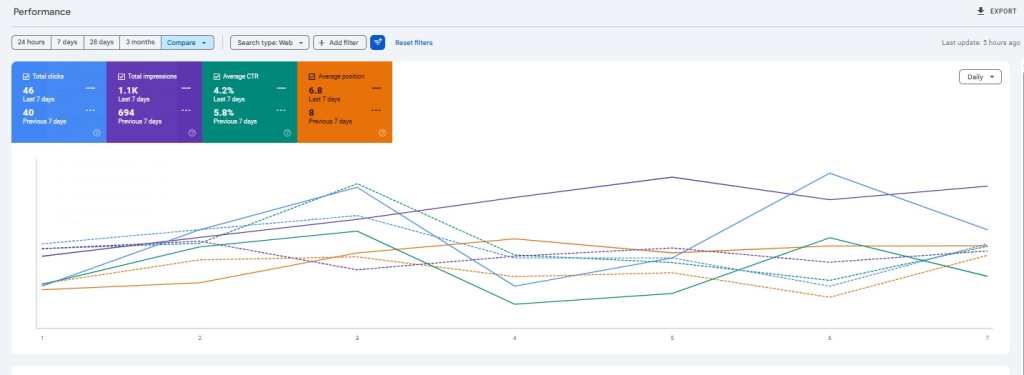
This result demonstrates a key principle: Fixing structure and technical SEO often delivers faster results than adding more content.
The New SEO Framework (2026)
SEO today operates as a system, not a single tactic.
The modern approach includes:
- SEO → Organic rankings
- AEO → AI answer visibility
- GEO → AI citations and entity presence
- Technical SEO → Foundation and crawlability
- CRO → Conversions and revenue
Missing any of these layers limits overall performance.
Common Mistakes We Still See
Despite these changes, many businesses are still:
- Publishing content without structure
- Ignoring internal linking
- Not implementing schema
- Failing to optimize for AI search
- Using generic landing pages without conversion strategy
This leads to:
Traffic without conversions, and visibility without results.
What Businesses Should Focus On Next
To remain competitive in 2026, the focus should be:
✔ Strong technical SEO foundation
✔ Clear content structure aligned with intent
✔ Entity consistency across platforms
✔ Local SEO optimization (Maps + website alignment)
✔ Conversion-focused landing pages
Final Perspective
SEO is not becoming more difficult.
It is becoming more precise and structured.
The websites that win today are not the ones doing more work,
but the ones doing the right work, in the right order.
From Taqweem Ahmad
If your website is:
- Not ranking
- Losing visibility
- Or not converting despite traffic
There is always a structural reason behind it.
If you need a second perspective, I’m always open to reviewing and sharing insights.
Book Free Consultation Consultation
(Free Stretegy For first 2 Businesses in April)
Frequently Asked Questions (SEO & AI Search – April 2026)
- What is changing in SEO in 2026?
SEO in 2026 is shifting toward AI-driven search, where Google focuses more on understanding intent, entities, and structured data. Rankings alone are no longer enough, as visibility in AI Overviews and zero-click results is becoming more important. Businesses now need to optimize for both search engines and AI systems.
- How do AI Overviews impact website traffic?
AI Overviews are reducing traditional click-through rates because users often get answers directly in search results. This means fewer users visit websites unless the content is highly relevant or authoritative. To adapt, businesses must focus on becoming part of AI-generated answers through structured and optimized content.
- What is the difference between SEO, AEO, and GEO?
SEO focuses on ranking in traditional search results, while AEO (Answer Engine Optimization) targets visibility in direct answers and featured snippets. GEO (Generative Engine Optimization) ensures your content is recognized and cited by AI systems. Together, they form a complete strategy for modern search visibility.
- Why is technical SEO more important now?
Technical SEO ensures that search engines and AI systems can properly crawl, understand, and index your website. Without a strong technical foundation, even high-quality content may not perform well. Elements like site structure, schema markup, and internal linking play a critical role in rankings and visibility.
- How can local businesses improve rankings on Google Maps?
Local businesses need to focus on consistent business information, optimized Google Business Profiles, and strong engagement signals like reviews. Website alignment with local SEO also plays a major role in rankings. Google now prioritizes trust, accuracy, and real-world signals over basic optimization.
- How long does it take to see SEO results after optimization?
SEO results typically take a few weeks to a few months depending on competition and website authority. Technical fixes and structural improvements can show early gains, while content and authority building take longer. Consistency and correct strategy are key to long-term growth.

Local SEO and AI Search (AEO & GEO) Specialist.
Building search visibility that converts into qualified demand.
Today, businesses need visibility on Google Maps and AI powered search and websites that actually convert visitors into leads. I am a Local SEO, AI Search & Conversion Rate Optimization (CRO) Specialist with 5+ years of hands on experience helping businesses turn underperforming websites into high converting growth engines. My work combines Local SEO, Technical SEO, Semantic SEO, GEO/AEO, and conversion focused landing page optimization to ensure brands are discoverable and profitable.
My Experience
I have delivered SEO and web growth projects across the US, UK, Australia, Canada, Finland, Germany, and the Czech Republic, working in industries such as local businesses (electrician, hvac, cleaning, Real estate, healthcare, B2B, eCommerce, SaaS, and environmental services.
Some Results
>> 200+ websites audited globally
>> specifically worked with 100+ local business (80% from USA)
>> 80+ websites improved through technical SEO & schema fixes
>> 20+ businesses featured in Google AI Overviews (SGE)
>> Multi million impression growth for eCommerce & SaaS brands
Book Free Consultation: calendly.com/dexora/30min
