
By Taqweem Ahmad | Local SEO & AI Search Strategist | 24 July 2026
Everyone in the SEO industry is talking about automation right now. AI tools that write content. Platforms that audit sites at scale. Systems that monitor rankings, generate briefs, build internal links, and push reports all without a human touching them.
And a lot of it is genuinely impressive.
But after seven years of running SEO campaigns for businesses across the USA, UK, Australia, and Canada and after seeing what happens when automation replaces strategy rather than supporting it, I want to share something that often gets lost in the excitement.
If you automate SEO without a high-level SEO mind driving the process, you are not moving faster. You are just making the wrong decisions faster.
This is not an argument against using AI or automation in SEO. I use both every single day. This is an argument for understanding where automation adds value and where it silently destroys it — and how CRO fits into this picture in a way most people never talk about.
What AI and Automation Genuinely Help With
Let me be honest about the genuine value first, because this debate is not black and white.
Used correctly, automation and AI make SEO work significantly more efficient. Specifically:
→ Data gathering and organisation.
Pulling GSC data, ranking reports, backlink profiles, and crawl results at scale in minutes instead of days. This is where automation shines — removing the mechanical work that used to consume hours.
→ Pattern identification.
AI is excellent at spotting anomalies across large datasets. A site with 3,000 URLs and a crawl error pattern on product pages — automation finds that in seconds. A human analyst would take a full day.
→ Content research and first drafts.
AI tools can surface topical gaps, suggest article structures, and generate first drafts that a skilled SEO strategist then shapes into something genuinely useful. The keyword is ‘first draft.’
→ Competitor monitoring.
Tracking competitor ranking movements, new content launches, and backlink acquisitions at scale is legitimately better when automated.
→ Technical alerts.
Rank tracking, uptime monitoring, Core Web Vitals changes — these are all tasks where automation is objectively superior because they require consistency, not judgment.
All of this is real. I use it. My team uses it. And it genuinely makes us faster.
But here is where the conversation usually stops — and where the real risk begins.
What Automation Cannot Replace
The part of SEO that separates agencies that generate results from agencies that generate reports is not technical. It is judgment.
And judgment is not something you can automate.
Understanding what a specific business actually needs
A keyword research tool will show you that ‘technical SEO consultant’ gets 2,900 monthly searches at a $72 cost per click. That data is valuable. What the tool cannot tell you is whether that keyword aligns with what your client actually sells, whether the searcher’s intent matches the service, or whether ranking for it will bring buyers or browsers.
That requires understanding the business — its margins, its client acquisition process, the questions its salespeople hear every day. That understanding comes from conversations, not crawls.
Knowing which gap is worth chasing and which is a trap
I have seen clients rank in the top 3 for high-volume keywords that brought zero revenue — because the keyword attracted the wrong audience at the wrong stage of their buying journey. The data showed a gap. The strategy filled it. The business made nothing from it.
A good SEO strategist reads the business goal before the keyword report. Automation reads the keyword report and reports back. The sequence matters.
Knowing when not to publish
This one is underrated. AI content generation has made it trivially easy to produce large volumes of content quickly. Some clients want 20 articles a month. Some need 3. Publishing 20 articles on a domain that cannot support the crawl budget, that has thin supporting pages, or that lacks the authority to rank those topics — that is a strategy that delays results, not accelerates them.
The judgment call about when to publish, what to publish, and what sequence to follow is not something a content calendar template can make for you.
Building a strategy that fits the business model, not a template
Every market is different. Every competitive landscape is different. A local plumbing company in Houston and a SaaS startup in Austin are both US businesses that need SEO. Their strategies share almost nothing in common different keyword structures, different content types, different link building approaches, different AI search signals.
Template-based automated SEO treats both the same way. That is why template-based automated SEO fails at the business model level even when it succeeds at the technical level.
The businesses that win in search are the ones with a high-level SEO mind at the centre — not the ones with the best automation stack.
The Part of This Conversation Nobody Talks About: CRO
There is a second problem with how most people think about SEO that goes deeper than the automation debate.
Most businesses hire an SEO agency to get their website to rank. They define success as position one, or page one, or a certain number of monthly visitors. And when they achieve that or when the agency reports that they achieved it the engagement feels complete.
But traffic without conversion means nothing.
A page at position one that nobody clicks, or that visitors land on and immediately leave, or that presents the right service to the wrong visitor with the wrong message — that page is not an asset. It is expensive real estate that generates zero return.
CRO is not separate from SEO — it is part of it
Conversion rate optimisation is often positioned as a separate discipline that runs alongside SEO. In practice, the two are inseparable.
When we structure a service page, we are making decisions about heading hierarchy, content depth, trust signals, CTA placement, and page speed all of which affect both rankings and conversion simultaneously. The title tag that gets someone to click is the same title tag that tells Google what the page is about. The content that answers a visitor’s question before they ask it is the same content that satisfies search intent.
The best SEO campaigns I have run over seven years all had one thing in common: the team thought about the visitor, not just the crawler.
→ Is the landing page structured to build trust before it asks for the lead?
→ Does the page load fast enough on mobile that the visitor stays?
→ Is the CTA visible before the visitor has to scroll?
→ Does the content match the exact stage of the buying journey that keyword represents?
→ Are there trust signals — reviews, credentials, verified results — in the right place?
These are CRO questions. They are also SEO questions. They are the same question.
When SEO and CRO are treated as separate projects with separate teams and separate timelines, both suffer. When they are integrated from the start — when the page is designed to rank and convert simultaneously — the results compound in a way that neither discipline achieves alone.
My Honest Advice After 7 Years
If you are a business owner, startup founder, or marketing director deciding between an automated SEO approach and a manual, strategy-led one here is my recommendation without any agenda attached to it.
Choose the manual, strategy-led route.
Not because automation is bad. Use it for data, for monitoring, for research efficiency. Insist that your agency or consultant uses it — if they are doing everything by hand in 2026 that is its own problem.
But insist equally that there is a senior SEO strategist who understands your business making every significant decision. Not a junior account manager filling in a template. Not an AI tool generating recommendations that nobody has validated against your actual goals.
SEO is not a software problem. It is a business problem that requires understanding of your market, your customers, your competitive position, and the specific gap between where you are and where you need to be.
AI and automation are tools that make a skilled strategist more effective. They do not make an unskilled one more skilled.
The businesses that understand this distinction are the ones building organic traffic that converts. The ones that don’t are the ones wondering why they have 10,000 visitors a month and nothing to show for it.
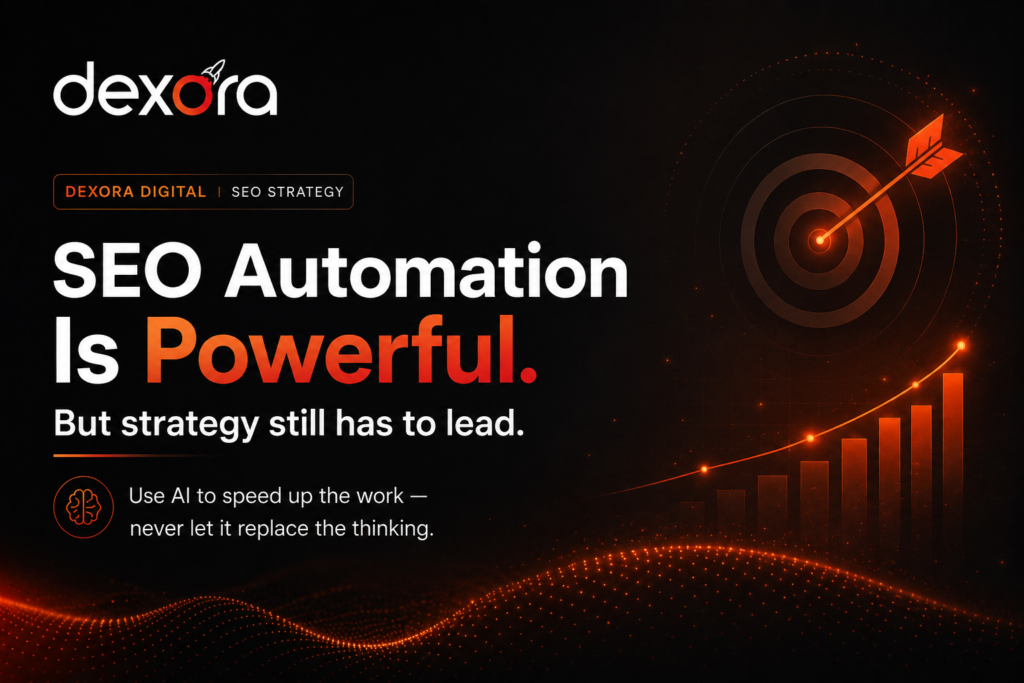
Use AI to make your thinking sharper. Use automation to move faster. But never let either one replace the thinking.
Summary — The Key Points
→ SEO automation adds real value in data gathering, pattern identification, monitoring, and content research — when driven by a skilled strategist.
→ Automation without strategic judgment produces faster execution of the wrong decisions — which often costs more to fix than it saved in time.
→ Understanding a specific business, its market, and its customers is not something any tool can replicate. That judgment is where SEO results actually come from.
→ CRO is not separate from SEO — it is built into every well-executed SEO campaign. Traffic without conversion is cost without return.
→ The safest path is always the manual, strategy-led approach supported by automation — not the automated approach supported by occasional human review.
ABOUT THE AUTHOR
Taqweem Ahmad
Founder, Dexora Digital | Local SEO & AI Search Strategist
Taqweem Ahmad is the founder of Dexora Digital, a full-stack SEO and AI Search Optimization agency serving businesses across the USA, UK, Australia, and Canada. Over 7 years and 500+ audits, he has helped companies rank on Google, dominate Google Maps, and get cited in ChatGPT and Perplexity.
Frequently Asked Questions
Q: Is SEO automation worth it for small businesses?
A: Automation is worth it for specific tasks — rank tracking, crawl monitoring, GSC data analysis, and content research efficiency. It is not worth it as a replacement for SEO strategy. Small businesses especially need a clear strategy before they automate anything, because automating the wrong approach at scale makes things worse, not better.
Q: What is the difference between automated SEO and manual SEO?
A: Automated SEO uses tools and systems to execute tasks without direct human involvement — content generation, rank tracking, link monitoring, reporting. Manual SEO involves a strategist making judgment calls about what to prioritize, how to structure a campaign, what content to create, and how to interpret data in the context of a specific business. The best approach combines both: automation for efficiency, manual judgment for strategy.
Q: Can AI replace an SEO strategist?
A: No. AI can speed up research, surface patterns in data, and generate first drafts — all of which make a skilled SEO strategist more effective. It cannot replace the business understanding, market reading, and judgment that determine whether an SEO strategy will actually generate revenue for a specific company in a specific market. The tool is only as good as the strategist directing it.
Q: Why is CRO considered part of SEO?
A: Because traffic without conversion has no business value. SEO decisions about page structure, title tags, content depth, and trust signals directly affect both search rankings and conversion rates simultaneously. A page optimized only for rankings that does not convert visitors into leads or sales is not delivering SEO results — it is delivering traffic reports. The best SEO campaigns are built with conversion in mind from the first page structure decision.
Q: How do I know if my SEO agency is using automation correctly?
A: Ask them to walk you through a strategic decision they made recently — not just what tools they used, but why they made a specific choice for your business over another option. A good agency using automation correctly will be able to explain the reasoning behind every significant recommendation. An agency relying on automation to replace strategy will give you template answers about tools and reports but struggle to connect their work to your specific business goals.

Local SEO and AI Search (AEO & GEO) Specialist.
Building search visibility that converts into qualified demand.
Today, businesses need visibility on Google Maps and AI powered search and websites that actually convert visitors into leads. I am a Local SEO, AI Search & Conversion Rate Optimization (CRO) Specialist with 5+ years of hands on experience helping businesses turn underperforming websites into high converting growth engines. My work combines Local SEO, Technical SEO, Semantic SEO, GEO/AEO, and conversion focused landing page optimization to ensure brands are discoverable and profitable.
My Experience
I have delivered SEO and web growth projects across the US, UK, Australia, Canada, Finland, Germany, and the Czech Republic, working in industries such as local businesses (electrician, hvac, cleaning, Real estate, healthcare, B2B, eCommerce, SaaS, and environmental services.
Some Results
>> 200+ websites audited globally
>> specifically worked with 100+ local business (80% from USA)
>> 80+ websites improved through technical SEO & schema fixes
>> 20+ businesses featured in Google AI Overviews (SGE)
>> Multi million impression growth for eCommerce & SaaS brands
Book Free Consultation: calendly.com/dexora/30min