




A civil engineering firm in the Southeast ranks #3 on Google for “site development engineer [city].” Real rankings, real traffic, a decade of work behind them.
Their business development lead asked ChatGPT a question a prospective client might ask: “who does stormwater design and permitting for commercial sites in [city]?”
ChatGPT named two firms. Neither was theirs.
This is happening across the engineering industry right now, and it isn’t a fluke of one prompt. It’s the predictable result of five structural gaps almost every engineering website shares — gaps that Google’s ranking system has learned to work around, and that AI answer engines have not. We built our AI SEO for engineering firms service specifically to close them, and this article walks through exactly what that means in practice.
The buyer changed before the marketing did
A decade of SEO trained engineering firms to chase a page-one ranking. That was the finish line. A prospective client typed a query, scanned ten blue links, opened three, and called the one that looked most credible.
That behavior is splitting in two. A growing share of the same searches — “structural engineer for a warehouse retrofit,” “who does arc flash studies near me,” “geotechnical report for a land development permit” — now happen inside ChatGPT, Gemini, or an AI Overview instead of a search results page. And an AI answer doesn’t return ten links. It names one or two firms and moves on.
Ranking #3 on Google still puts a firm in the consideration set. Being absent from an AI answer means the firm was never considered at all — the searcher never saw a list to scroll past. This is the core distinction our AI search optimization work is built around: traditional rank and AI recommendation are correlated, not identical, and a firm can win one while losing the other entirely. It’s also the exact problem our AI SEO for engineering firms service was purpose-built to solve, rather than treating engineering firms like any other local business.
A worked example: two firms, same discipline, opposite outcomes
Picture two structural engineering firms, both licensed in the same state, both roughly the same size, both with fifteen years of real project history.
Firm A has a single “Structural Engineering Services” page describing itself as offering “comprehensive structural solutions.” No schema. Its project history lives in a 30-page capabilities PDF emailed to prospects on request. It has a handful of generic directory listings and no association memberships listed anywhere on the site.
Firm B has separate pages for structural inspection, foundation repair, seismic retrofit design, and forensic engineering — each one naming the actual codes and standards it works to. Its five strongest projects are published as standalone pages with location, scope, and outcome. It carries Organization and Service schema sitewide. It’s listed on its state licensing board and its NSPE chapter page, both linking back to its site.
Ask ChatGPT “who does seismic retrofit design for masonry buildings in [their state]” and Firm B is the answer, not because its engineers are better — there’s no evidence either way — but because Firm B is the only one of the two that gave an AI system anything specific, structured, and independently confirmed to work with. Firm A may still outrank Firm B for a branded search. It has functionally ceased to exist for the unbranded, high-intent query that actually produces a project inquiry.
This is the gap our full AI SEO for engineering firms page is built to close, discipline by discipline.
The five gaps behind almost every invisible engineering site
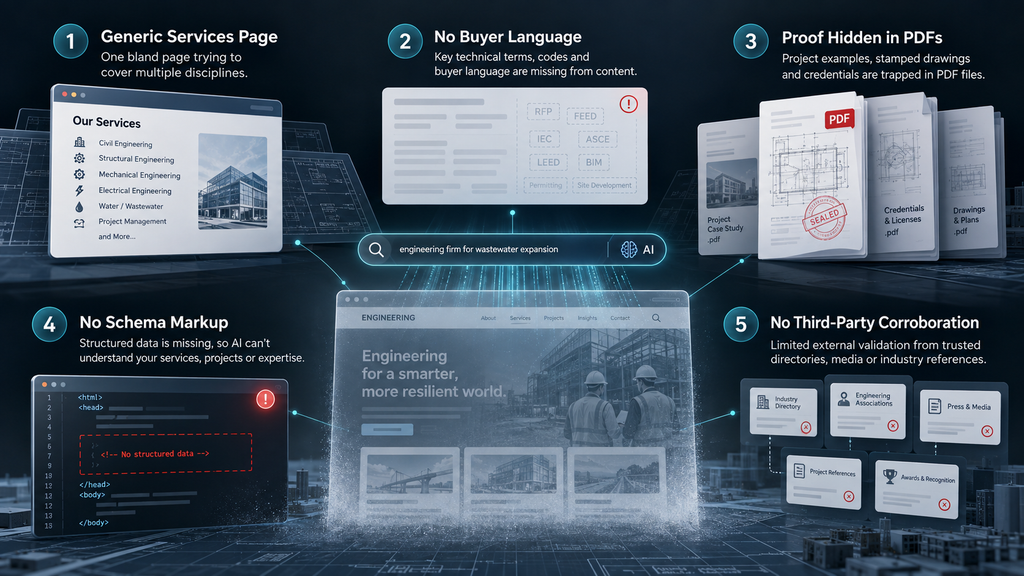
We diagnosed this exact pattern across dozens of engineering websites while building out the framework behind our AI SEO for engineering firms service. The same five gaps show up, in some combination, nearly every time.
1. One generic “Services” page covering every discipline. A firm doing electrical, civil, structural, and MEP work often has a single page listing all four in a bulleted list. That page can rank for the firm’s own name. It cannot rank — or get cited — for “arc flash study” or “grading plan for permit,” because it never actually answers either question in enough depth for a retrieval system to quote it. Splitting that page into real, individually authoritative discipline pages is usually the single highest-leverage fix on the list, and it’s the starting point of nearly every technical SEO engagement we run for an engineering client.
2. No content written in the language buyers and codes actually use. Engineering buyers don’t search “quality engineering services.” They search “NERC compliance,” “IEEE 1547,” “Phase I ESA,” “PLC programming,” “foundation repair engineer.” A site that never uses this vocabulary in its own words gives an AI system nothing specific to match the query against — we go deep on exactly which terms matter, by discipline, in our companion article on the standards language engineering buyers actually search, and the full discipline-by-discipline keyword list lives on our AI SEO for engineering firms page.
3. Projects and credentials buried in PDFs. The strongest proof a firm has — completed projects, stamped drawings, case studies, licenses — often lives only inside downloadable PDFs. Most AI crawlers and retrieval systems don’t reliably extract and index PDF content the way they index a normal web page. The best evidence on the site is functionally invisible; we cover exactly how to fix this in why your best engineering projects are invisible to AI search.
4. No schema markup, so AI tools can’t confirm what the firm does or where. Structured data (Organization, Service, LocalBusiness schema) is how a machine confirms, rather than guesses, your name, services, and service area. Without it, an AI system is inferring from unstructured paragraphs — and inference is exactly where firms drop out of consideration. Our full breakdown of which schema types matter most is in schema markup for engineering firms.
5. Almost no third-party corroboration. Industry directories, association listings, press mentions, and case studies published by other credible sources all function as outside confirmation that a firm actually does what its own website claims. Most engineering firms have plenty of client relationships and almost no visible trail of them anywhere but their own site — see why third-party links matter more than ever for engineering AI visibility for how to start closing that gap.
Why this isn’t a content problem you fix with more blog posts
The instinct, once a firm notices the gap, is to write more. More articles, more service pages, more volume. Volume alone doesn’t close any of the five gaps above — a hundred generic posts on a site with no schema and no discipline-specific pages still gives AI systems nothing new to extract or verify.
The fix is structural: split the generic services page into real, individually authoritative pages per discipline; write in the standards language buyers search; move credentials and project history out of PDFs and onto crawlable pages; add schema; and build a visible trail of third-party corroboration. This is the exact rebuild we ran for a structural and civil engineering firm — see the full engineering business growth case study — that went from 0 to 70 Ahrefs Domain Rating, from zero ranked keywords to 879, and now shows up with 8,119 AI citations a month across Bing Copilot alone, with 179 pages cited directly by ChatGPT, Gemini, and Google AI. That firm now ranks #1 for a genuinely technical query — “POI interconnection engineering support” — and gets cited in AI Overviews for substation design, power system studies, and NERC compliance content specifically.
None of that came from writing more. It came from closing these five gaps, deliberately, in order — the same order and framework laid out on our AI SEO for engineering firms page. The same underlying approach — entity clarity, first-party evidence, and third-party corroboration working together rather than one alone — is what carried a very different type of business through a comparable transformation in our Australian digital agency AI search case study, which is worth a look if you want to see the same framework applied outside engineering specifically.
What “authoritative” actually means to an AI system
It’s worth being precise about this, because “authority” gets used loosely in marketing conversations. For a traditional search engine, authority leans heavily on backlinks and domain history. For an AI system deciding what to cite, authority is closer to verifiability: can this specific claim be confirmed, cross-checked, and traced back to something concrete? A page that says “we’ve completed over 200 substation projects” is a claim. A page that names three of them, with location, scope, and the standard they met, is evidence. The first is marketing copy. The second is exactly the kind of self-contained, quotable material AI systems are built to extract and cite.
This is also why authority compounds across a site rather than living on one page. A firm with five discipline pages, each backed by real project evidence, schema markup, and outside corroboration, reads as a coherent, verifiable entity. A firm with one strong page and four thin ones reads as inconsistent — and inconsistency is what pushes an uncertain AI system toward a competitor it can verify more easily. This is precisely the standard every page in our AI SEO for engineering firms framework is built to meet before it’s considered finished.
How long this actually takes, gap by gap
Worth being honest about pacing, because “AI SEO” gets sold as either instant or magical, and it’s neither. Schema markup — gap four — is typically the fastest, often live within weeks since it’s a technical addition rather than new content. Splitting a generic services page into discipline pages — gap one — and rewriting in standards language — gap two — usually takes a focused month or two of research and writing, discipline by discipline, not all at once. Moving project history out of PDFs — gap three — scales with how much history exists; five strong rebuilt project pages beat forty half-converted ones. Third-party corroboration — gap five — is the slowest, because it depends on licensing boards, associations, and outside publications rather than anything you control directly, and it’s worth starting in parallel with the on-site work rather than waiting until it’s “done.”
Full AI citation volume, the kind Keentel Engineering now sees at 8,119 citations a month, compounds over 6 to 12 months once all five gaps are closed and reinforcing each other — not from any single fix in isolation.
What actually closes the gap
Start with an honest audit: which of the five gaps above does your site actually have? Most firms have three or four, not all five. Fixing the wrong one first wastes months. A free AI visibility audit is the fastest way to find out which ones apply to your site specifically, rather than guessing from a generic checklist.
From there, the sequence that works: build (or split into) discipline-specific pages using the actual technical and code language your buyers search; pull your strongest project evidence out of PDFs and onto real pages; add Organization, Service, and LocalBusiness schema so AI systems can confirm what you do and where; then invest in the third-party mentions — industry directories, association listings, published case studies — that corroborate it. This entire process, and how each piece fits together, is what our AI SEO for engineering firms page walks through in full, alongside our companion piece on generative engine optimization for engineering companies. When you’re ready to talk through what this looks like for your specific firm, our consultation page is the place to start.
FAQ
Why does my engineering firm rank on Google but not show up in ChatGPT?
Google ranking and AI answer visibility are related but separate systems. A site can be technically well-optimized for Google while still missing the discipline-specific content, schema markup, or third-party corroboration that AI systems rely on to select and cite a source.
Do I need a separate page for every engineering discipline?
In most cases, yes. A single combined “Services” page can rank for your firm’s own name, but it rarely contains enough specific, standards-based content to be cited for a technical query like “arc flash study” or “geotechnical report.”
Does keeping project history in PDFs actually hurt AI visibility?
Yes — PDF content is inconsistently crawled and indexed compared to standard web pages. Your strongest proof points (completed projects, credentials, stamped work) should also exist as real, crawlable page content, not only as downloads.
What’s the fastest of the five gaps to fix?
Schema markup is usually the fastest — it’s a technical addition, not a content-production project, and it directly helps AI systems confirm your name, services, and service area.
How long does it take to see AI citations after fixing these gaps?
Technical fixes (schema, crawlability) can take effect within 2-3 months. Building real AI citation volume — as opposed to just being crawlable — typically takes 6-12 months of consistent, standards-based content and third-party corroboration.
Can a small or niche engineering firm compete with larger firms in AI search?
Often, yes, more easily than in traditional rankings. AI systems reward depth and specificity on a narrow discipline over general size or brand recognition — a firm with genuinely authoritative content on, say, substation design can out-cite a much larger generalist firm for that specific query.
Is this just SEO with a new name?
It shares the same foundation — crawlability, content quality, technical health — but adds requirements traditional SEO never needed: structured data AI systems can parse, and content written to be directly quotable, not just rankable.
Do AI citations actually turn into project inquiries?
In the case we reference above, yes — the same firm that gained 8,119 monthly AI citations also saw a corresponding jump in Google impressions (3.34M) and referring domains (506), consistent with genuine visibility growth rather than an isolated metric.
What does “authority” actually mean to an AI system, versus a traditional search engine?
Traditional search leans on backlinks and domain history. AI systems weigh verifiability more heavily — specific, checkable claims (named projects, standards met, credentials) extract and cite more reliably than general statements of expertise.
Where can I see the full framework this article is built around?
Our AI SEO for engineering firms page covers the complete service — the five gaps, the fix for each, real case study data, and discipline-by-discipline keyword coverage — and is the best starting point before requesting an audit.
By Taqweem Ahmad | Founder, Dexora Digital