
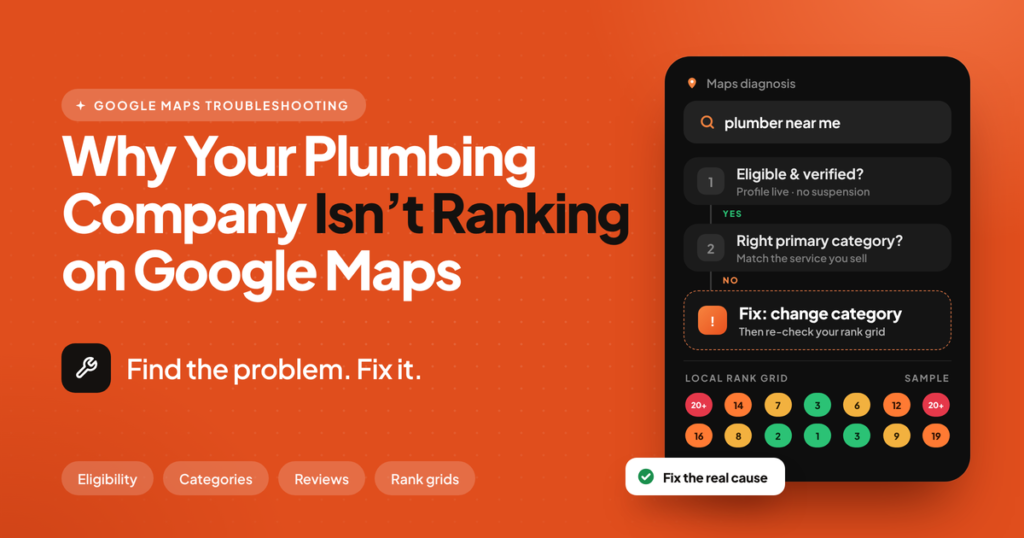
Your plumbing company may not be ranking on Google because of an unverified or restricted Google Business Profile, incorrect business categories, proximity to searchers, weak local relevance, limited reviews, or problems with your website.
For sewer repair and drain-cleaning companies, the problem can be even more specific: Google may understand that you operate a plumbing business without clearly understanding which specialized services you provide.
Imagine a homeowner in Dallas searching for “emergency drain cleaning near me.” Your company offers the service, answers emergency calls, and serves that neighborhood. Yet three competitors appear on Google Maps while your business is nowhere to be found.
That does not necessarily mean your company needs a new website or hundreds of backlinks.
First, you need to identify what’s preventing your business from appearing.
This guide explains how to diagnose why your plumbing company isn’t ranking on Google, how to fix common Google Maps visibility problems, and how to measure whether those improvements generate more service calls.
Quick Diagnosis: Why Isn’t My Plumbing Business Showing Up on Google?
Start by identifying the actual problem before making changes.
| What you’re experiencing | Possible cause | First action |
|---|---|---|
| Business doesn’t appear even when searching its exact name | Verification, suspension, eligibility, or listing issue | Check Business Profile status |
| Business appears for its name but not “plumber near me” | Relevance, distance, prominence, or competition | Review categories and local competitors |
| Ranks near its office but disappears in nearby cities | Distance and geographic competition | Check location-based rankings |
| Ranks for plumbing but not sewer repair | Weak service-specific relevance | Review sewer repair services and website pages |
| Website pages aren’t appearing in organic results | Indexing, canonical, or content problems | Inspect URLs in Search Console |
| Maps visibility is good but calls are low | Conversion, contact, or search-demand issues | Review profile interactions and call handling |
| Rankings dropped after a profile edit | Possible profile changes, reverification, or other factors | Check profile notifications and status |
Important: Google Maps rankings and traditional website rankings are related but different. A plumbing company can have indexed website pages and still struggle to appear in the local map pack.
1. Your Google Business Profile Isn’t Verified or Has Restrictions
Before investigating keywords or backlinks, confirm that your business is eligible to appear on Google and that its profile is functioning normally.
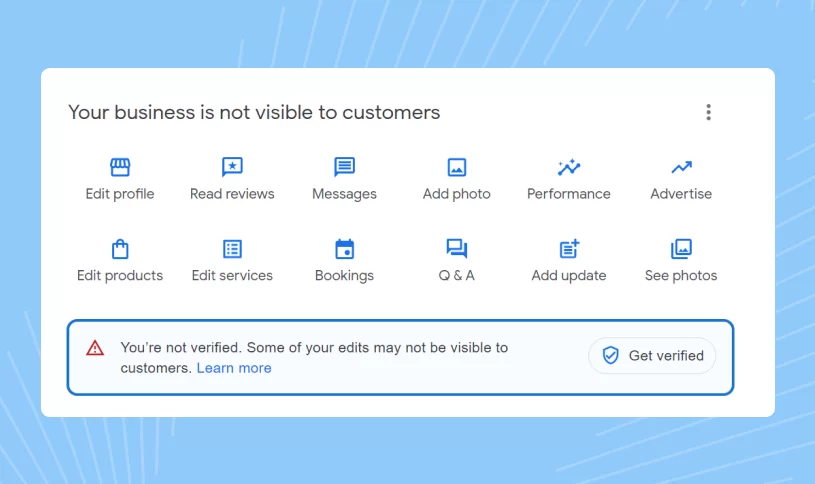
Google Business Profile is the system businesses use to manage their information on Google Search and Maps.
If your profile is unverified, suspended, disabled, or otherwise restricted, ordinary SEO improvements may not address the immediate problem.
How to check your plumbing company’s profile
- Sign in to the Google account that manages your business.
- Search Google for your business name or “my business.”
- Open your Business Profile management options.
- Check for verification requests, restrictions, and account notifications.
- Confirm that the business name, website, phone number, and location information are accurate.
If Google requests verification, follow the verification method offered for your business.
The available methods may vary. Google may require evidence showing that the company operates from the stated location and that you are authorized to manage it.
What if your plumbing profile is suspended?
A suspended profile needs a policy and eligibility review.
Common areas to investigate include:
- Business names containing promotional keywords
- Addresses that do not represent legitimate business operations
- Duplicate profiles
- Ineligible virtual offices
- Incorrect service-area configurations
- Business details that cannot be verified
Review Google’s official Business Profile guidelines before making changes.
If an appeal is appropriate, use Google’s designated process and provide genuine supporting evidence.
Do not create another profile simply to bypass a suspension. That can create further problems.
2. Your Plumbing Business Category Doesn’t Match What Customers Search

Google needs to understand what your business actually does.
One of the first fields to review is the primary Google Business Profile category.
For a conventional plumbing company, “Plumber” will often be the appropriate primary category.
However, the correct choice depends on your actual core business and the categories currently available in Google.
A company primarily performing sewer and drain work should evaluate whether its existing categories accurately represent those services.
Example: General plumbing versus drain cleaning
Consider two companies.
Company A: A full-service plumbing contractor offering leak repair, water heaters, pipe replacement, sewer repair, and drain cleaning.
Company B: A specialized company primarily providing drain clearing, hydro jetting, sewer inspections, and sewer line repairs.
Both may serve similar customers, but their primary business focus differs.
Their profiles and websites should accurately reflect that distinction.
How to fix category problems
Review your primary category and any additional categories.
Use categories that describe services the company genuinely provides. Do not select unrelated categories to capture more searches.
Then check that the business description, service fields, and website explain your actual work.
For example, a drain-cleaning specialist might describe clogged kitchen drains, main sewer line blockages, sewer camera inspections, and hydro jetting if those services are genuinely available.
Adding services does not guarantee rankings for every related query. It helps provide clearer information about the business.
3. You’re Trying to Rank Too Far From Your Actual Business Location
One of the most frustrating problems for plumbing contractors is ranking in one neighborhood but disappearing a few miles away.

This often happens because distance is a major component of Google’s local ranking system.
A plumbing company based in one part of Houston may have strong visibility near its operating location but face stronger competition in distant neighborhoods.
Even if you serve the entire Houston metropolitan area, Google does not necessarily rank you equally across it.
Why adding more service areas doesn’t solve the problem
Adding Dallas, Plano, Frisco, McKinney, and Richardson to a Business Profile does not automatically make the business rank in every city.
Service-area settings tell customers where you operate. They do not override the geographic considerations used in local ranking.
Google allows service-area businesses to specify relevant cities, postal codes, or other supported areas, subject to its guidelines.
What should plumbers do instead?
Focus on legitimate geographic coverage.
First, evaluate where your business already has visibility. Then identify the nearby communities where your services are relevant but your online presence is weak.
Improve your website’s service-area information and build useful location pages when you have meaningful local content.
Do not rent virtual offices or create fake business locations to manipulate proximity.
If your company has multiple genuine operational locations with separate staff and service areas, review Google’s eligibility requirements before creating additional profiles.
4. Your Service-Area Business Address Is Configured Incorrectly
Many plumbing companies operate from a home office, warehouse, or dispatch location and travel to customers.

Google distinguishes between storefront businesses, service-area businesses, and hybrid businesses.
If customers do not visit your business at its address, your profile should generally be configured as a service-area business with the address hidden from public display.
Example: A plumber operating from home
Suppose a plumbing contractor runs the company from a residential address in Tampa.
Technicians travel to homes and commercial properties, but customers do not visit the residence.
That company should not display the home address as a customer-facing storefront.
Instead, it should follow Google’s service-area business requirements.
Can hiding your address hurt your rankings?
Hiding an address is not inherently a ranking penalty.
It is a compliance requirement for businesses that do not receive customers at their location.
The business still has a real operating location relevant to geographic ranking considerations.
Google’s service-area documentation explains how to configure these settings.
Avoid this mistake: Do not display a private home address or create a fake storefront solely because competitors appear to have visible addresses.
5. Your Competitors Have Stronger Local Prominence
You may have a verified profile, accurate categories, and a legitimate location but still rank below other plumbing companies.

One possible reason is prominence.
Google considers information about businesses from across the web, including reviews and links.
A well-established local contractor may have stronger online recognition than a newer company.
How to evaluate competing plumbers
Search for the services you provide from several locations within your actual service territory.
Compare relevant competitors on:
- Business category and service focus
- Review count and overall rating
- Recent customer feedback
- Quality of their service pages
- Relevant local website mentions
- Clarity of contact and service information
- Proximity to the search location
Do not assume that the company with the most reviews will always rank first.
Google uses multiple signals, and competitors may be closer or more relevant to a particular search.
How to improve your local authority
Start with legitimate business relationships.
If your company belongs to a local chamber of commerce, trade association, or recognized industry organization, ensure your membership information is accurate.
Manufacturer partnerships, community involvement, relevant local publications, and useful industry resources can also create legitimate opportunities for mentions and links.
Avoid buying large quantities of irrelevant backlinks.
A sustainable strategy builds genuine business credibility rather than artificial signals.
6. Your Plumbing Company Doesn’t Have Enough Genuine Customer Reviews
Reviews matter for both local search visibility and customer decisions.

Google identifies review quantity and positive ratings among factors that can contribute to local prominence.
For homeowners dealing with an overflowing toilet or a blocked sewer line, reviews can also help determine which company they trust.
What a healthy review strategy looks like
Build a repeatable process that requests feedback after completed jobs.
For example:
- Finish the plumbing service.
- Confirm that the customer understands the work performed.
- Send a neutral review request.
- Provide a direct link to your review profile.
- Respond professionally to feedback.
Ask customers for their honest experience, not a five-star rating.
Do not offer discounts or gifts in exchange for Google reviews.
Should reviews mention plumbing keywords?
Customers may naturally mention services such as drain cleaning, sewer repair, or water heater replacement.
That context can help prospective customers understand what the business does.
However, do not script keyword-rich reviews or pressure customers to include city names.
Authenticity is more important than manipulating review language.
What if you have fewer reviews than competitors?
Focus on creating a consistent process rather than collecting a large number all at once.
Review volume alone cannot explain every ranking difference.
Also examine relevance, geographic location, and the strength of competing businesses.
7. Your Website Doesn’t Clearly Explain Your Plumbing Services
A common problem is having a single generic services page that mentions everything the company does.

For example:
We provide residential and commercial plumbing, repairs, drain cleaning, water heaters, and emergency services.
That statement may be accurate, but it provides little detail for a homeowner researching a specific problem.
It also leaves important search intents insufficiently addressed.
Build dedicated pages for important services
Consider separate pages for your genuine core offerings.
| Service | Example customer search |
|---|---|
| Drain cleaning | drain cleaning company near me |
| Sewer line repair | sewer repair company in [city] |
| Emergency plumbing | emergency plumber near me |
| Water heater repair | water heater repair [city] |
| Hydro jetting | hydro jetting service near me |
| Sewer camera inspection | sewer line camera inspection [city] |
| Leak detection | plumbing leak detection [city] |
These are illustrative search phrases, not verified monthly search-volume estimates.
What makes a useful sewer repair page?
A strong sewer repair page should explain the problems customers experience and the services the company actually provides.
For example:
Common warning signs
- Multiple drains backing up
- Recurring sewer odors
- Gurgling plumbing fixtures
- Slow drainage throughout the property
- Wastewater returning through floor drains
Diagnostic process
Explain how a qualified technician evaluates the issue, including when a sewer camera inspection may be appropriate.
Available repair methods
Describe the company’s actual capabilities, which may include localized pipe repairs, traditional excavation, or trenchless methods.
Customer expectations
Explain how estimates are prepared, what factors affect the scope of work, and what happens after a customer requests service.
Avoid guaranteeing that every sewer problem can be solved without excavation.
For businesses focused on this specialty, explore Dexora Digital’s SEO for sewer and drain cleaning companies to understand how specialized service visibility can be approached.
8. Your City Pages Are Too Similar or Lack Local Evidence

Many plumbing companies publish location pages such as:
- Plumber in Dallas
- Plumber in Plano
- Plumber in Frisco
- Plumber in McKinney
Location pages are not inherently problematic.
The issue arises when every page contains essentially the same text with a different city name.
These pages may fail to provide useful local information and can resemble doorway pages if created primarily to funnel search traffic to the same destination.
What should a useful plumbing city page contain?
A strong city page can include:
- The plumbing services genuinely available in that city
- Relevant service coverage and scheduling information
- Examples of completed local work, where available
- Real customer feedback associated with the area
- Common plumbing issues relevant to the local housing stock
- Accurate business contact information
- Links to relevant service pages
For example, an established plumbing company serving older neighborhoods might explain the types of pipe problems its technicians commonly encounter there, supported by real experience.
A company serving newer developments might focus on services it genuinely performs in those properties.
Do not invent local jobs, neighborhoods served, customer reviews, or office locations.
How many city pages should you create?
There is no universal number.
Create pages where the business has legitimate coverage and enough useful information to justify a separate page.
A smaller number of genuinely helpful location pages is generally preferable to hundreds of repetitive pages.
9. Your Plumbing Website Has Indexing or Technical SEO Problems
A plumbing company can publish excellent service pages that generate little organic traffic if search engines cannot properly access or index them.


Google Search Console is the starting point for diagnosing these issues.
Step 1: Check whether important pages are indexed
Open Google Search Console and inspect the URLs of your main plumbing services.
Prioritize pages such as:
- Homepage
- Emergency plumbing
- Drain cleaning
- Sewer repair
- Water heater repair
- Primary service-area pages
Use URL Inspection to review indexing status and Google’s selected canonical URL.
Step 2: Look for technical blockers
Common problems include:
Accidental noindex directives: Pages intended to rank may be marked not to appear in search results.
Incorrect canonical tags: A service page may identify another URL as its preferred version.
Broken internal links: Important pages may be difficult for visitors and crawlers to discover.
Redirect errors: Old service URLs may redirect incorrectly or lead to errors.
Server problems: Repeated availability issues can interfere with crawling.
Duplicate or low-value pages: Multiple URLs may compete to provide essentially the same information.
Step 3: Improve the mobile experience
Plumbing customers often search from mobile devices, particularly during urgent situations.
Check that your website loads reliably, displays contact information clearly, and makes calling easy.
Compress oversized images, reduce unnecessary scripts, and test your most important service pages.
Step 4: Request indexing after meaningful fixes
Once a technical problem is corrected, use Search Console to request indexing when appropriate.
Google does not guarantee immediate crawling or indexing.
Repeatedly requesting indexing without fixing the underlying problem is unlikely to help.
10. Your Plumbing Business Has Inconsistent Online Information
Customers may encounter your company through Google Maps, your website, industry directories, and other local platforms.

If those sources contain different phone numbers, business names, or outdated addresses, potential customers may struggle to identify the correct company.
Audit important citations
Review relevant listings such as:
- Google Business Profile
- Bing Places
- Apple Business Connect
- Established local business directories
- Relevant industry associations
- Legitimate manufacturer or contractor directories
Correct old phone numbers, outdated websites, and duplicate records where possible.
For service-area businesses, maintain consistent legitimate business details while respecting each platform’s address-privacy requirements.
Do citations directly control Google Maps rankings?
There is no public Google formula assigning a fixed ranking value to citation consistency.
Accurate listings support customer trust and a consistent business identity.
They should be part of a broader local SEO strategy, not treated as a guaranteed ranking shortcut.
11. You’re Measuring Google Maps Rankings From Only One Location
Searching “plumber near me” from your own office provides a limited view of your visibility.

Google’s local results vary according to the search location and other factors.
Your business might rank well near its base but poorly across the wider service area.
How local rank-grid tracking works
A local rank grid checks a chosen keyword from multiple geographic points.
For example, a plumbing company serving a metropolitan area might track “drain cleaning near me” from several locations across its real service territory.
This helps identify where the business is more or less visible.
What should you measure?
Track separate searches for important services.
For example:
- Plumber near me
- Emergency plumber
- Drain cleaning
- Sewer line repair
- Water heater installation
Compare rankings over time using consistent locations and search terms.
Do not treat a single rank-grid snapshot as definitive proof of business performance.
Search results can fluctuate, and grid-tracking tools approximate what users may see.
How to interpret the results
If rankings are strong near your business location but weaker farther away, distance and local competition may be important constraints.
If your business ranks for general plumbing but not drain cleaning, review service relevance and competing businesses.
If visibility declines everywhere, investigate profile status, website changes, competition, and other possible causes.
12. You’re Getting Visibility but Not Enough Plumbing Calls
Sometimes the ranking problem is actually a conversion problem.

A plumbing company may receive impressions, website visits, and Business Profile interactions without generating enough booked work.
Common conversion problems
Calls go unanswered. Emergency plumbing customers may contact another contractor if they cannot reach your team.
The website hides the phone number. Customers should not have to search through multiple pages to find contact information.
Forms are too complicated. A simple service request form is often more useful than a long questionnaire.
Service availability is unclear. Customers need to know whether you handle emergencies, residential work, commercial work, or specialized sewer problems.
The page doesn’t match the search. Someone searching for sewer line repair should reach a relevant service page rather than a generic homepage whenever practical.
Track qualified leads, not just rankings
Use Google Search Console to measure organic search performance.
Use Business Profile performance data to review available interactions.
Use analytics and properly configured call tracking to understand website enquiries.
Then connect those enquiries to actual appointments or completed jobs where your systems allow.
A practical reporting dashboard might include:
| Metric | What it tells you |
|---|---|
| Local map visibility | Where the business appears across its territory |
| Organic clicks | How much Google Search traffic reaches the website |
| Business Profile interactions | How customers interact with the profile |
| Qualified calls | How many relevant enquiries reach the business |
| Booked plumbing jobs | How many enquiries turn into appointments |
| Revenue attributed to organic/local search | Commercial contribution, subject to attribution limitations |
The ultimate goal is not simply more visibility. It is more relevant customers contacting your business.
Why Is My Sewer Repair Company Not Ranking on Google?
Sewer repair companies often face an additional challenge: their websites emphasize general plumbing services while their most valuable work involves specialized problems.

A homeowner may search for “sewer line replacement,” “main sewer line clog,” or “trenchless sewer repair” rather than simply “plumber.”
If your website does not adequately explain those services, it may fail to satisfy the searcher’s specific needs.
Improve sewer repair relevance
Start with your main sewer service page.
Explain which sewer problems you diagnose, the repair methods you actually offer, and how customers can request an inspection.
Use original project photographs when available.
Describe real diagnostic procedures, equipment, and limitations without making unsupported claims.
Connect the sewer repair page to related content about drain cleaning, sewer camera inspections, hydro jetting, and emergency plumbing where relevant.
Improve Google Maps ranking for sewer repair
Review whether your Business Profile accurately represents the company and its core services.
Then evaluate competitors ranking for sewer repair queries from your actual operating area.
Look for differences in service focus, proximity, reviews, and website content.
Remember that Google Maps ranking for sewer repair is not determined by the number of times you repeat “sewer repair” on a page.
It depends on multiple local ranking considerations.
Improve local search ranking for drain cleaning companies
Drain-cleaning companies should clearly distinguish their services from general plumbing where appropriate.
A dedicated drain-cleaning page might explain kitchen drain blockages, bathroom drain problems, main line obstructions, and when professional inspection is required.
Include the methods the company actually uses.
If you provide hydro jetting or camera inspections, explain when those services may be appropriate and when they may not be suitable.
This creates useful content for customers rather than a page built around keyword repetition.
Google My Business Optimization for Sewer Repair Companies
Although the product is now called Google Business Profile, some business owners still search for “Google My Business optimization for sewer repair.”
The underlying process is the same: ensure your business is eligible, verified, accurate, and clearly represented.
Use this practical checklist:
- Confirm profile verification and eligibility.
- Choose categories that accurately describe the business.
- Configure the real business location and service area.
- List genuine sewer repair and drain-cleaning services.
- Maintain accurate operating and emergency hours.
- Add original photographs of relevant work.
- Request genuine customer reviews.
- Keep website and contact information current.
- Review available performance data.
- Monitor local visibility from relevant search locations.
No individual checklist item guarantees a ranking improvement. Together, they provide a sound foundation for local search visibility.
Your 30-Day Plumbing Google Maps Recovery Plan
If your plumbing company is struggling to rank, prioritize the highest-impact problems rather than changing everything at once.
Week 1: Diagnose visibility and eligibility
Check Business Profile verification, restrictions, categories, address configuration, and service areas.
Record your current visibility for important searches from multiple locations.
Inspect the indexing status of your main service pages.
Week 2: Fix business information and service relevance
Correct inaccurate profile information.
Update your main plumbing, sewer repair, and drain-cleaning pages with useful, factual details.
Repair broken contact forms, incorrect phone links, and major technical issues.
Week 3: Strengthen trust and local content
Introduce a consistent review-request process.
Correct important outdated citations.
Add genuine project examples and local service information where available.
Improve internal links between relevant service pages.
Week 4: Measure and refine
Compare profile interactions, organic search performance, and qualified enquiries with your baseline.
Review local rankings using the same geographic points and keywords.
Identify remaining gaps and prioritize the next improvements.
This is a 30-day implementation plan, not a guarantee that Google Maps rankings will recover within 30 days.
Competitive improvements may require ongoing work over several months.
When Should You Hire a Local SEO Specialist for Your Plumbing Business?
Some problems can be resolved internally.
Updating business hours, correcting contact information, and requesting honest customer reviews are manageable tasks for many plumbing companies.
Professional assistance may be useful when:
- Your Business Profile has complex eligibility or suspension problems.
- You cannot identify why competitors consistently outrank you.
- Important plumbing pages are not indexed.
- Your website has extensive technical SEO issues.
- You serve several cities and need a structured content strategy.
- You want to connect SEO reporting with qualified calls and booked jobs.
- Previous SEO work has created duplicate pages or questionable backlinks.
A reputable SEO provider should begin with diagnosis rather than promising a top-three Google Maps position.
The right recommendations depend on your company’s actual location, services, competition, and website condition.
For a broader understanding of local search strategy, read our guide to local SEO for plumbers.
Frequently Asked Questions
Why is my plumbing company not ranking on Google?
Common reasons include an unverified or restricted Google Business Profile, incorrect categories, geographic distance, strong competitors, limited reviews, weak service relevance, and website problems. Diagnose the specific issue before making changes.
Why is my plumbing business showing on Google but not Google Maps?
A business may appear in organic website results without ranking prominently in Google Maps. Local results use relevance, distance, and prominence, while website search results operate through broader organic ranking systems.
How do I get my plumbing company into the Google Maps top three?
Start with a verified, compliant Business Profile, accurate categories, genuine reviews, relevant service pages, and consistent business information. Improve local authority and track visibility across your service area. No provider can guarantee a top-three position.
Why does my plumbing company rank in one city but not another?
Distance and competition are common explanations. Google evaluates the location of the searcher and the businesses relevant to the query. Listing additional service areas does not guarantee equal visibility in every city.
Can I rank a plumbing company on Google Maps without a storefront?
Yes, eligible plumbing companies that visit customers can use service-area Business Profiles. Businesses that do not receive customers at their address should generally hide that address and configure accurate service areas.
Why is my sewer repair company not ranking on Google?
Your business may lack clear sewer repair service information, face stronger competitors, have limited local prominence, or experience technical website issues. Review both Google Business Profile relevance and your sewer-specific website content.
Do Google reviews help plumbing companies rank?
Google confirms that review quantity and positive ratings can contribute to local prominence. Reviews also help customers evaluate a company. Businesses should request genuine feedback without incentives or manipulation.
Does adding more cities to my Google Business Profile improve rankings?
Not automatically. Service areas communicate where a business operates, but local rankings still depend on multiple factors, including distance and competition.
How long does it take to improve plumbing Google Maps rankings?
It depends on the underlying problem. Correcting a profile restriction is different from building competitive local visibility. Some changes may be reflected relatively quickly, while broader SEO improvements may take months.
Should I create separate pages for drain cleaning and sewer repair?
Yes, when they represent distinct services your business actually offers and each page provides substantial, useful information. Avoid creating near-duplicate pages that target slightly different keywords without serving different customer needs.
Conclusion: Find the Real Problem Before Spending More on SEO
If your plumbing company isn’t ranking on Google Maps, don’t assume the answer is buying backlinks, adding keywords to your business name, or creating dozens of city pages.
First, determine whether your profile is eligible and verified. Then investigate relevance, distance, prominence, service-page quality, indexing, reviews, and actual customer enquiries.
For sewer repair and drain-cleaning businesses, clearly explaining specialized services is especially important.
A strong local SEO strategy makes your business easier to understand, easier to find, and easier to contact.
Get a Free Plumbing SEO Audit From Dexora Digital
Not sure what’s preventing your plumbing company from appearing in Google Maps?
Dexora Digital helps US service businesses investigate local SEO, technical website issues, service-area content, and search visibility.
Request Your Free Plumbing SEO Audit
Share your website and the locations you serve so the review can focus on your actual business needs.