


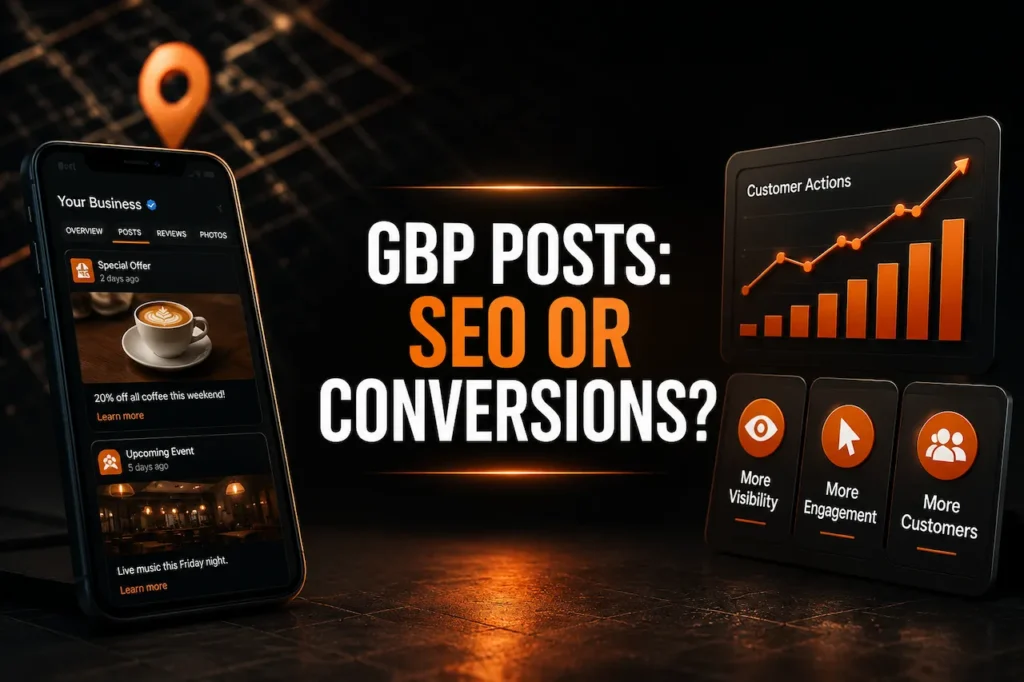
Google Business Profile posts SEO is often treated like a simple formula. Post every day, stay active, and Google will reward the profile with higher Maps rankings. That sounds convenient. It is also more confident than Google’s own documentation supports.
Google clearly encourages businesses to use posts to share updates, offers, events, photos, and useful customer information on Search and Maps. Google also explains that these posts can help customers decide whether to visit or engage with a business. What Google does not say is that publishing more frequently directly improves local rankings.
At Dexora Digital, I separate ranking evidence from conversion value. Google Business Profile posts can absolutely be useful. They can keep offers visible, support customer decisions, promote events, communicate recent changes, and make a profile more useful. But businesses should not confuse usefulness with a confirmed ranking boost.
What Google Has Actually Said About Posts as a Ranking Factor
The strongest place to start is Google’s own local ranking documentation. Google says local search results are mainly determined by relevance, distance, and prominence. Relevance measures how closely a Business Profile matches the search. Distance considers how far the business is from the searcher. Prominence reflects how established or well known the business appears.
Google also specifically mentions several actions that can improve the quality of a Business Profile. It recommends keeping information accurate. It recommends verifying the business. It encourages responding to reviews. It recommends adding photos and videos. It explains that more reviews and positive ratings can help local ranking.
What is missing from that ranking explanation is important. Google does not say:
Publishing daily posts improves rankings. Posting three times each week increases relevance. Adding keywords to every post expands Maps visibility. Publishing more frequently increases prominence.
This is why Google Business Profile ranking factors should be separated into confirmed signals and useful profile features.
Google Describes Posts as Customer Communication
Google’s current documentation describes Business Profile posts as a way to share:
- Business updates
- Offers and promotions
- Events
- Photos and videos
- Current information
- Action buttons that send customers to useful pages
Google specifically says that seeing recent updates on a Business Profile can help customers decide whether to visit a business. That is a conversion benefit. It is not the same as Google saying the post creates a ranking benefit.
This distinction is critical because many local SEO strategies waste time optimizing features for rankings when their real value is customer engagement.
Posts Can Appear Directly on Search and Maps
Business Profile posts can appear in areas such as the Updates or Overview sections on mobile and the From the Owner section on desktop. Google can also feature certain event, deal, or special posts more prominently on mobile. That means a customer who already discovers the business may see timely information without visiting the website first.
For example, a restaurant can promote a seasonal menu. A dentist can announce new appointment availability. A roofing company can communicate storm response services. A tennis club can promote an upcoming event. A retailer can highlight an offer. That can influence what the customer does next. The value is real even without a direct ranking effect.
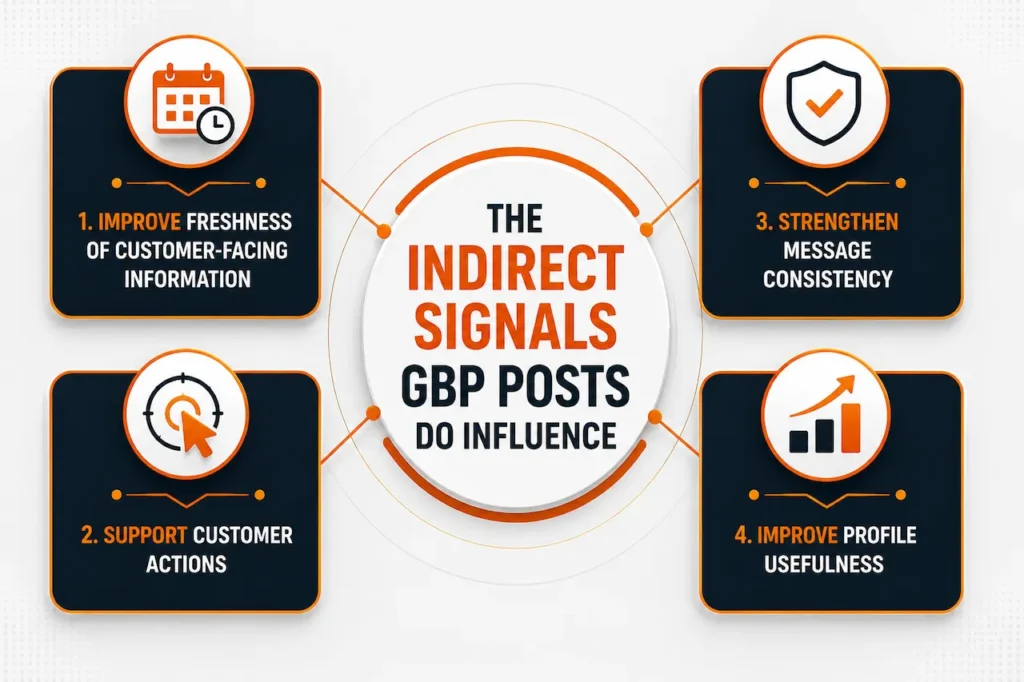
The Indirect Signals GBP Posts Do Influence
The phrase indirect ranking signal is often overused.
If a feature increases engagement, that does not automatically mean Google feeds that engagement back into the Maps algorithm.
There is no need to invent that connection.
A better framework is to look at what GBP posts clearly influence at the customer and profile level.
Posts Improve the Freshness of Customer-Facing Information
Freshness here means current business information, not a confirmed ranking freshness signal. Google says posts allow businesses to share up-to-date information and improve customer experience. That is useful when something changes. A holiday schedule changes. A promotion launches. An event is approaching. A service becomes temporarily available. A seasonal product returns.
A business has a major announcement. The Business Profile now contains recent information that may help the customer make a decision. This supports a healthier Google Business Profile optimization strategy even if the post itself does not move rankings.
Posts Can Support Customer Actions
Posts can contain action buttons directing customers to pages where they can learn more, book, order, or complete another action. That creates clear conversion opportunities. Consider a dental practice publishing an offer for teeth whitening. The customer may already be evaluating several nearby practices. The promotion does not need to improve the ranking to create value.
The customer discovers the profile. Sees the offer. Clicks through. Books. That is a successful GBP post.
Posts Can Strengthen Message Consistency
Google says Business Profile information can be sourced from the business itself, public web content, third-party sources, users, and Google’s own interactions with places. A well-managed profile should therefore reinforce the same real business represented on the website. Suppose an HVAC company starts offering heat pump installation. Its website has a new service page.
The Business Profile services are updated. A post announces the service. Recent customer reviews begin mentioning heat pumps. That creates a coherent customer-facing information environment. Do not call that proof of a special posting ranking factor. Call it strong entity and message consistency.
Posts Can Improve Profile Usefulness
Google Business Profile performance reporting includes metrics such as views, searches, and interactions with the profile. A useful post can contribute to a better profile experience. But businesses should avoid making the next unsupported leap:
More interaction equals higher Maps rankings. Google does not publicly confirm that formula.
A strong local SEO guide should distinguish between improving customer experience and manipulating ranking signals.
Do GBP Posts Affect Ranking?
The most accurate answer is:
Google does not publicly confirm Business Profile posting frequency as a direct local ranking factor. That does not mean posts are useless. It means the reason for using them should be correct.
If someone asks whether daily posting guarantees improved Google Maps ranking, the answer should be no. If someone asks whether useful GBP posts can help turn profile visitors into customers, the answer is yes.
What Matters More for Maps Rankings
If your primary objective is higher local visibility, I would prioritize stronger confirmed and well-supported areas before increasing post frequency.
These include:
- Correct primary and additional categories
- Complete and accurate Business Profile information
- Genuine customer reviews
- Review quality and sustained review acquisition
- Strong website relevance
- Local authority and prominence
- Accurate business location information
- Appropriate service area setup
- Strong local citations and web references
- Competitive proximity
Google’s documentation specifically connects local ranking with relevance, distance, prominence, reviews, ratings, links, and complete business information. This is why local SEO ranking factors matter more than trying to hit an arbitrary posting schedule.
If your Google Maps visibility is weak because the wrong category is selected, posting every morning will not solve the underlying issue. If your competitors have dramatically stronger prominence, daily offers will not erase that difference.
If your business is twenty miles away from the searcher, posting frequency does not change your physical location.
A Posting Cadence That Is Actually Worth the Time
There is no Google confirmed ideal posting frequency. The correct cadence depends on whether the business has useful information worth publishing. For many small businesses, one or two meaningful updates each week can be enough. Some businesses may need less. Others with frequent promotions, events, inventory changes, or seasonal activity may benefit from more.
The important question is not:
How often can we post? Ask:
How often do we have something useful to tell customers?
Use a Sustainable Cadence
A practical monthly approach might include:
- One important company update
- One useful service or product post
- One offer when a legitimate promotion exists
- One event or seasonal post when relevant
- Additional posts only when the business has real news
A restaurant may naturally publish more frequently because menus, specials, and events change often.
A custom home builder may have fewer time-sensitive updates.
A lawyer may publish only when there is a useful business announcement, event, or service message.
The cadence should reflect the business.
Stop Treating Posting Like a Streak
Some businesses become worried when they miss a week. There is no evidence that breaking a daily posting streak causes a Google Maps ranking drop. Posting should not become administrative busywork. I would rather publish four strong posts in a month than thirty repetitive posts saying:
Call us today. We are the best. Contact our team. Get a free quote.
Those posts provide almost no new information. A healthy local SEO services strategy should prioritize work according to expected business impact.
What to Post on Google Business Profile
Good posts usually have a clear reason to exist.
They tell customers something new, useful, timely, or commercially relevant.
Posts Worth Publishing
Useful ideas include:
- New services
- Important service updates
- Seasonal offers
- Genuine discounts
- Events
- New products
- New locations
- Holiday hours reminders
- Major business announcements
- Completed project highlights
- Educational customer tips
- Appointment availability
- Seasonal preparation advice
- New booking options
- Important changes customers need to know
These posts help the profile communicate with customers.
They also give the business a reason to use photos, videos, and action buttons naturally.
Use Original Media When Possible
Google allows photos and videos in Business Profile posts and recommends professional, useful content rather than low-value or distracting material. Real media is often stronger than generic stock graphics. A contractor can show completed work. A restaurant can show a current dish. A dentist can show the practice. A retailer can show a new product.
A fitness business can show an event. Authenticity supports conversion.
Connect Posts With Real Landing Pages
If a post promotes a specific service, send the customer to the relevant service page. Do not send every post to the homepage. A roofing repair post can lead to the roof repair service. An event can lead to the registration page. An offer can lead to the relevant booking page. This creates a clearer customer journey.
Good internal linking on the website can then help the visitor continue exploring related information after they arrive.
What to Skip
Some GBP posts create work without creating meaningful customer value.
Avoid content that exists simply because someone said the profile must look active.
Skip These Posting Habits
Avoid:
- Repeating the same sales message every few days
- Stuffing city and service keywords unnaturally
- Publishing irrelevant generic marketing tips
- Posting low-quality AI-generated filler
- Copying blog introductions without adapting them for profile users
- Creating fake urgency
- Publishing offers that do not actually exist
- Repeating the business name unnecessarily
- Treating every post as a ranking experiment
Google itself advises businesses to avoid misspelled, distracting, auto-generated, or low-value post content.
The standard should be usefulness.
Do Not Keyword Stuff GBP Posts
There is no need to write:
“Best Plumber Dallas Emergency Plumbing Dallas Drain Cleaning Dallas Water Heater Repair Dallas.”
A real customer does not want to read that. Write naturally. If the service and location belong in the message, mention them. If they do not, do not force them.
Google Maps optimization should not make customer-facing content worse.
Where GBP Posts Fit in a Complete Local SEO Strategy
Business Profile posts should sit lower in the priority hierarchy than many foundational local SEO tasks. First, make sure the profile is eligible and accurate. Then verify categories. Review the business name. Check the address or service area. Strengthen customer reviews. Improve website content. Fix local citations. Build authority.
Improve Google Maps ranking coverage. Then use posts as an ongoing customer communication and conversion layer. This does not make posting unimportant. It gives posting the correct job.
The Correct Hierarchy
Think of the process like this:
Profile eligibility first. Profile accuracy second. Relevance and prominence development next. Review velocity local SEO and reputation work alongside those efforts. Website and local authority support the entity. Posts then help communicate what is happening now. This is much more sustainable than trying to use GBP posts as a shortcut.
The strongest permission marketing local SEO Google Business Profile strategy respects the customer’s attention. A post should earn attention by containing something worth seeing.
Frequently Asked Questions
Do Google Business Profile posts help SEO?
Google does not publicly confirm GBP posting frequency as a direct local ranking factor. Posts can still support customer communication, offers, events, profile usefulness, and conversion opportunities. Do GBP posts affect ranking?
Google’s official local ranking guidance focuses mainly on relevance, distance, and prominence.
It specifically mentions reviews, ratings, links, and complete business information, but it does not identify posting frequency as a direct ranking factor.
How often should I post on Google Business Profile?
There is no official ranking-based frequency. Publish whenever you have useful updates, offers, events, service information, or customer-facing news. For many active businesses, one or two meaningful weekly posts can be a practical cadence.
Is daily GBP posting necessary?
No. Google does not state that daily posting is required to rank. Publishing repetitive content every day can consume time without delivering meaningful customer value.
Do keywords in GBP posts improve Maps rankings?
Google does not publish a rule saying keywords in posts directly improve local rankings. Use natural language that accurately describes the update rather than stuffing keywords into customer-facing copy.
What should businesses post on Google Business Profile?
Useful posts can include offers, events, service updates, new products, completed projects, seasonal messages, appointment availability, and important business announcements.
Do Google Business Profile posts expire?
Google currently says posts older than six months are archived unless a date range has been specified. Event and offer posts can operate according to their configured dates.
Are GBP posts more useful for SEO or conversions?
Their clearest documented value is customer communication and conversion support. Google says posts provide current information and can help customers decide whether to visit or engage with a business. Their role as a direct local ranking factor is not confirmed.
Turn Your Google Business Profile Into a Better Conversion Asset
Google Business Profile posts should not be treated as a daily ranking ritual. Their real strength is helping customers see current offers, services, events, project activity, and useful reasons to choose your business.
Dexora Digital helps businesses improve Google Business Profile performance through local SEO services, review strategy, profile optimization, Maps visibility analysis, website relevance, local authority, and conversion-focused profile management.
If you are posting consistently but your Maps visibility is still weak, the problem may be categories, reviews, proximity, prominence, website relevance, or another part of the local search system. Book a consultation to identify which local SEO signals deserve priority and where your Google Business Profile strategy needs improvement.

Local SEO, Website Design & AI Search (AEO/GEO) Specialist.
Building search visibility that converts into qualified demand.
Today, businesses need visibility on Google Maps and AI-powered search, plus a website that actually converts visitors into leads. I’m a Website Design, Local SEO, AI Search, and Conversion Rate Optimization (CRO) Specialist with 7+ years of hands-on experience helping businesses turn underperforming websites into high-converting growth engines. My work combines website design and redesign, Local SEO, Technical SEO, Semantic SEO, AEO/GEO, and conversion-focused landing page optimization to make sure brands are both discoverable and profitable.
My Experience
I have delivered SEO and web growth projects across the US, UK, Australia, Canada, Finland, Germany, and the Czech Republic, working in industries such as local businesses (electrician, hvac, cleaning, Real estate, healthcare, B2B, eCommerce, SaaS, and environmental services. I also delivered 1000+ SEO audits delivered globally.
Some Results
>> 100+ local businesses ranked in Google Maps (80% from USA)
>> 80+ websites improved through technical SEO & schema fixes
>> 50+ businesses cited in ChatGPT and Google AI Overviews
>> Multi-million impression growth for eCommerce & SaaS brands
>> 200+ websites developed
Book Free Consultation: calendly.com/dexora/30min