




Updated: August 27, 2026
A successful SEO campaign in 2026 requires much more than publishing content and waiting for rankings. Search engines have become more competitive, user behavior has changed, and AI-powered search experiences are transforming how businesses are discovered online. Companies need a structured approach that connects technical SEO, content strategy, authority building, AI visibility, and conversion optimization.
The goal of a modern SEO campaign is not only to increase website traffic. A successful campaign should attract the right audience, improve search visibility, generate qualified leads, increase revenue opportunities, and build long-term brand authority. Every optimization decision should support measurable business outcomes.
At Dexora Digital, we build SEO campaigns as complete growth systems. By combining traditional SEO with AEO and GEO strategies, businesses can improve visibility across Google Search, AI Overviews, and emerging AI search platforms while creating a stronger foundation for sustainable growth.
What Is an SEO Campaign?
An SEO campaign is a structured process designed to improve a website’s search visibility and achieve specific business objectives.
Unlike random SEO activities, a campaign follows a planned system that includes:
- Business goal identification
- Market and competitor research
- Technical improvements
- Keyword and search intent analysis
- Content creation and optimization
- Internal linking
- Authority building
- Conversion optimization
- Performance tracking
A strong SEO campaign connects every activity to a business goal.
For example:
A local service company may focus on:
- Increasing phone calls
- Improving Google Maps visibility
- Ranking for high-intent local searches
A SaaS company may focus on:
- Increasing qualified organic traffic
- Building topical authority
- Generating demo requests
An ecommerce brand may focus on:
- Growing category visibility
- Increasing product discovery
- Improving revenue from organic search
The best SEO campaigns are not focused only on rankings. They focus on creating measurable business growth.
SEO Campaign vs SEO Strategy: What Is the Difference?
SEO strategy and SEO campaigns work together, but they are not the same.
An SEO strategy defines the long-term direction:
- Which markets to target
- Which audiences matter
- Which keywords create opportunities
- Which growth channels should be prioritized
An SEO campaign turns that strategy into execution:
- What improvements will be made
- When tasks will be completed
- How performance will be measured
A strategy answers:
“Where should we go?”
A campaign answers:
“How will we get there?”
Businesses need both to create consistent SEO growth.
The 9-Step Framework Behind a Winning SEO Campaign
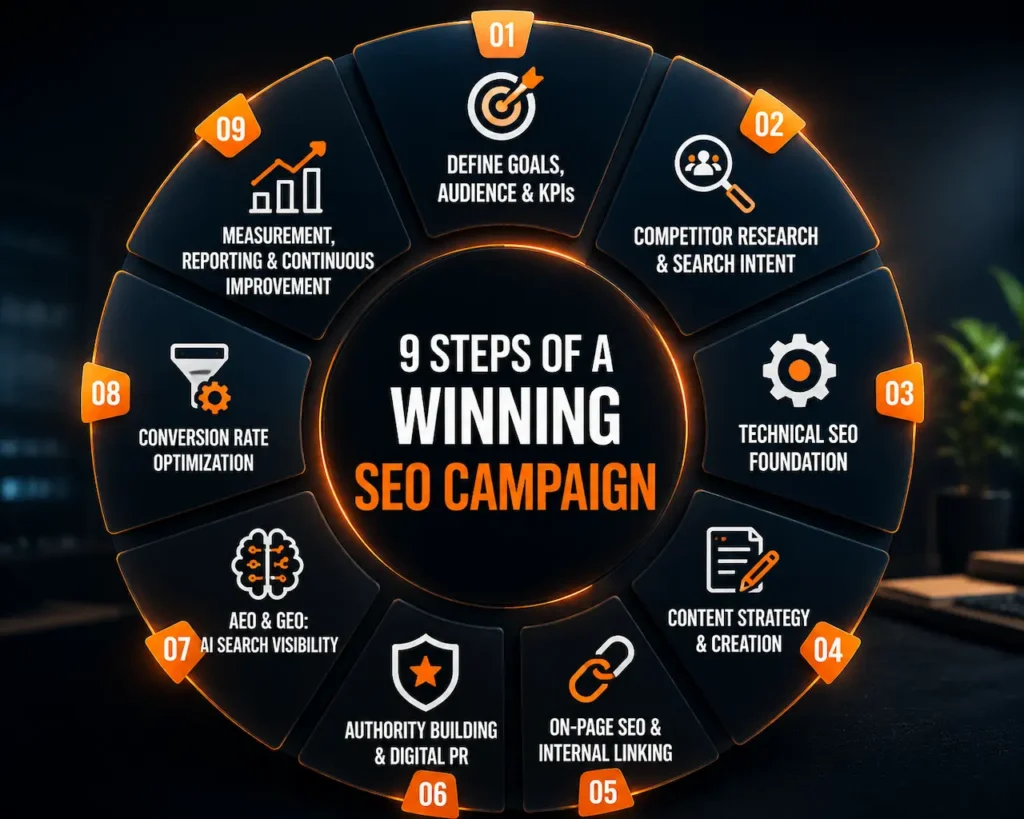
1. Define Business Goals, Audience, and KPIs
The first step of any successful SEO campaign is understanding the business.
Before making changes, analyze:
- Business objectives
- Target customers
- Main services or products
- Geographic markets
- Current website performance
- Existing competitors
A campaign without clear goals often becomes a list of disconnected SEO tasks.
Important SEO KPIs include:
- Organic traffic growth
- Qualified leads
- Revenue generated from search
- Conversion rate
- Non-branded keyword visibility
- Search impressions
- AI search visibility
Rankings are useful indicators, but they are not the final goal.
A keyword ranking increase only matters when it contributes to business results.
A detailed SEO audit helps identify technical issues, content opportunities, authority gaps, and conversion problems before building the campaign roadmap.
2. Competitor Research and Search Intent Analysis
SEO is a competitive process.
Your website does not rank in isolation. It competes against pages already receiving visibility, traffic, and authority.
A strong SEO campaign analyzes:
- Which competitors rank for important keywords
- Their content structure
- Their service pages
- Their backlink profile
- Their internal linking strategy
- Their topic coverage
- Their strengths and weaknesses
The purpose is not copying competitors.
The purpose is finding opportunities.
A proper competitor analysis identifies:
- Missing topics
- Weak competitor pages
- Underserved search intent
- New content opportunities
A content gap analysis helps businesses discover valuable topics and keywords competitors already capture but the website does not cover.
Search intent mapping is also critical.
Every keyword should have a clear purpose:
Informational Intent
Users looking for answers.
Examples:
- What is SEO?
- How does technical SEO work?
Commercial Intent
Users comparing solutions.
Examples:
- Best SEO agency
- SEO services for businesses
Transactional Intent
Users ready to take action.
Examples:
- Hire SEO company
- Book SEO consultation
Each intent requires a different page type.
3. Build a Strong Technical SEO Foundation
Technical SEO creates the foundation that allows search engines to properly crawl, understand, and index a website.
A winning campaign reviews:
- Website architecture
- Crawlability
- Indexing issues
- XML sitemaps
- Canonical URLs
- Redirects
- Broken links
- Mobile performance
- Core Web Vitals
- JavaScript rendering
- Website security
A website can have excellent content but still struggle if technical issues prevent search engines from accessing important pages.
A complete technical SEO service focuses on finding and fixing technical barriers that limit organic performance.
Structured Data and Search Understanding
Structured data helps search engines understand website information.
Common schema types include:
- Organization
- Article
- Service
- LocalBusiness
- FAQ
Schema helps clarify relationships between:
- Businesses
- Services
- Content
- Locations
However, structured data is not a ranking shortcut.
It works best when combined with:
- Helpful content
- Strong authority
- Good user experience
- Accurate information
Proper schema markup for SEO implementation helps search engines better understand important website elements.
4. Build a Commercial Content Strategy
A winning SEO campaign requires more than publishing regular blog posts.
Content should have a clear purpose:
- Capture valuable search demand
- Support commercial pages
- Answer customer questions
- Build topical authority
- Improve AI visibility
- Create conversion opportunities
The strongest SEO campaigns build a connected content ecosystem where service pages, educational resources, case studies, and supporting articles strengthen each other.
Create Content Based on Business Intent
Every piece of content should have a clear role.
Service Pages
Service pages target users who are closer to making a decision.
They should explain:
- What the service provides
- Who needs it
- The process
- Benefits
- Differentiators
- Results
- FAQs
- Clear calls-to-action
Examples:
- SEO services
- Technical SEO
- Local SEO
- AI search optimization
Industry and Location Pages
Businesses targeting specific markets should create dedicated pages for important audiences and locations.
Examples:
- SEO for law firms
- SEO for dentists
- SEO for SaaS companies
- Local SEO services in specific cities
These pages should not be created only by replacing city names or industries.
High-performing pages include:
- Industry challenges
- Specific solutions
- Relevant examples
- Customer-focused information
- Internal connections to supporting content
Supporting Content and Topic Clusters
Supporting content helps establish topical authority.
Example:
Main topic:
SEO Campaign Strategy
Supporting topics:
- Technical SEO guide
- Keyword research strategy
- SEO reporting
- AI search optimization
- Content optimization
A connected content structure helps search engines understand expertise across a subject.
5. On-Page SEO and Internal Linking Strategy
Creating content is only one part of SEO.
Search engines also need to understand:
- What each page is about
- Which pages are most important
- How topics connect together
Important on-page optimization includes:
Title Tags and Meta Data
Every page should have:
- Clear SEO title
- Relevant meta description
- Search intent alignment
Titles should attract clicks while accurately representing the page.
Heading Structure
A strong content structure improves readability and understanding.
Use:
- One H1
- Clear H2 sections
- Supporting H3 sections
Headings should organize information naturally rather than simply adding keywords.
Internal Linking
Internal linking is one of the most overlooked parts of SEO campaigns.
A strong internal linking system helps:
- Users discover related content
- Search engines crawl important pages
- Build topical relationships
- Strengthen commercial pages
For example, businesses building a complete growth strategy can explore SEO services that combine technical optimization, content strategy, and authority building.
Internal links should:
- Use descriptive anchor text
- Point to relevant pages
- Support user journeys
- Connect supporting content with priority pages
Avoid:
- Generic “click here” links
- Random page connections
- Excessive exact-match anchors
6. Authority Building and Digital PR
Competitive SEO requires more than excellent content.
Search engines need signals that demonstrate trust and authority.
Authority-building strategies include:
Digital PR
Earn mentions through:
- Industry publications
- Expert contributions
- News coverage
- Research studies
Original Research
Unique data creates stronger authority signals.
Examples:
- Industry reports
- Surveys
- Market research
- Testing results
Partnerships and Brand Mentions
Relevant relationships can generate:
- Trusted mentions
- Referral traffic
- Brand awareness
- Authority signals
Case Studies and First-Hand Experience
Modern search increasingly values evidence.
Businesses should showcase:
- Real projects
- Challenges solved
- Processes followed
- Results achieved
Case studies demonstrate experience better than generic claims.
A strong SEO campaign should not only say:
“We know SEO.”
It should prove:
“We have successfully applied SEO strategies.”
7. SEO + AEO + GEO: Preparing for AI Search
Search behavior is changing.
Users are no longer only clicking traditional search results. They are asking AI systems questions and receiving summarized answers.
Modern SEO campaigns must consider:
- Google AI Overviews
- ChatGPT
- Perplexity
- Gemini
- Other AI search experiences
The goal is not replacing SEO.
The goal is expanding visibility.
Traditional SEO Foundation
AI systems still depend on strong SEO fundamentals:
- Crawlable websites
- Clear content structure
- Relevant information
- Authority signals
- Accurate business entities
Without these foundations, AI systems cannot confidently understand or recommend a brand.
Answer Engine Optimization (AEO)
AEO focuses on improving visibility when users ask direct questions.
Important practices include:
- Clear answers
- FAQ sections
- Structured formatting
- Question-based content
- Concise explanations
Example:
Instead of:
“SEO is important.”
Explain:
“SEO improves online visibility by helping search engines understand website content and connect businesses with relevant users.”
Generative Engine Optimization (GEO)
GEO focuses on improving how brands appear in AI-generated answers.
Important GEO signals include:
- Brand consistency
- Entity clarity
- Expert information
- Original insights
- First-party evidence
- Strong authority signals
Businesses should optimize for not only:
“Where do we rank?”
but also:
“How easily can AI systems understand and recommend us?”
Businesses can improve AI visibility through AI Search Optimization strategies designed for modern search environments.
GEO vs SEO: How They Work Together
SEO builds the foundation.
GEO expands visibility within AI-driven experiences.
A complete strategy combines:
SEO:
- Rankings
- Traffic
- Technical performance
AEO:
- Direct answers
- Question visibility
GEO:
- AI recommendations
- Brand mentions
- Entity understanding
Businesses can better understand this relationship through GEO vs AEO vs SEO analysis.
8. Conversion Rate Optimization (CRO)
Traffic is only valuable when it creates business results.
An SEO campaign should optimize the journey from visitor to customer.
Important conversion elements include:
- Clear calls-to-action
- Strong landing pages
- Trust signals
- Reviews
- Testimonials
- Case studies
- Simple forms
Different pages have different goals.
A blog article may encourage:
- Consultation requests
- Newsletter signup
- Resource downloads
A service page may focus on:
- Calls
- Quotes
- Bookings
SEO and CRO should work together.
Ranking more pages does not automatically create revenue if visitors cannot easily take action.
9. Measurement, Reporting, and Continuous Improvement
A successful SEO campaign does not end after implementation.
Search behavior changes, competitors improve, and Google continues updating how it evaluates content. Continuous measurement is required to understand what is working and where improvements are needed.
A proper SEO reporting system should connect:
SEO Activity → Search Visibility → User Engagement → Business Results
Track the Right SEO Metrics
Organic Visibility Metrics
Monitor:
- Keyword rankings
- Organic impressions
- Click-through rate
- Non-branded search growth
- Search visibility trends
These metrics show whether your website is becoming more visible.
Business Performance Metrics
SEO should ultimately support business growth.
Track:
- Qualified leads
- Revenue from organic traffic
- Conversion rate
- Cost per acquisition
- Sales opportunities generated
A website receiving traffic but generating no business results requires a different strategy.
Technical Health Metrics
Monitor:
- Indexed pages
- Crawl issues
- Core Web Vitals
- Broken links
- Page performance
Technical improvements should be continuously reviewed as websites evolve.
AI Search Visibility Metrics
Modern SEO campaigns should also monitor:
- Brand mentions in AI answers
- AI citations
- Entity visibility
- Search presence across AI platforms
The future of search is not only about ranking a page.
It is about becoming a trusted source across multiple discovery systems.
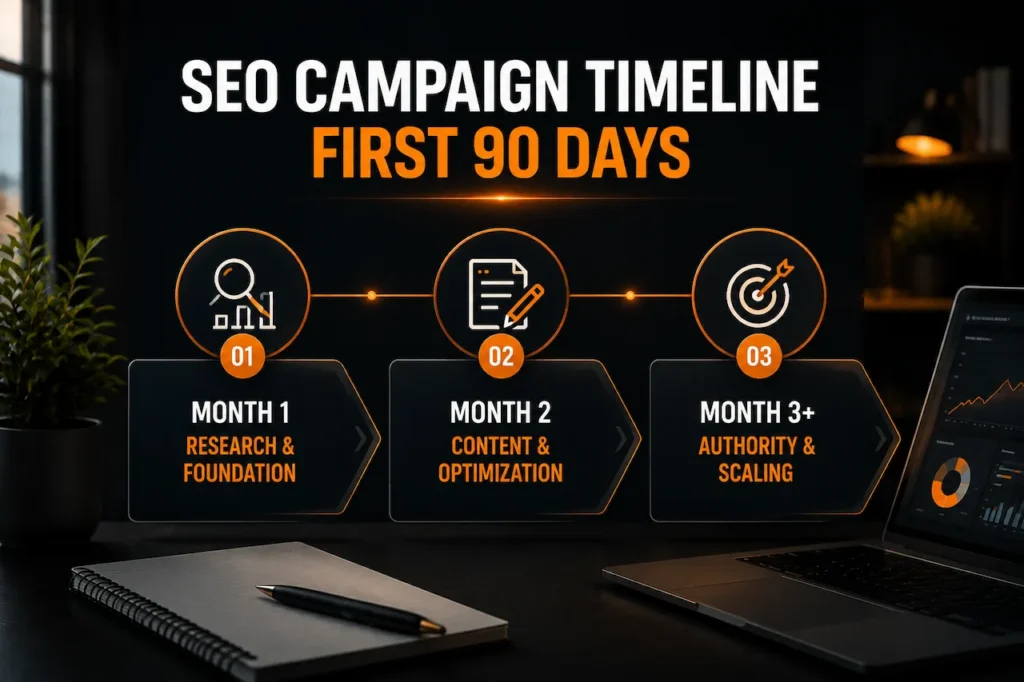
SEO Campaign Timeline: First 90 Days
SEO requires consistent execution. Results depend on:
- Website condition
- Competition
- Industry
- Authority
- Implementation quality
A typical campaign roadmap looks like this:
Month 1: Research and Foundation
The first month focuses on understanding opportunities and fixing critical issues.
Key activities:
Website Analysis
Review:
- Technical problems
- Indexing issues
- Existing rankings
- Content gaps
- Conversion barriers
Competitor Research
Analyze:
- Ranking competitors
- Keyword opportunities
- Content weaknesses
- Authority gaps
Technical Improvements
Implement:
- Crawl fixes
- Indexing improvements
- Internal linking updates
- Speed improvements
- Schema implementation
Strategy Development
Create:
- Keyword roadmap
- Content plan
- Internal linking structure
- Authority strategy
Month 2: Content and Optimization
The second phase focuses on improving relevance and search visibility.
Activities include:
- Creating new commercial content
- Updating existing pages
- Improving metadata
- Expanding service pages
- Building content clusters
- Strengthening internal links
Existing pages should also be reviewed.
Many websites already have ranking opportunities hidden in pages that:
- Receive impressions
- Rank on page two
- Have weak content depth
- Miss search intent
Improving existing content can often create faster results than publishing completely new pages.
Month 3+: Authority and Scaling
After the foundation is improved, campaigns focus on growth.
Activities:
- Digital PR
- Link acquisition
- Expert content
- New market expansion
- Conversion optimization
- AI search improvements
At this stage, SEO becomes a long-term growth channel.
Types of SEO Campaigns
Different businesses require different SEO approaches.
The strategy depends on:
- Business model
- Competition
- Audience
- Location
- Growth goals
Local SEO Campaigns
Designed for businesses serving specific locations.
Examples:
- Dentists
- Lawyers
- Contractors
- Restaurants
- Home service companies
Focus areas:
- Google Business Profile
- Reviews
- Local citations
- Location pages
- Local authority
Businesses targeting geographic markets can improve visibility through a dedicated Local SEO services strategy focused on Maps rankings and local customer acquisition.
National SEO Campaigns
Designed for businesses targeting customers across an entire country.
Focus areas:
- Competitive keyword targeting
- Large-scale content
- Topic authority
- Digital PR
- Strong backlink acquisition
Examples:
- SaaS companies
- National brands
- Online services
Ecommerce SEO Campaigns
Designed for online stores.
Focus areas:
- Product optimization
- Category pages
- Internal linking
- Technical SEO
- Conversion optimization
Enterprise SEO Campaigns
Designed for large websites with complex structures.
Focus areas:
- Scalable technical systems
- Large content databases
- Automation
- International SEO
- Platform optimization
Common SEO Campaign Mistakes
Even experienced businesses can waste resources when SEO campaigns lack proper planning.
1. Focusing Only on Rankings
Rankings are important, but they are not the final goal.
A successful campaign focuses on:
- Qualified traffic
- Leads
- Revenue
- Customer growth
2. Creating Content Without Strategy
Publishing more pages does not guarantee growth.
Content should support:
- Search intent
- Business objectives
- Customer journey
- Conversion goals
3. Ignoring Existing Content Opportunities
Many websites focus only on creating new content.
However, existing pages may already have:
- Search impressions
- Existing authority
- Ranking potential
Optimization can unlock faster improvements.
4. Weak Technical Foundation
Content cannot perform if search engines cannot properly:
- Crawl pages
- Understand content
- Index important URLs
5. Poor Internal Linking
Important pages should not exist alone.
A strong internal linking structure helps:
- Search engines discover pages
- Users navigate content
- Build topic relationships
6. Ignoring AI Search Evolution
Businesses focusing only on traditional rankings may miss future visibility opportunities.
Modern campaigns should prepare content for:
- Search engines
- Answer engines
- Generative AI systems
Frequently Asked Questions About SEO Campaigns
Q. What is an SEO campaign?
An SEO campaign is a structured process that improves search visibility through technical optimization, content strategy, authority building, and performance measurement.
Q. How long does an SEO campaign take?
The timeline depends on competition, website condition, authority, and goals. Many campaigns require several months before meaningful growth appears.
Q. What is included in an SEO campaign?
A complete SEO campaign may include:
- SEO audits
- Keyword research
- Competitor analysis
- Technical SEO
- Content optimization
- Internal linking
- Authority building
- Reporting
- CRO improvements
Q. How much does an SEO campaign cost?
SEO investment depends on:
- Website size
- Industry competition
- Number of target pages
- Content requirements
- Technical complexity
- Growth goals
A local business campaign and an enterprise campaign require different levels of resources.
Q. Can SEO replace Google Ads?
SEO and Google Ads serve different purposes.
Paid advertising provides immediate visibility, while SEO builds long-term organic growth.
Many businesses use both together.
Q. Why is competitor analysis important in SEO?
Competitor research reveals:
- Ranking opportunities
- Content gaps
- Authority differences
- Search intent patterns
It helps create a smarter campaign.
Q. Are backlinks still important for SEO?
Yes, but quality matters more than quantity.
Relevant authority links and brand mentions are more valuable than unrelated links.
Q. Does AI change SEO campaigns?
Yes.
Businesses now need content that is:
- Helpful
- Trustworthy
- Structured
- Supported by real expertise
Q. What tools are used in SEO campaigns?
Common tools include:
- Google Search Console
- Google Analytics
- SEO platforms
- Crawling tools
- Reporting dashboards
Q. What is the future of SEO?
SEO is moving toward broader search visibility.
Successful businesses will need:
- Strong rankings
- AI visibility
- Brand authority
- Clear expertise
- Trusted information
Build a Winning SEO Campaign With Dexora Digital
A successful SEO campaign requires a complete system, not isolated tactics.
The strongest campaigns combine:
- Technical SEO
- Content strategy
- Competitor research
- Authority building
- AI search optimization
- Conversion improvement
- Data-driven decisions
At Dexora Digital, we help US businesses build search strategies designed for modern search behavior — from traditional Google rankings to AI-powered discovery.
If your business wants to identify ranking opportunities, improve organic visibility, and build a stronger digital presence, start with a SEO consultation and discover the growth opportunities available for your website.