




AI search has changed how businesses think about website traffic. A visitor may discover a brand through ChatGPT, Google AI Overviews, Perplexity, or another AI experience before arriving on a website. The challenge is that many businesses cannot clearly identify where those visitors came from, leading to inaccurate reporting and missed opportunities.
I have seen companies look at an increase in direct traffic and immediately assume AI platforms are responsible. That conclusion is too simple. AI can influence customer journeys without producing a clearly identifiable referral. Accurate measurement requires separating AI impressions, citations, referral sessions, branded discovery, and AI-influenced conversions.
Why AI Traffic Tracking Is More Complicated Than Traditional Search
Traditional analytics was built around a relatively simple customer journey. Someone searched on Google, clicked a result, landed on a website, and analytics recorded the source.
AI search can create a much less direct path.
A customer might discover your company in ChatGPT, remember the name, search for the brand on Google two days later, and then convert. Another person might click a citation directly from Perplexity. Someone else may see your business in an AI-generated answer several times before eventually typing your domain into a browser.
These journeys can produce very different attribution data even though AI influenced all of them.
That is why businesses should track AI search visibility separately from ordinary website traffic. Visibility tells you whether AI systems are discovering and representing your brand, while referral analytics tells you whether those experiences generate identifiable website sessions.
The main AI measurement signals to separate are:
- AI impressions: Your content or brand appears within an AI-generated search experience.
- AI citations: An AI system references your website as a supporting source.
- AI referral traffic: Someone clicks a source or citation and lands on your website.
- AI-influenced conversions: AI contributes to discovery, but the customer converts later through another channel.
- Branded search growth: More people search specifically for your company after encountering it elsewhere.
This distinction matters because a brand can receive substantial AI exposure without seeing an equivalent increase in referral traffic.
Why Direct Traffic Should Not Automatically Be Called ChatGPT Traffic
One of the biggest attribution mistakes is treating unexplained direct traffic as evidence of ChatGPT visibility.
Direct traffic can contain many different types of sessions, including:
- Typed URLs
- Bookmarks
- Privacy-restricted referrals
- Untracked links
- Copy-and-paste visits
- Sessions where referral information was lost
- AI-influenced visits that occurred after an earlier discovery
Suppose a prospect sees your company recommended by an AI assistant but does not click anything. Three days later, that person remembers the company and types the URL directly.
GA4 can record the website visit, but the final session does not necessarily tell you about the earlier AI interaction.
The right conclusion is therefore not, “Direct traffic increased, so ChatGPT traffic increased.”
The better question is: “What combination of visibility, branded search, referrals, and conversion behavior changed during the same period?”
Understanding AI Impressions, Citations, Referrals and Conversions
AI traffic is not one metric. Businesses need a measurement model that separates different stages of discovery.
AI Impressions
AI impressions indicate that your information is being surfaced in an AI-driven search experience.
An impression does not necessarily mean someone visited your website. It can still have value because the user may read the answer, remember the brand, or encounter the business again later.
This is especially important when analyzing how Google AI Overviews impact SEO. Search visibility can influence discovery even when the customer does not immediately follow a traditional organic result.
AI Citations
A citation means an AI experience references a website or page as a supporting source.
Citation visibility can indicate that a platform recognizes the page as relevant to a particular question. But citations and clicks should not be treated as the same KPI.
A company could be referenced frequently while receiving relatively few visits. That does not automatically mean those citations have no value. They may contribute to recognition, trust, branded searches, or later conversions.
AI Referral Traffic
AI referral traffic is easier to identify because a user actually follows a link to the website.
Depending on the platform and environment, this can include traffic originating from:
- ChatGPT
- Perplexity
- AI assistants
- AI-powered browsers
- Other identifiable AI referral sources
Referral sessions should be analyzed by source, landing page, engagement, and conversion performance rather than counted as one generic “AI traffic” number.
AI-Influenced Conversions
This is where measurement becomes more valuable and more difficult.
The customer journey might look like:
AI discovery → brand recognition → branded Google search → website visit → lead
The final conversion could be attributed to organic search even though AI contributed to initial discovery.
For that reason, a broader generative engine optimization guide should consider both visibility and business outcomes rather than evaluating GEO success purely through referral clicks.
How to Track AI Traffic With GA4 and Google Search Console
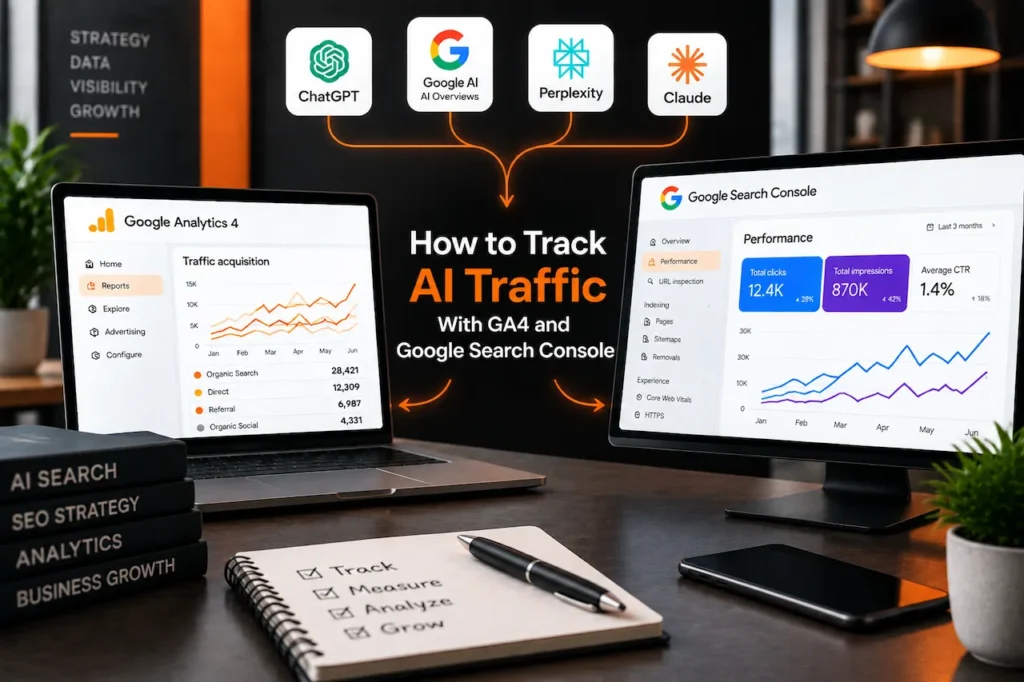
GA4 is useful for identifying referral sessions that reach the website, while Search Console provides another view of search visibility and query behavior. Neither should be treated as a complete AI attribution system on its own.
Tracking ChatGPT and Other AI Referrals in GA4
Start with GA4 acquisition data and investigate traffic sources rather than relying only on channel totals.
Review:
- Traffic acquisition reports
- Source and medium
- Referral sources
- Landing pages
- Engagement
- Key events and conversions
Look for identifiable AI-related sources and then compare their landing-page and conversion behavior.
Do not stop at session counts. If 100 AI referral sessions produce substantially stronger engagement or more qualified leads than 500 sessions from another channel, the smaller traffic source could be more commercially valuable.
UTM parameters can also help when you control the links used in campaigns, partnerships, or AI-focused distribution. However, they are not a complete solution because naturally generated AI citations will not necessarily contain your campaign parameters.
Measuring Perplexity Referrals
Perplexity presents an interesting measurement opportunity because citations are prominent within its answer experience.
When identifiable traffic arrives from those citations, analyze:
- Referral sessions
- Landing pages
- Engagement
- Conversion actions
- Pages attracting referrals
But ask two separate questions:
“Did Perplexity send visitors?”
and
“Did Perplexity recognize our expertise?”
Those questions measure different parts of the search journey.
Tracking Google AI Search Visibility
Google’s AI experiences require a broader analysis because an AI-generated answer can influence a searcher without necessarily generating a traditional click.
Search Console data should therefore be analyzed alongside your GA4 data. As search measurement evolves, businesses should pay close attention to Search Console reporting updates and avoid assuming that an individual analytics report represents the complete customer journey.
Compare changes across:
- Search impressions
- Clicks
- Important landing pages
- Branded queries
- Non-branded queries
- Devices
- Countries
- Dates and periods
The purpose is not to force every metric into an “AI traffic” category. It is to identify relationships.
For example, if visibility around a topic grows while branded searches, direct visits, and conversions also increase, you have a stronger signal worth investigating than direct traffic alone.
Measure Visibility Beyond the Click
AI search introduces a discovery stage that conventional last-click reporting can easily miss.
The journey can look like:
User asks an AI platform a question.
AI uses or references your information.
The user becomes familiar with your brand.
The user searches for the company later.
The user converts.
Traditional analytics may primarily capture the later stages.
This is why businesses trying to understand how to rank their site in AI search engines also need to measure whether increased AI visibility ultimately contributes to meaningful demand.
Building an AI Search Tracking and Measurement System
Individual reports are useful, but a repeatable measurement system is more valuable.
I recommend building an AI search dashboard that combines website analytics, search performance, AI visibility observations, and conversion data.
A useful dashboard can track:
- AI referral sessions
- AI citations
- AI or generative-search visibility
- Landing pages receiving AI-related exposure
- Brand mentions across AI platforms
- Branded search trends
- Leads and conversions
- Competitor visibility
- Changes over time
The dashboard should answer business questions, not simply display more charts.
Are AI platforms discovering our content?
Which pages are being recognized?
Which competitors appear more often?
Is AI visibility contributing to branded demand?
Which AI referrals actually generate leads?
Which content should we improve next?
Test AI Platforms Directly
Analytics should be combined with controlled prompt testing.
Choose important commercial and informational prompts and test them across relevant platforms. Record which companies are mentioned, which websites are cited, and which pages appear repeatedly.
Repeat the tests over time.
This gives you another layer of information that GA4 alone cannot provide.
Monitor AI Brand Visibility
Traffic measurement becomes more meaningful when connected to brand visibility.
For example, if AI mentions increase at approximately the same time as branded searches and direct visits, you have a pattern worth investigating.
Building stronger AI brand visibility therefore requires both optimization and measurement. You need to know whether AI systems understand the company, associate it with the right topics, and surface it for relevant prompts.
Make Monitoring an Ongoing Process
AI search changes quickly. Platforms update retrieval systems, answer formats, interfaces, and source-selection behavior.
A useful monitoring workflow should include:
- Regular commercial prompt testing
- Citation monitoring
- Brand mention tracking
- Competitor comparisons
- GA4 referral analysis
- Search Console analysis
- Content refreshes
- Conversion review
A strong AI search optimization strategy requires measurement because you cannot improve visibility intelligently without knowing where the brand currently appears and where the gaps remain.
Real-World Example: Finding Hidden AI Influence
I worked with a business that noticed an increase in direct website visits but could not clearly identify why traffic was growing.
The first assumption was that more people were simply typing the website address.
After examining search behavior and AI visibility patterns, another possibility emerged. The business had started appearing more frequently for relevant industry questions in AI-generated experiences.
Many users did not appear to click directly from those platforms. Instead, some searched for the business later or returned through another channel.
We examined:
- AI visibility patterns
- Branded search growth
- Referral traffic
- Pages receiving greater exposure
- Conversion trends
This produced a much more useful interpretation than simply relabeling direct traffic as ChatGPT traffic.
The lesson is important:
AI traffic is not always a referral session. Sometimes AI creates demand before it creates a click.
Why Choose Us
At Dexora Digital, we approach AI search measurement as part of a broader SEO, GEO, analytics, and conversion strategy.
We do not label every unexplained visit as AI traffic. Instead, we look for evidence across multiple data sources and use that information to identify practical opportunities.
Our approach includes:
- AI visibility and citation analysis
- GA4 referral and conversion analysis
- Search Console performance analysis
- Branded demand monitoring
- Competitor AI visibility testing
- Technical SEO and content analysis
This allows businesses to move beyond vanity metrics and understand whether AI search is actually contributing to visibility, demand, leads, and growth.
For companies that need a tailored measurement and optimization roadmap, an SEO consultation can help identify current visibility gaps and prioritize the next actions.
Conclusion
AI search has changed how businesses need to measure digital performance.
A direct referral from ChatGPT is only one piece of the picture. AI can influence a customer before the website session begins, which means GA4 alone cannot always explain the complete discovery journey.
The better approach is to combine referral analysis, search performance, citations, AI visibility, branded demand, and conversions.
Most importantly, avoid turning assumptions into analytics. An increase in direct traffic is not proof of ChatGPT traffic. Look for supporting evidence across the complete customer journey before attributing growth to AI.
FAQs
Can GA4 show all ChatGPT traffic?
No. GA4 can identify some referral sessions originating from AI platforms, but it cannot reliably identify every AI-influenced visit. A person may discover your business through ChatGPT and return later through branded search, direct traffic, or another channel.
Is direct traffic always caused by AI search?
No. Direct traffic can include typed URLs, bookmarks, missing referral information, privacy-related attribution loss, untracked links, and other sources. Some direct visits may have been influenced by AI, but the channel should not automatically be classified as ChatGPT traffic.
How can I track Google AI Overview visibility?
Use available Search Console performance information alongside page-level visibility monitoring, query analysis, AI testing, and your analytics data. The goal is to evaluate both search visibility and downstream business outcomes.
Do AI citations always create website traffic?
No. Someone can see your company or website cited in an AI-generated answer without clicking the source. The citation can still contribute to awareness, trust, and later branded discovery.
What is the best way to measure AI search success?
Combine several signals instead of relying on a single KPI. Track identifiable AI referrals, citations, visibility, branded searches, landing-page performance, leads, sales, and conversion trends.
Can I track Perplexity traffic in GA4?
Identifiable referral sessions can be analyzed in GA4 when referral information is passed to your website. Review source/medium, landing pages, engagement, and conversions. Keep citation visibility separate from referral traffic because not every citation generates a click.
Should AI traffic have its own GA4 channel group?
It can be useful to create reporting that groups identifiable AI referrals, particularly if those sources are becoming meaningful for your business. However, the group should contain verified referral sources rather than direct traffic that you merely suspect came from AI.
How often should businesses monitor AI search visibility?
For active SEO and GEO campaigns, monitoring should be ongoing. Review important commercial prompts, citations, referral traffic, branded searches, competitors, and conversions regularly so changes in AI visibility can be identified and acted on.
Want to Know Whether AI Search Is Actually Driving Business?
Seeing more direct traffic does not automatically mean ChatGPT is sending customers to your website.
Dexora Digital can help you understand what is actually happening across AI visibility, Google Search, website analytics, citations, branded demand, and conversions.
We can identify where your brand already appears, where competitors are gaining visibility, what your analytics can genuinely prove, and which opportunities should be prioritized next.
Book an SEO consultation and build a clearer measurement strategy for SEO, GEO, and AI search.