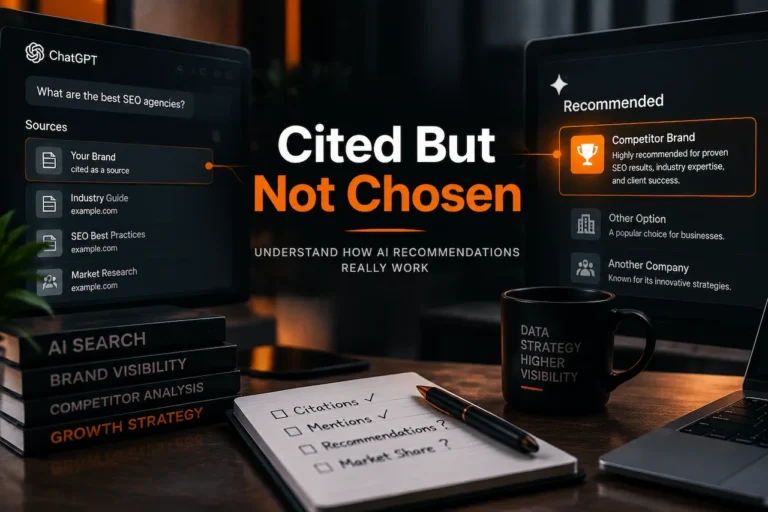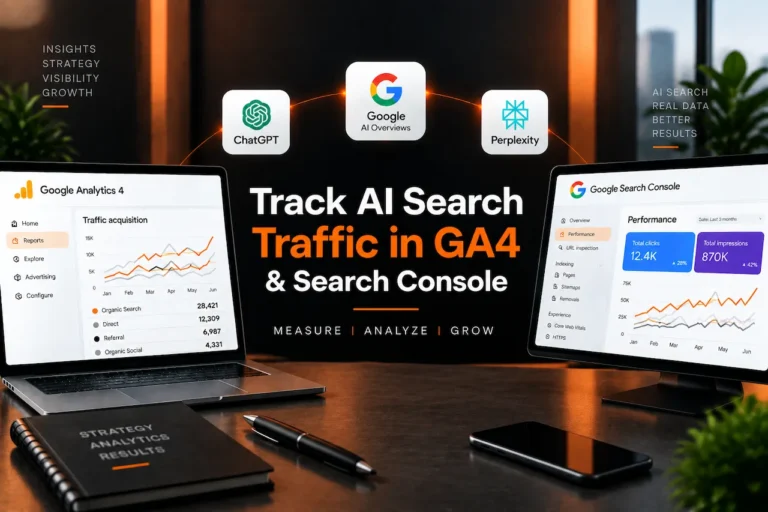

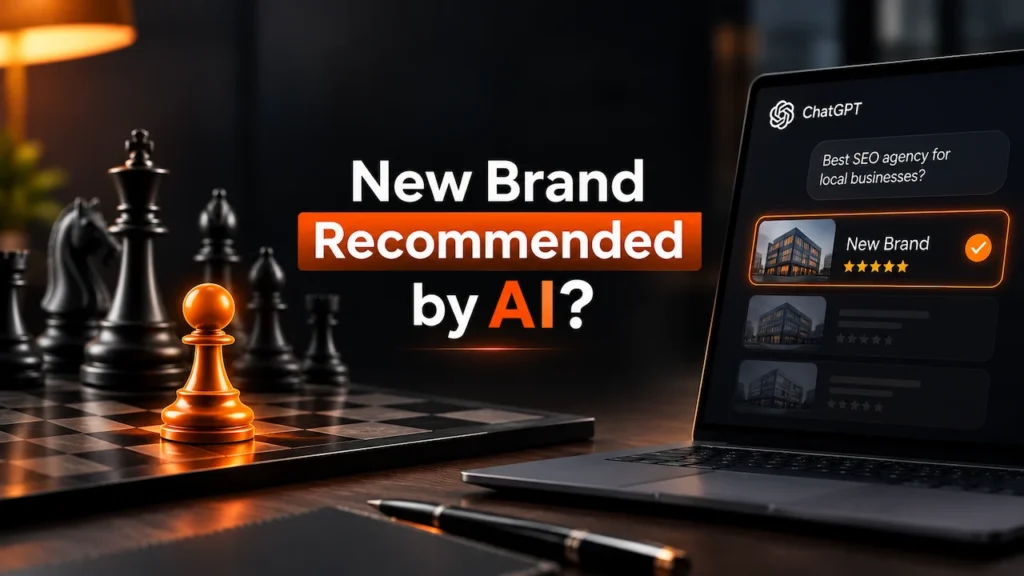
New businesses entering competitive markets often face established competitors with years of content, backlinks, reviews, press coverage, and brand recognition.
The key question is simple: if a competitor has existed for ten years and your company launched six months ago, why would ChatGPT, Google AI Search, Gemini, or another AI system recommend you?
The answer is that AI search visibility does not depend only on domain age. A newer company can become a strong recommendation candidate when its business identity is clear, its expertise is specific, its information is accessible, and credible sources support its claims.
Authority still takes time to build. However, new businesses can make faster progress by reducing ambiguity and strengthening the evidence, reputation, mentions, links, reviews, and experience that support their credibility.
The goal is not to make a new brand look old. The goal is to make it easy for search and AI systems to understand and verify.
Why AI Recommendation Does Not Equal Domain Age
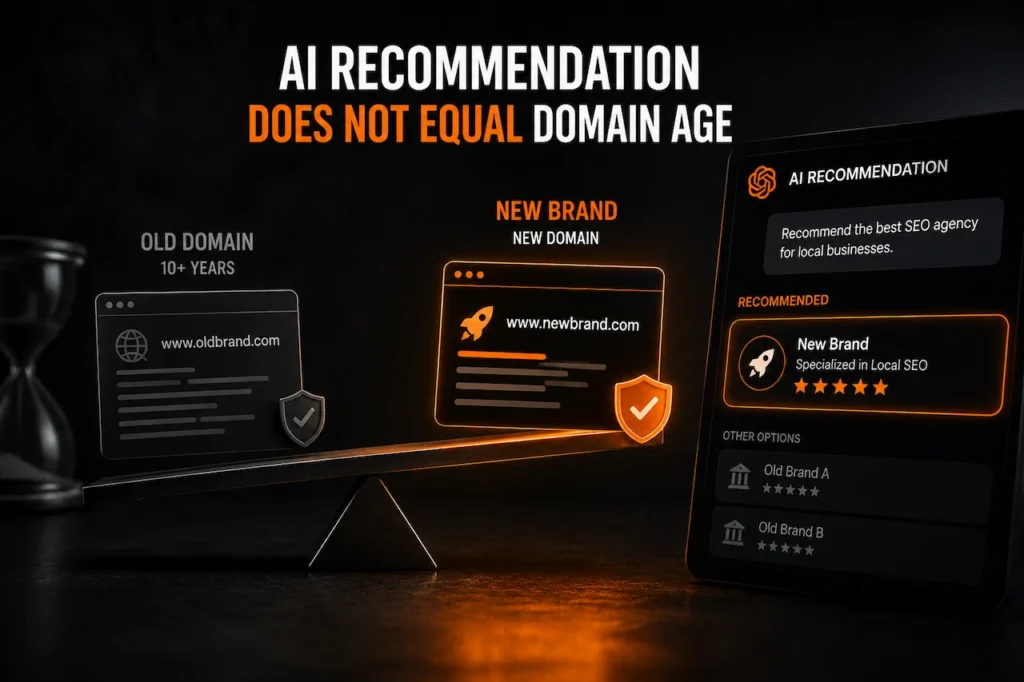
Traditional SEO conversations often give new websites the impression that age itself is the main barrier. Older websites frequently have advantages. They may have accumulated backlinks. They may have more indexed content. They may have stronger branded search demand. They may have thousands of customer reviews.
They may have been cited by industry publications for years. Those advantages are real. But they are not the same thing as saying domain age itself guarantees visibility. Google’s own documentation does not provide a rule saying older domains automatically outrank newer businesses.
Google instead emphasizes crawlability, useful content, technical accessibility, and quality signals across its search systems. Google also notes that a website being very new can be one reason it has not yet been discovered or indexed, which is different from saying age is a direct authority score. AI recommendations introduce an additional distinction.
The system may need to answer a specific question rather than simply produce a ten-result ranking. Imagine someone asks:
“Recommend an SEO agency specializing in AI Search and Local SEO for US home service companies.”
A business does not become a good recommendation simply because its domain is old.
The system needs evidence supporting multiple attributes. The agency needs to offer Local SEO. It needs credible AI Search expertise. It needs evidence of working with US businesses. It should ideally have relevant industry experience. Its public information should be consistent.
The more specific the query becomes, the more important those attributes become.
Established Brands Have an Evidence Advantage
New businesses should not misunderstand this. Established competitors still have a major advantage when their age has produced evidence. Years of operation may have created:
Customer reviews. Backlinks. Media coverage. Case studies. Industry awards. Community mentions. Professional profiles. Brand searches. Expert content. Forum discussions.
Partner references. That creates a larger public footprint. An AI system searching the web may find far more evidence supporting the established business. The opportunity for a new company is not to pretend that history does not matter. It is to build a cleaner and more specific evidence graph.
Specificity Can Help a New Brand Compete
An established digital marketing agency might be known broadly for:
SEO. PPC. Web development. Social media. A newer agency might position itself narrowly around:
AI Search optimization. Local SEO. Technical SEO. Home service companies. Google Maps. Entity optimization. For a broad query, the established agency may remain stronger.
For a highly specific query, the newer agency may become a better semantic match if it has credible evidence supporting those areas. That is where generative engine optimization becomes different from simply chasing one broad search keyword. A new company can focus.
Established companies often have broader identities. Specificity gives younger brands a way into narrower recommendation sets.
The Entity Clarity Shortcut New Brands Can Exploit
The biggest advantage a new brand controls immediately is clarity. Older companies often accumulate digital inconsistency. They change addresses. They change phone numbers. Services evolve. Leadership changes. Old directory listings remain live. Outdated company descriptions stay indexed. Abandoned social profiles survive. Former branding remains visible.
A newer company can avoid that history. It can launch with one clean entity structure from the beginning.
Make the Business Identity Unambiguous
An AI system should be able to answer:
What is the business called? What does it do? Where does it operate? Who owns or leads it? Which services does it specialize in? Who does it serve? What evidence proves those claims? Where else is the business referenced?
Google similarly explains that business information can be assembled from the official website, publicly available web content, licensed third-party information, users, and business owners. That makes consistency valuable. If your website says one thing and external platforms say another, retrieval systems have more work to do.
Establish One Canonical Business Description
New businesses often make a simple mistake. The homepage describes the company one way. LinkedIn uses another positioning statement. Google Business Profile uses a third. Directories use generic category descriptions. Founder biographies use different experience claims.
Create a clear core description. For example:
“Dexora Digital is an SEO and AI Search agency helping businesses improve visibility across Google Search, Google Maps, ChatGPT, and other AI discovery platforms.”
Individual platforms do not need identical copy. They should reinforce the same business identity.
Connect the Organization and Its People
People provide credibility. An anonymous website making expert claims is harder to evaluate than a company connected to identifiable specialists. Build clear founder and author pages. Show experience. Connect expert content to authors. Document professional backgrounds. Use consistent names across the website and external profiles.
Where appropriate, Organization structured data can help search systems disambiguate an organization and understand details such as its name, website, logo, address, and other identifiers. Google explicitly describes this disambiguation benefit in its current Organization structured data documentation.
Structured data does not manufacture authority. It can reduce ambiguity. That matters greatly for a new entity.
Use First-Party Proof Early
A new business may not have hundreds of reviews.
It can still publish evidence.
Useful evidence includes:
- Detailed case studies
- Real project screenshots
- Before and after performance data
- Original photographs
- Client outcomes
- Founder experience from previous projects
- Original research
- Tools created by the company
- Process documentation
- Industry-specific observations
- Expert commentary based on real work
Generic thought leadership is easy to reproduce.
Specific evidence is harder.
A new company with five excellent case studies can sometimes present a clearer expertise story than an old company with two hundred generic blog posts.
Fast Wins New Brands Can Implement
Not every AI visibility improvement requires years.
Several foundational problems can be corrected quickly.
Fix Technical Discoverability
A website cannot become a reliable search source if important content is inaccessible.
Check:
- Important pages are indexable
- Canonical URLs are correct
- XML sitemaps contain only intended canonical pages
- Internal links lead to important content
- Robots directives are intentional
- OAI SearchBot is not accidentally blocked when ChatGPT search visibility is desired
- Important content is available in accessible page text
- JavaScript does not unnecessarily hide essential information
- Server errors do not block crawlers
OpenAI’s current publisher guidance specifically says public websites can appear in ChatGPT search and recommends allowing OAI SearchBot when publishers want content to be discoverable and cited there.
This is a practical fast win.
It does not guarantee recommendations.
It removes a preventable barrier.
Implement Accurate Structured Data
Use Organization structured data when appropriate. For legitimate local businesses, use the correct LocalBusiness subtype where appropriate. Google says structured data provides a standardized way to classify information and that Organization markup can help it understand and disambiguate organizations. Make sure the markup agrees with visible content.
Do not invent awards. Do not fabricate review ratings. Do not list locations that do not exist. Do not create fictional expertise. Structured data should describe reality.
Complete Google Business Profile Properly
For local companies, Google Business Profile can establish important public business facts. Google uses Business Profile information to surface relevant local businesses and compiles information from business owners, official websites, third-party sources, users, and its own interactions with places.
A new business should make sure its profile accurately represents:
Business name. Location or service area. Phone number. Website. Hours. Categories. Services. Images. Operating model. Google also says complete and accurate Business Profile information makes businesses more likely to appear for relevant local searches. Do not keyword stuff the business name.
Do not create fake offices. Do not add categories the company does not genuinely represent. Entity clarity works only when the entity is real.
What About llms.txt?
llms.txt is frequently promoted as a fast AI visibility win. That claim needs qualification. Google explicitly clarified in June 2026 that it does not require or use llms.txt for Google Search and that maintaining one will neither improve nor damage Google Search visibility or rankings.
You may still maintain an llms.txt file for systems or experiments where you believe it has operational value. Do not treat it as a substitute for:
Crawlable content. Authority. Evidence. Entity clarity. Backlinks. Reviews. Third-party mentions. Useful pages. For a new brand, those fundamentals deserve priority.
What Still Takes Time
Some authority cannot be accelerated responsibly.
That is where new businesses need realistic expectations.
Third-Party Authority
Your website can describe your expertise immediately. Independent sources take longer. You need to earn:
Relevant backlinks. Industry mentions. Professional directory profiles. Podcast appearances. Local press. Trade association references. Partnership pages. Expert quotes. Real customer discussions.
These signals become valuable because you do not completely control them. They create corroboration.
Reviews and Reputation
A new business should not attempt to manufacture the review history of an established competitor. Reviews should come from real customers. That naturally takes time. A sustainable review process gradually builds:
Review count. Review recency. Service mentions. Customer language. Reputation. Local evidence.
Twenty detailed legitimate reviews are more valuable than one hundred purchased reviews that put the Business Profile at risk.
Brand Demand
Established businesses may already have thousands of people searching specifically for the company name.
New brands usually do not.
Brand demand develops through:
Customer relationships.
Advertising.
Word of mouth.
Social visibility.
Public relations.
Useful tools.
Case studies.
Search visibility.
Community presence.
Repeated exposure.
That takes time.
Deep Topical Authority
A new site cannot become the best resource in an industry simply by publishing fifty articles in two weeks. Topical authority should develop around real expertise. Build content clusters carefully. Answer customer questions. Publish original research. Add case studies.
Connect related pages through internal linking. Update important resources. Do not manufacture hundreds of keyword variations. Google’s 2026 guidance for generative AI search explicitly emphasizes valuable, unique, non-commodity content and says normal SEO best practices remain foundational.
A Realistic New Brand AI Visibility Roadmap
There is no official ChatGPT timeline promising that a new brand will appear within a particular number of days.
Avoid agencies that promise:
ChatGPT rankings in seven days.
Guaranteed AI Overview citations in thirty days.
Guaranteed Gemini recommendations.
No credible provider controls those systems.
Instead, use milestones.
First 30 Days
Focus on foundation.
Typical priorities include:
- Complete the website’s primary entity information
- Fix crawling and indexation problems
- Configure intentional AI crawler access
- Add accurate Organization or LocalBusiness structured data
- Complete Google Business Profile where applicable
- Standardize business facts across important profiles
- Publish strong service pages
- Build author and company profiles
- Publish the first evidence-based case studies
- Establish AI visibility tracking
At this point, success means the business is cleanly represented.
It does not mean AI systems must already recommend it.
Days 30 to 90
Start expanding corroboration. Publish genuinely useful content. Earn customer reviews. Strengthen important third-party profiles. Develop relevant backlinks. Create project evidence. Publish expert-led articles. Monitor which AI platforms mention the brand. Track citations. Measure Google generative search visibility. Compare competitors.
This is where early signs may begin appearing for some companies. Do not interpret one mention as full authority. Look for repeated evidence.
Months 3 to 6
By this stage, the goal is broader association. You want the brand appearing across several related prompts. Multiple pages should begin gaining visibility. Case studies should support commercial claims. External mentions should be increasing. Reviews should be accumulating. The website should have a clear topical structure.
AI search optimization now moves from technical setup toward authority building.
Beyond Six Months
Strong brands continue compounding. More customers create more reviews. More projects create more case studies. More research creates more citations. More expertise creates stronger content. More public exposure creates more branded searches. More authoritative mentions strengthen the entity. That is the advantage established competitors currently have.
The new business has to start building the same compounding system.
Can a New Brand Beat an Established Competitor?
Yes, but not everywhere immediately. The strongest opportunity appears where the new business has a more precise match to the user’s need. Suppose an established agency has:
Ten years of history. Thousands of backlinks. Broad digital marketing expertise. A new competitor has:
Strong Local SEO expertise. Specific AI Search case studies.
A clear home services specialization. Accurate entity information. Original AI visibility research. Detailed technical documentation. For the query:
“digital marketing agency”
the older company may dominate. For:
“agency specializing in ChatGPT visibility and Local SEO for home service businesses”
the newer specialist may have a stronger evidence match.
That is the opportunity. Do not try to beat established brands at everything immediately. Own narrower recommendation categories first.
Use SEO Audits to Find the Fastest Gaps
New brands often need to prioritize aggressively. A complete SEO audit helps identify which weaknesses are structural and which are authority related. Look for:
Technical indexation problems. Weak service architecture. Missing entity information. Poor internal linking. Duplicate content. Schema errors.
Thin expertise pages. Missing author information. Weak case study evidence. Crawl problems. Incomplete Local SEO signals. Poor AI discoverability. The objective is to avoid spending six months building backlinks while an important service page remains noindex.
Or publishing fifty articles while the company identity remains inconsistent. New brands need sequencing. Fix the fastest barriers first. Then invest in authority.
Frequently Asked Questions
Can new brands rank in ChatGPT?
A new business can appear in ChatGPT search and recommendations, but there is no guaranteed ranking process. The business needs accessible information, clear entity signals, relevant expertise, and enough evidence to support the recommendation.
Does domain age affect ChatGPT recommendations?
OpenAI does not publish domain age as a ChatGPT recommendation factor. Older businesses often have indirect advantages because they have accumulated more reviews, links, mentions, content, and public evidence.
How can a new business improve AI search visibility?
Start with technical discoverability, entity consistency, accurate structured data, strong service content, Google Business Profile where relevant, original evidence, case studies, reviews, and credible third-party mentions.
How quickly can a new business appear in AI Search?
There is no guaranteed timeline. Technical improvements can be implemented quickly, but authority, reviews, mentions, brand demand, and independent corroboration normally develop over time.
Does schema help a new brand get recommended by ChatGPT?
Schema can help machines interpret business information, but it should not be treated as a guaranteed ChatGPT ranking factor. Its primary value is accurately clarifying the organization, people, services, and other entities represented on the website.
Does llms.txt improve AI Search visibility?
Google explicitly says llms.txt does not improve or reduce visibility in Google Search, including generative features. It can be maintained for other systems or experiments, but it should not replace normal crawling, SEO, entity, and authority work.
Is Google Business Profile important for new businesses?
For legitimate local businesses, yes. A complete and accurate Business Profile provides important public information about location, categories, hours, services, and contact details and supports local discovery on Google.
Do I need backlinks before ChatGPT can recommend my business?
There is no published minimum backlink count for ChatGPT recommendations. However, credible third-party links and mentions can strengthen authority and provide independent corroboration of business claims.
Can a new company outrank an established competitor in AI recommendations?
It can become the preferred recommendation for specific queries when its expertise, services, location, and evidence match the user’s requirements more precisely. Established competitors still retain advantages where their broader authority is stronger.
Should a new business prioritize SEO or AI Search optimization?
Treat them as connected disciplines. Strong technical SEO, useful content, local visibility, authority, structured information, and entity clarity provide the foundation for both traditional and AI-assisted discovery.
Build AI Authority Before Your Competitors Own the Category
A new company does not need to wait ten years before becoming visible in AI Search. It needs to give search and AI systems enough reliable evidence to understand what the business does, who it helps, and why it deserves consideration.
Dexora Digital helps new and growing businesses strengthen AI search visibility through technical SEO, entity optimization, Local SEO, structured data, evidence-led content, authority development, and AI visibility tracking.
If established competitors are already appearing in ChatGPT and Google AI Search while your brand is still emerging, book an AI search optimization assessment. We can identify the evidence gaps limiting your visibility and prioritize the opportunities that can help your business compete more effectively.