By Taqweem Ahmad, Founder of Dexora Digital
The Quick Numbers
| Metric | Result |
|---|---|
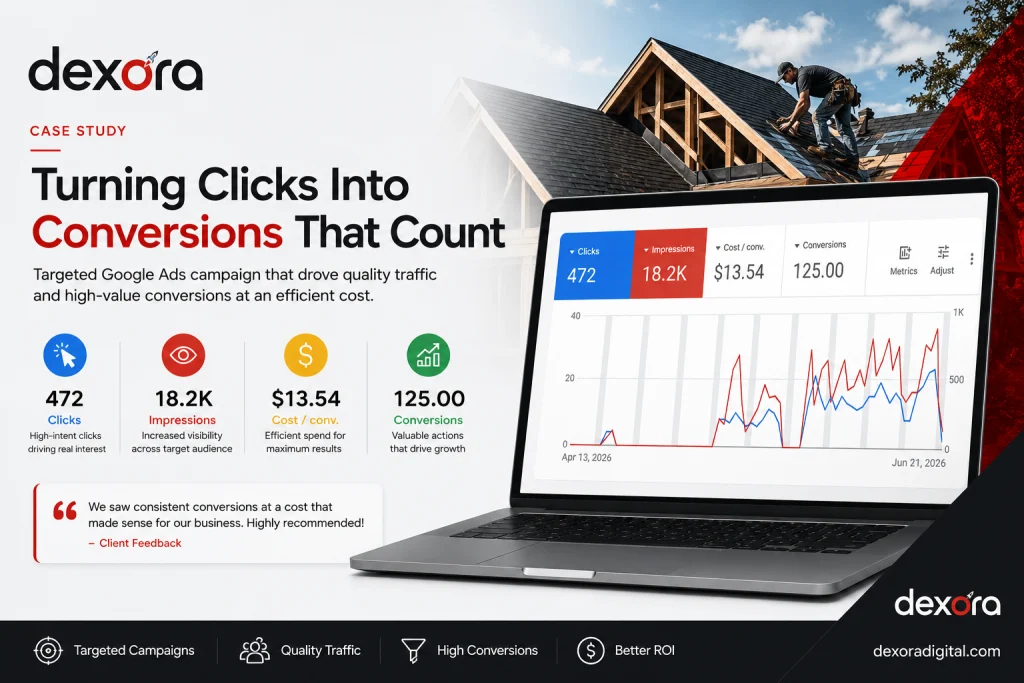
| Total Impressions | 18,200+ |
| Total Clicks | 472 |
| Total Conversions | 125 |
| Cost Per Conversion | $13.54 |
| Conversion Rate | 26.5% of clicks |
| Trend | Consistent growth in clicks and impressions throughout the campaign |
A $13.54 cost per conversion is not a number you get from a campaign running on autopilot. It comes from a specific set of decisions about targeting, ad relevance, and the quality of traffic the campaign was built to attract. Here is exactly what produced it.
The Goal
The client needed a Google Ads campaign that did one thing well: generate qualified enquiries at a cost per lead that made sense for their business economics. Not the lowest possible cost per click. Not the highest possible impression count. A controlled, predictable cost per conversion that the client could plan around and scale with confidence.
That distinction matters. A campaign optimized purely for cheap clicks often produces a flood of low-intent traffic that never converts, which makes the cost per click look impressive in a report while doing nothing for the business. We built this campaign around the metric that actually matters: cost per qualified conversion.
What We Built
Targeting built around buyer intent, not broad reach. Rather than casting a wide net across every possible related search term, we built the campaign around the specific queries that signal someone is ready to make contact, not someone browsing for general information. This is the single biggest lever in controlling cost per conversion — every dollar spent on a low-intent click is a dollar not available for a high-intent one.
Ad relevance matched precisely to search intent. Each ad group was structured around tightly related keyword themes with ad copy written to speak directly to that specific search, rather than one generic ad running across a broad, loosely related keyword list. Higher relevance produces a higher Quality Score, which directly lowers the cost per click Google charges for the same auction position.
Conversion-focused landing experience. The traffic arriving from these ads was sent to a page built specifically to convert that specific intent, not a generic homepage asking visitors to figure out what to do next. Every additional step between a click and a conversion is an opportunity to lose the lead you already paid for.
Continuous optimization based on real conversion data, not click data alone. We tracked which keywords, ad variations, and audience segments were producing actual conversions, not just clicks, and reallocated budget toward what was working throughout the campaign rather than leaving the initial setup untouched.
The Results
18,200+ impressions. The campaign reached a substantial, relevant audience without inflating reach through broad, low-relevance targeting that would have driven the cost per click up without improving conversion quality.
472 clicks. A click-through rate that reflects ads genuinely relevant to the searches triggering them, rather than a high volume of clicks from an oversized, loosely targeted audience.
125 conversions. More than one in every four people who clicked through completed a conversion action. That conversion rate is the clearest evidence that the traffic quality, not just the volume, was right.
$13.54 cost per conversion. A controlled, predictable cost that gives the client a clear economic basis for deciding how much to scale the campaign and what return to expect from doing so.
Consistent growth in clicks and impressions over time. The campaign did not spike and fade. Performance built steadily, which is the pattern you want to see when a campaign is being actively managed and optimized rather than left to run unattended after launch.

Why the Cost Per Conversion Matters More Than Any Other Number Here
It would be easy to lead with the impression count or the click total in a case study like this. We are leading with $13.54 because it is the number that determines whether this campaign is actually good for the client’s business, not just active.
A campaign that generates thousands of clicks at a high cost per conversion can look impressive in a vanity report and still be losing the client money. A campaign that generates a fraction of the clicks at a controlled, sustainable cost per conversion is the one that is actually worth scaling. This campaign is the second kind.
What This Means for Businesses Considering Google Ads
Google Ads is frequently treated as a volume game — more clicks, more impressions, bigger numbers in the monthly report. The campaigns that actually produce business results are built around the opposite instinct: narrower, more relevant targeting, ad copy that speaks directly to a specific intent, and a conversion path that does not waste the traffic you have already paid for.
A controlled cost per conversion is not a constraint on growth. It is the foundation that makes growth worth pursuing in the first place — because every dollar of additional spend produces a result you can actually predict.
Frequently Asked Questions
Q: Is $13.54 a good cost per conversion for Google Ads?
A: It depends entirely on the industry, the value of a single conversion, and the competitiveness of the keywords involved. For many local service and lead-generation businesses, a cost per conversion in this range represents a strong, scalable result. The relevant comparison is not an industry benchmark in isolation — it is whether the cost per conversion is meaningfully lower than the value the business gets from each converted lead.
Q: What is the difference between cost per click and cost per conversion, and why does it matter more?
A: Cost per click measures how much you pay for a visitor to your site. Cost per conversion measures how much you pay for an actual qualified result — a lead, a booking, a sale. A campaign can have a very low cost per click and still be a poor investment if very few of those clicks ever convert. Optimizing for cost per conversion, rather than cost per click alone, is the difference between a campaign that looks efficient and one that actually is.
Q: How long did it take to achieve this conversion rate?
A: Google Ads campaigns typically improve over the first several weeks as real conversion data accumulates and informs ongoing optimization — keyword refinement, ad copy testing, and budget reallocation toward what is actually converting. The consistent growth pattern in this campaign reflects that ongoing optimization process rather than a result achieved instantly at launch.
Q: Can this approach work for any industry?
A: The specific tactics — intent-based targeting, tightly themed ad groups, conversion-focused landing pages, ongoing optimization based on conversion data — apply across industries. The exact targeting strategy and expected cost per conversion will vary significantly depending on the competitiveness and search volume in your specific market.
Q: Do you manage Google Ads alongside SEO, or only as a standalone service?
A: Both. Many clients run Google Ads for immediate lead flow while SEO builds toward sustainable organic visibility over a longer timeline. The two channels work well together, particularly when ad performance data informs which keywords and landing pages are worth prioritizing in the SEO strategy as well.
Get Your Own Google Ads Account Reviewed
If you are running Google Ads and unsure whether your cost per conversion reflects a genuinely optimized campaign, we can take a direct look.
Book a free 30-minute strategy call at dexoradigital.com/consultation or run a free audit of your website’s conversion readiness at allinoneseoaudit.com.
Related Case Studies
Zero Website to First Lead in 40 Days — Local SEO
Mid Century Restoration Melbourne — 0 to 107,000 Impressions
Keentel Engineering — 81 to 718 Keywords