
Google Business Profile ranking factors are often discussed as if there is a secret checklist that guarantees a top three Maps position. In reality, local search is more complicated. Google evaluates how closely a business matches the search, how close it is to the searcher, and how established or prominent that business appears.
At Dexora Digital, we see businesses spend time posting every day, uploading dozens of images, or changing service areas while ignoring the signals that matter most. Understanding what Google actually confirms, what industry testing suggests, and what remains speculation is the better way to build a local SEO strategy in 2026.
Proximity vs. Relevance vs. Prominence
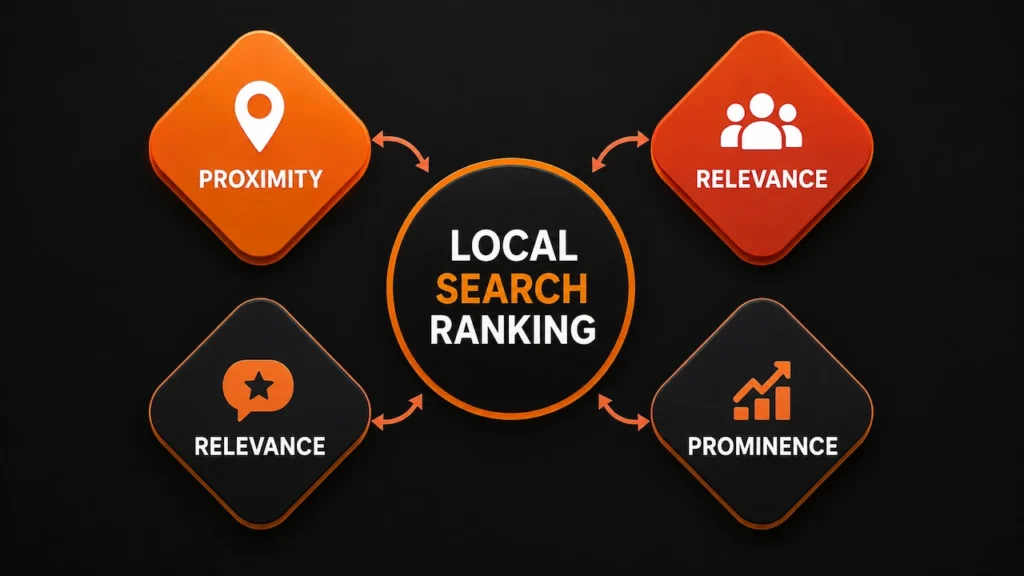
When business owners ask, “How does Google rank Maps listings?” the best starting point is Google’s own documentation.
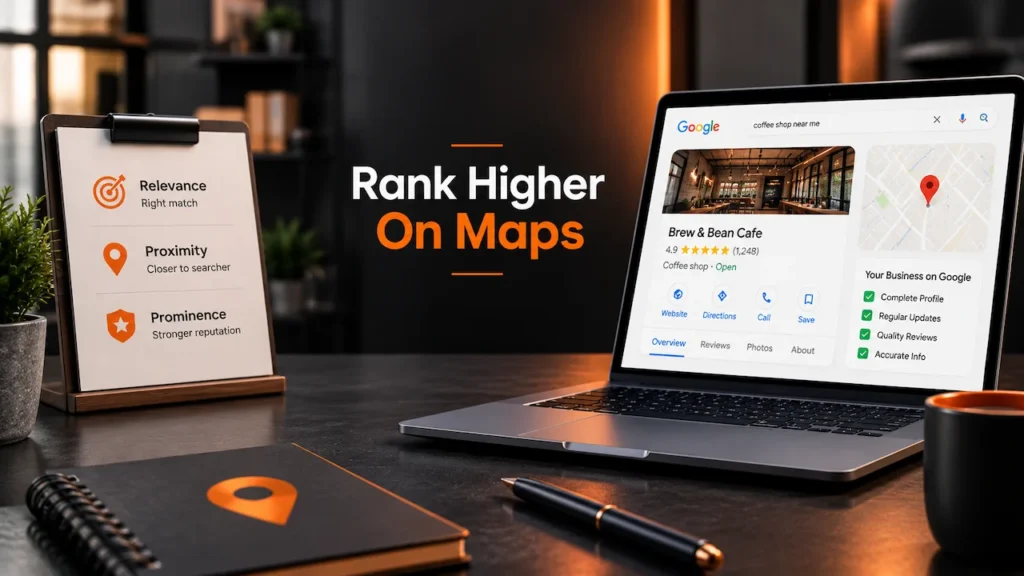
Google says local results are mainly based on three factors: relevance, distance, and prominence. Google does not publish the exact weighting assigned to each factor, and the importance of individual signals can change depending on the query and searcher.
That distinction matters.
A business cannot optimize every local ranking factor in exactly the same way. Some signals can be improved directly. Others depend heavily on geography, competition, customer behavior, and Google’s understanding of the business.
Proximity Determines Whether You Are Geographically Competitive
Distance refers to how far a business is from the location associated with the search.
If someone searches for an emergency plumber while standing in downtown Los Angeles, Google does not necessarily show the plumber with the strongest website in the entire county. It also considers which relevant businesses are reasonably close to that searcher.
When Google does not receive an exact location from the searcher, it uses the location information available to estimate where that person is searching from.
This creates one of the biggest limitations in local SEO.
You cannot optimize your way out of geography completely.
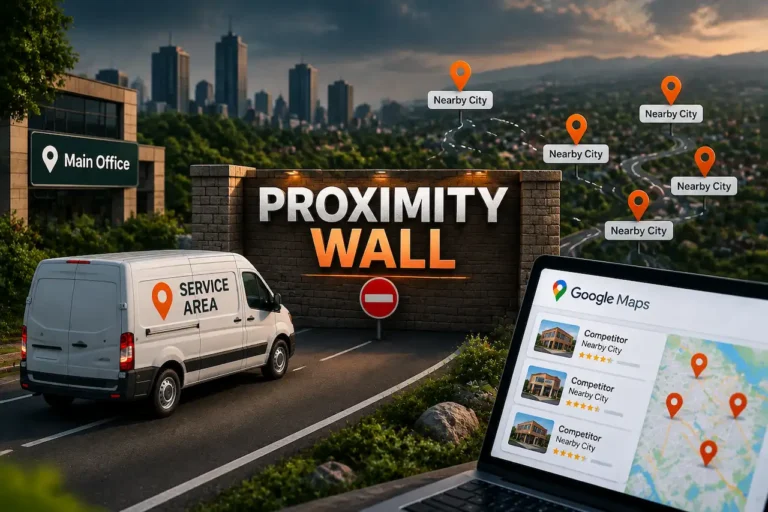
A business located twenty miles away from a searcher may struggle against equally relevant competitors located two miles away. That does not mean proximity is the only factor. It means proximity defines part of the competitive environment.
I always advise local businesses to stop measuring Maps rankings from a single location.
A business can rank number one near its office, number four three miles away, and disappear from the local pack farther across the city.
That is normal behavior.
Local rank tracking should therefore use geographic grids rather than one citywide ranking position.
The goal is not simply to say, “We rank number three for plumber.”
The better question is:
“How much of our commercially important service area can see us near the top?”
Relevance Determines Whether Google Understands the Match
Relevance describes how closely a Business Profile matches what someone is searching for.
Google specifically recommends providing complete and detailed business information so that it can understand the business and connect it with relevant searches.
This is where category selection, services, website content, business information, and the overall entity relationship become important.
Consider two companies.
The first company has a Business Profile categorized correctly as an HVAC contractor. Its services include air conditioning repair, furnace repair, heat pump installation, and emergency HVAC service. Its linked website contains dedicated pages for those services.
The second company uses a broad contractor category, has an incomplete service list, and sends visitors to a homepage that barely explains what the company does.
Even if the businesses are equally close to the searcher, Google has more information available to understand the first company.
Relevance is one reason local SEO should never be treated as GBP optimization alone.
Your Business Profile, website, service pages, internal links, structured data, external citations, reviews, and other web references collectively help Google understand what your business represents.
Google itself explains that Business Profile information can come from owner supplied information, public web content, third party sources, user contributions, and Google’s own interactions with a place.
Your GBP therefore operates inside a larger local entity ecosystem.
Prominence Measures How Established the Business Appears
Prominence is Google’s concept of how well known or established a business is.
Google specifically states that prominence can incorporate information such as links to a business and the number of reviews it has. Google also says that more reviews and positive ratings can help local rankings.
This explains why two businesses located almost beside each other can perform very differently.
One may have:
A strong website.
Hundreds of legitimate reviews.
Local press coverage.
Relevant backlinks.
Accurate business information.
Years of online history.
Consistent brand mentions.
The other may have almost no authority outside its Business Profile.
Distance may be similar, but prominence is not.
Prominence is also where traditional organic SEO and local SEO begin to overlap heavily.
A local business cannot depend entirely on GBP edits.
Its website still matters.
Its links still matter.
Its reputation still matters.
Its brand footprint still matters.
Its customer feedback still matters.
This is why our local SEO services focus on the complete local search ecosystem rather than Business Profile edits alone.
Category Selection Is One of the Strongest GBP Relevance Signals
Category selection deserves special attention because Google directly confirms that Business Profile categories affect local rankings.
Your primary category tells Google what kind of business you fundamentally are.
Additional categories provide supporting context.
This makes category selection one of the most important areas of GBP optimization that a business owner can directly control.
A roofing contractor should not select a broad category simply because it sounds related. A pediatric dentist should not automatically settle for the broadest dental category if a more accurate supported category exists.
Google advises businesses to choose the specific category that best represents the business and to describe what the business is rather than everything it sells or offers.
That guidance is important because excessive category selection can create a noisy profile rather than a more relevant one.
How We Approach GBP Category Selection
Before changing categories, we normally review:
- The category that most accurately represents the primary revenue generating business activity
- Categories used by legitimate competitors appearing consistently for important local queries
- Additional categories that represent real business functions rather than keyword variations
- Whether the website supports the services implied by the selected categories
- Whether a category change accurately reflects the real world business and complies with Google’s guidelines
- Whether different physical locations genuinely provide different services
The primary category should not be changed casually.
A category change can alter which searches Google associates with the profile. In some cases, correcting the primary category can materially improve visibility for an important group of searches. In other cases, choosing an inaccurate category simply because competitors use it can create relevance problems.
The best category is not always the category with the largest search volume.
It is the category that most accurately represents the business while aligning with the queries that matter commercially.
Google also allows additional categories, but it advises businesses to use only a few categories that genuinely describe what the business is.
Think of the primary category as the strongest classification.
Additional categories should expand Google’s understanding, not turn the profile into a list of every service keyword.
Review Velocity and Reputation Signals
Reviews are among the few local ranking signals Google discusses directly.
Google states that more reviews and positive ratings can help a business’s local ranking.
However, this is where an important distinction needs to be made.
Google confirms that reviews can affect local ranking.
Google does not publicly confirm a specific formula for “review velocity.”
There is no official rule saying that receiving five reviews every week generates a defined ranking improvement.
There is also no published threshold stating that a business needs a particular number of reviews per month.
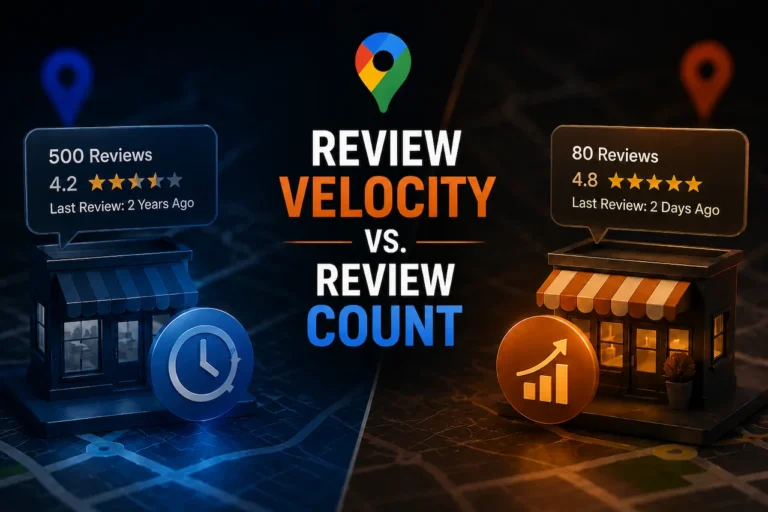
When local SEO professionals discuss review velocity, they are normally referring to the rate and consistency at which a business earns new customer reviews.
That concept is still operationally useful.
A company that earns legitimate customer feedback continuously is usually building a healthier reputation than a business that receives thirty reviews in one short burst and nothing for the next year.
However, we should not confuse that observation with a disclosed Google ranking formula.
What a Healthy Review Strategy Looks Like
We normally recommend businesses focus on:
- Asking real customers for feedback consistently after genuine transactions
- Making the review process simple without pressuring customers for positive ratings
- Avoiding sudden artificial review campaigns or purchased reviews
- Responding professionally to both positive and critical reviews
- Monitoring review themes to identify recurring customer experience issues
- Maintaining a long term review acquisition process rather than running one short campaign
The quality of the underlying business experience matters more than any trick.
Google review scores are based on published ratings, and profiles can display both the overall rating and total review count.
For service businesses, Google may also gather feedback about specific aspects of a customer’s experience or the type of work completed. Google notes that service information can be influenced by the profile’s service list, website information, and other authoritative sources.
That is another reason website content and GBP services should agree with each other.
A plumber claiming to specialize in water heater installation should provide clear supporting information across the profile and website.
We will cover the mechanics of sustainable review acquisition more deeply in our dedicated review velocity guide.
For an applied example of how profile optimization works within a specific vertical, see our Google Business Profile optimization for plumbers guide.
GBP Posting Frequency in 2026
GBP posting is one of the most misunderstood areas of local SEO.
Some businesses have been told they need to publish every day.
Others are told that exactly three posts per week are required to rank.
Google does not publish such a rule.
Google describes Business Profile posts as a way to share updates, offers, announcements, events, photos, and videos with customers on Search and Maps. Google says these updates can help customers make decisions about visiting or engaging with a business.
That is valuable.
But Google does not state in its local ranking documentation that posting seven times instead of two times per week provides a direct local ranking boost.
This distinction matters.
GBP posts are useful for customer communication, offer visibility, conversion support, freshness, and profile activity.
They should not be treated like a guaranteed ranking lever.
A Practical Posting Approach
For most active local businesses, we prefer a sustainable publishing pattern built around useful updates such as:
- New services or meaningful service updates
- Seasonal promotions
- Events
- Completed projects
- New locations
- Important business announcements
- Educational information that supports customer decisions
- Time sensitive offers
A roofing company entering storm season has a genuine reason to publish an update.
A restaurant introducing a seasonal menu has something meaningful to communicate.
A dental practice adding a new treatment may benefit from explaining it.
Publishing an empty promotional message every morning because someone said “daily posting increases rankings” is much harder to justify.
The correct GBP posting frequency depends on how often the business has something useful to communicate.
For many businesses, one or two meaningful posts each week can be more sensible than daily filler.
For highly active businesses with events, products, promotions, or frequent project work, more frequent posting may be appropriate.
We will break this down further in our dedicated GBP posting frequency guide.
The core principle is simple.
Post because the information is useful to customers.
Do not manufacture low value content solely to create activity.
Photo and Video Activity
Photos and videos influence how customers experience a Business Profile.
Google encourages verified businesses to add photos and videos showing their storefront, products, and services. It also explains that exterior photos can help customers recognize a business when they arrive.
That makes media valuable.
But again, we should separate user experience value from confirmed ranking factors.
Google does not publicly state that uploading ten photos per week creates a specific ranking increase.
There is no confirmed rule saying a business with 300 owner uploaded photos will outrank one with 100.
The value of GBP media is broader.
Good photos can demonstrate legitimacy.
They can show what the business actually does.
They can improve customer confidence.
They can make the listing more useful.
They can help customers recognize a storefront, team, product, project, treatment environment, or service outcome.
For local businesses where trust is important, those benefits can influence whether someone calls, requests directions, visits the website, or chooses another competitor.
This is particularly important for industries such as:
Home improvement.
Dentistry.
Restaurants.
Landscaping.
Automotive services.
Beauty services.
Hotels.
Real estate.
Construction.
Customers want visual evidence.
A contractor can show completed projects.
A restaurant can show current dishes and its dining environment.
A dentist can show the practice and team.
A landscaper can demonstrate actual work.
Google recommends realistic photos that are properly lit and in focus without excessive alterations.
At Dexora Digital, we prioritize authentic business media rather than generic stock images.
A real project photograph usually communicates more trust than another polished stock image that could belong to any competitor.
The same principle applies to video.
Short videos can show a location, completed work, a product, a service process, or part of the customer experience.
The media should support the business entity Google and users are trying to understand.
Website Link Consistency and Local Entity Signals
The website connected to your Business Profile is not an isolated button.
Google states that it gathers Business Profile information from multiple sources, including publicly available web content such as a business’s official website.
Google’s Business Profile guidelines also tell businesses to provide a website that represents the individual business location.
This makes website alignment important.
The business name on the website should accurately represent the same real business.
The address should be correct where an address is publicly displayed.
The phone number should route to the correct business or location.
The services described on the site should support the services represented on GBP.
Location pages should represent legitimate locations and service areas.
Important categories should have corresponding content where appropriate.
The website should provide clear signals about who the business is, what it does, and where it operates.
This does not mean Google has published a simple rule called “NAP consistency equals ten ranking points.”
It has not.
Local SEO often becomes oversimplified when useful practices are converted into imaginary ranking formulas.
The better explanation is that consistent information reduces ambiguity.
Imagine a Business Profile says a company is an HVAC contractor in Austin.
Its website homepage says it is a general home improvement company in Dallas.
A directory listing shows another phone number.
A location page uses a third address.
Google then has to reconcile conflicting information from several sources.
Contrast that with a business whose profile, website, major citations, customer reviews, service pages, and local references reinforce the same entity.
The second business provides a clearer information environment.
Website Signals We Check During GBP Optimization
Our local SEO audits normally examine:
- Whether the GBP website link points to the correct canonical page
- Whether the business name and contact information are accurate
- Whether location information agrees with the real business setup
- Whether important services have supporting website content
- Whether local landing pages have genuine unique value
- Whether structured data accurately describes the business
- Whether the website is indexable and accessible to Google
- Whether backlinks and citations reinforce the business entity rather than introduce conflicting information
This is why GBP optimization and website SEO should not be separated into unrelated campaigns.
Google itself uses web content as one source for understanding business information.
The website therefore helps provide the context behind the listing.
Service Area vs. Storefront Setup
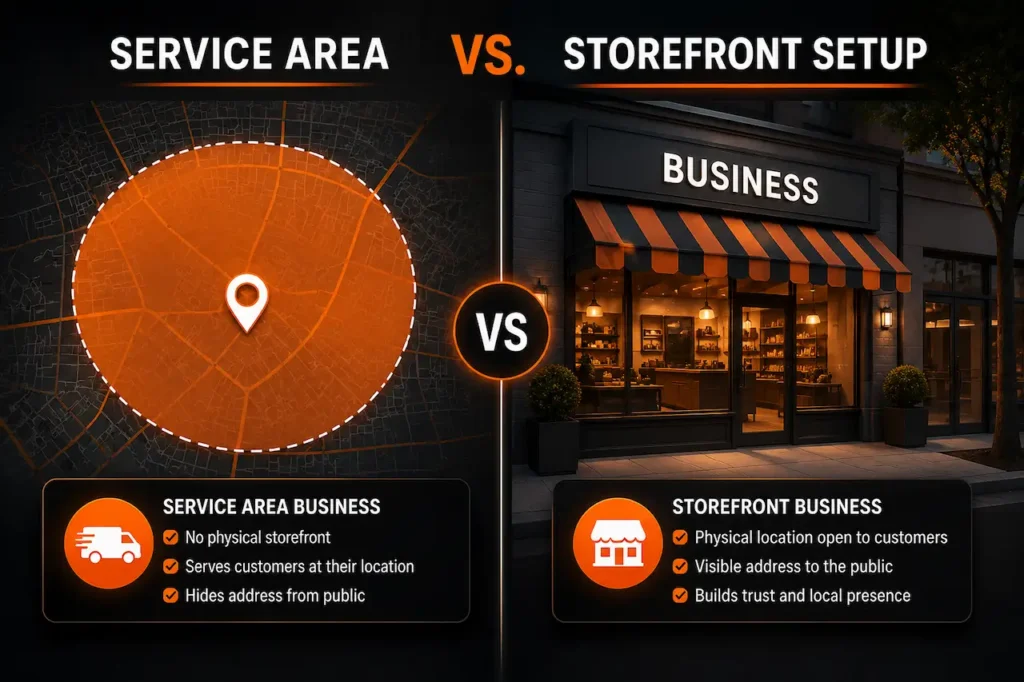
Service area configuration creates another common local SEO misunderstanding.
Business owners sometimes believe that adding twenty cities to their service area will automatically make them rank across all twenty locations.
Google does not state that service area selection overrides distance.
What Google does say is that service areas help customers understand where the business can provide products or services.
A service area business is a company that visits or delivers to customers but does not serve customers at its business address.
Plumbers and cleaning companies are common examples.
A hybrid business serves customers at its physical location but also travels or delivers to customers.
A qualifying storefront has a real location where customers can visit during stated hours.
These distinctions are important because the profile must reflect how the business actually operates.
Google’s guidelines state that businesses without a storefront that travel to customers should generally use one service area profile for the central location. Businesses should not use virtual offices unless they meet Google’s eligibility requirements.
Google also says a service area business should hide its address when customers are not served there.
Setting Up the Profile Correctly
A business should generally think through:
- Whether customers can genuinely visit and receive service at the address
- Whether permanent signage exists where storefront eligibility requires it
- Whether staff are present during the stated business hours
- Whether the company travels to customers
- Whether separate locations actually have separate staff and operations
- Whether the selected service areas accurately represent where the company works
- Whether a home address should remain hidden because customers are not served there
Google currently allows businesses to specify service areas using cities, postal codes, or other areas, with up to twenty service areas. Google advises keeping the overall coverage reasonably close to the actual operating base and says the boundaries generally should not extend farther than about two hours of driving time.
The key point is accuracy.
Adding more cities is not a substitute for having geographic relevance.
A plumber based in one part of a large metropolitan area may still rank more strongly close to its actual base than forty miles away.
Local landing pages, reviews from real customers, service evidence, links, local prominence, and overall relevance can help expand visibility.
But a service area field should not be treated as a magic radius expansion setting.
This is one of the most persistent myths surrounding the GBP algorithm in 2026.
What Google’s Own Guidelines Confirm vs. SEO Myths
Local SEO becomes easier to manage when confirmed information is separated from assumptions.
Google does not disclose every signal used by its local ranking systems.
That means responsible optimization requires two categories of thinking.
First, we have statements Google explicitly makes.
Second, we have strategies supported by testing, experience, correlation, or good business practice but not confirmed as direct ranking signals.
Confusing the two creates bad advice.
What Google Clearly Confirms
Google’s current documentation supports the following points:
- Local ranking is mainly based on relevance, distance, and prominence
- Complete and accurate business information can help Google understand and match a business to relevant searches
- Business categories affect local ranking
- Reviews and positive ratings can help local ranking
- Links to the business can contribute to prominence
- Business information may come from the official website and other public sources
- Service area and address information should accurately reflect how the business operates
- Business Profile posts are intended to communicate updates, offers, events, and other useful information to customers
- Photos and videos help complete the Business Profile and help customers understand the business
Google also states that businesses cannot request or pay Google for better local rankings.
Common Local SEO Myths
Now consider some claims Google does not confirm.
“Posting every day guarantees higher rankings.”
No confirmed Google documentation supports that rule.
“Adding twenty service areas makes you rank in twenty cities.”
Service areas tell customers where you operate. Google does not state that adding a city eliminates the distance component.
“Uploading one hundred photos improves rankings.”
Photos are valuable for profile completeness and customer engagement, but Google does not publish a photo count ranking formula.
“Keywords should be added to the GBP business name.”
Only when those words form part of the business’s genuine real world name. Google’s guidelines require businesses to represent themselves consistently with their real world branding.
“Every possible category should be added.”
Google advises choosing categories that accurately describe the business rather than using categories as keywords.
“Reviews only matter because customers look at them.”
Google explicitly says review quantity and positive ratings can help local ranking.
“The website no longer matters because Google Maps is separate.”
Google says Business Profile information can be sourced from crawled web content, and prominence can incorporate links. The website remains part of the larger local search ecosystem.
“GBP optimization is a one time task.”
Business information changes. Competitors change. Categories change. Reviews accumulate. Websites evolve. Search behavior changes.
Local SEO therefore requires monitoring, not constant random edits.
The goal is not to manipulate every field every week.
The goal is to maintain the clearest, most accurate, and most authoritative representation of the business possible.
What Actually Moves the Needle in 2026
There is no single GBP setting that replaces a complete local SEO strategy.
The strongest businesses tend to build several advantages together.
They have the right primary category.
Their business information is complete.
The website supports the same services and locations.
They earn genuine reviews.
Their reputation grows consistently.
They attract links and local mentions.
Their profile contains useful and current information.
Their photos demonstrate a real business.
Their operating model follows Google’s eligibility guidelines.
Their location gives them a realistic chance of competing for the searcher’s area.
This is also why two companies following the same GBP checklist can receive completely different results.
The competitive environment matters.
The searcher’s location matters.
Category competition matters.
Business history matters.
Website authority matters.
Reviews matter.
Prominence matters.
At Dexora Digital, we prioritize the signals that can be improved while respecting the signals a business cannot simply manipulate.
You cannot move your physical location every time a searcher changes neighborhoods.
You can improve relevance.
You can strengthen prominence.
You can improve category selection.
You can build better location and service content.
You can earn stronger reviews.
You can improve the website.
You can make the entity easier for Google to understand.
You can strengthen the overall local brand footprint.
That is where sustainable Maps growth comes from.
Businesses that need a complete strategy can explore our local SEO services, where GBP optimization is integrated with website SEO, local authority building, reputation signals, and conversion improvement.
Frequently Asked Questions
What are the most important Google Business Profile ranking factors in 2026?
Google says local results are mainly determined by relevance, distance, and prominence. Relevance reflects how closely the business matches the search. Distance considers how far the business is from the searcher’s location. Prominence reflects how established and well known the business appears. Categories, reviews, links, accurate information, website signals, and other sources can contribute to these broader systems.
Does the primary GBP category affect Google Maps rankings?
Yes. Google specifically states that the categories selected for a Business Profile affect local ranking. The primary category should accurately describe what the business fundamentally is. Additional categories can provide further context, but they should represent genuine business activities rather than being selected simply because they contain attractive keywords.
Does adding more GBP categories improve rankings?
Not automatically. Additional categories can improve relevance when they accurately describe real parts of the business. However, adding every vaguely related category is not a sound strategy. Google recommends selecting categories that describe what the business is rather than using them as keywords or trying to list every service.
Do Google reviews affect local rankings?
Yes. Google explicitly states that more reviews and positive ratings can help local ranking. Reviews also influence customer trust and conversion. Businesses should focus on earning genuine reviews from real customers consistently rather than purchasing reviews or running manipulative campaigns.
Is review velocity a confirmed Google ranking factor?
Google confirms that review quantity and positive ratings can influence local ranking, but it does not publicly disclose a specific review velocity formula. Consistently earning legitimate reviews is a sensible reputation strategy, but claims that a precise number of reviews per week produces a guaranteed ranking improvement should be treated cautiously.
How often should I post on Google Business Profile?
There is no Google confirmed posting frequency required for ranking. Publishing useful updates when the business has relevant news, offers, events, services, or customer information is a better strategy than producing daily filler content. Google describes posts primarily as a way to communicate current information and help customers make decisions.
Do GBP posts directly improve Google Maps rankings?
Google does not currently state that posting more frequently creates a direct ranking improvement. Posts can support customer engagement, communicate offers, keep information current, and improve the usefulness of the profile. Those benefits matter, but they should not be presented as proof of a direct ranking boost.
Do photos help Google Business Profile rankings?
Google encourages businesses to upload accurate photos and videos because they help complete the profile and allow customers to understand the business. However, Google does not publish a formula connecting a specific number of uploaded photos to a specific ranking improvement. Media should primarily be used to demonstrate authenticity and help customers make decisions.
Does adding more service areas improve Maps rankings?
Not necessarily. Google says service areas help customers understand where a business provides services. It does not state that selecting more service areas overrides the distance factor. Service areas should accurately represent where the business actually works rather than being used as a way to target every surrounding city.
Is a storefront Business Profile stronger than a service area profile?
A storefront is not automatically better simply because the address is visible. The correct profile type depends on how the business operates. If customers are served at a genuine staffed location, storefront or hybrid setup may be appropriate. If the business travels to customers and does not serve them at its address, Google requires the address to be hidden and the profile to operate as a service area business.
Does my website affect Google Maps rankings?
The website forms part of the wider local search ecosystem. Google says Business Profile information can be compiled from publicly available web content, including the business’s official website. Google also says prominence can incorporate links to the business. A clear, authoritative website therefore supports Google’s understanding of the company even though there is no simple website score used exclusively for Maps.
Should I put keywords in my Google Business Profile name?
Only if those words genuinely form part of the real business name. Google’s guidelines require businesses to represent themselves as they are consistently represented in the real world. Adding service or location keywords solely to manipulate rankings can violate Business Profile guidelines and create unnecessary suspension or profile editing risk.
Why does my Business Profile rank near my office but disappear farther away?
Distance is one of Google’s main local ranking factors. A business may have excellent relevance and prominence but still become less competitive as the searcher’s location moves farther away. This is why local rankings should be measured across geographic grids rather than from one fixed search location.
Can I guarantee a number one Google Maps ranking?
No legitimate local SEO provider can guarantee a permanent number one Maps position. Google’s results depend on multiple factors, including distance, relevance, prominence, competition, and the individual search context. Google also states that there is no way to request or pay Google for better local organic rankings.
What should I improve first if my GBP is not ranking?
Start with fundamentals. Confirm that the business is eligible and verified, check the primary category, verify the address or service area setup, complete important profile information, analyze review quality and quantity, assess the linked website, and compare your prominence against businesses currently ranking. Avoid changing several unrelated fields at once without understanding the underlying problem.
Improve Your Google Business Profile Visibility With a Smarter Local SEO Strategy
Google Business Profile rankings are not improved by random edits or short term tactics. Strong local visibility comes from improving relevance, strengthening prominence, building genuine reviews, and aligning your profile with a well optimized local website.
If your business is struggling to appear consistently in Google Maps, Dexora Digital can help you identify the ranking gaps that matter most and build a data driven local SEO strategy focused on sustainable visibility, qualified leads, and measurable growth.
Ready to improve your Google Maps visibility? Explore our Local SEO Services and build a stronger local search presence.