
A plumber in Dallas has a fully optimized Google Business Profile. Complete categories, 40 photos, weekly posts, 80 reviews. He ranks #2 in the map pack for searches made from his own parking lot. Three miles away, he’s not on the map at all.
He assumes his GBP is broken. It isn’t. He’s diagnosing the wrong layer.
Search “why isn’t my business ranking on Google Maps” and you’ll get the same four-item list from dozens of agencies: get verified, avoid suspension, get reviews, add content. All true. All incomplete. That list treats every ranking problem as if it has one cause, when in reality a business can pass every item on that checklist and still be invisible three miles from its own front door because the list stops at the point most agencies stop investigating.
This guide goes further. It’s built around the same framework Google itself uses to explain Maps rankings relevance, distance, and prominence expanded into six diagnostic layers, in the order you should actually check them, because each layer can hide the one underneath it.
What Google itself says controls Maps rankings
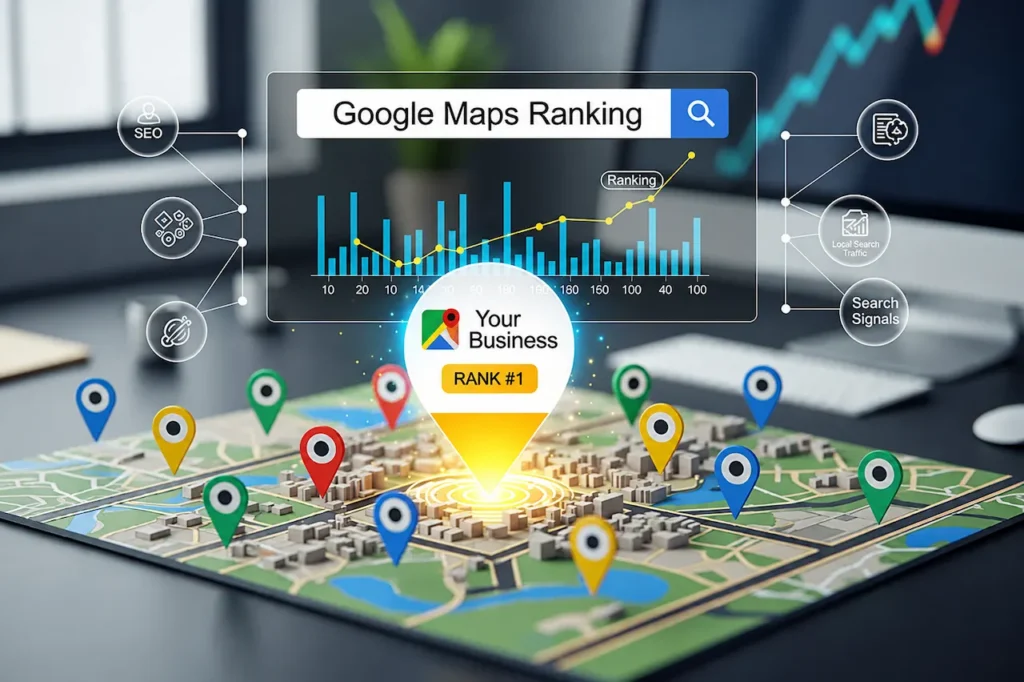
Google’s own Business Profile documentation is direct about this: local ranking comes down to three factors how well a profile matches what’s being searched (relevance), how close the business is to the searcher (distance), and how well-known and trusted the business is (prominence). Everything else categories, reviews, citations, website quality is a lever that moves one of those three dials. Nothing else exists outside them.
That’s a useful filter for bad advice. If a tactic doesn’t plausibly improve relevance, distance, or prominence, it’s not going to move your ranking no matter how often it shows up in a “10 tips” listicle.
Layer 0 — Are you even listed correctly?
Before ranking is even possible, your profile has to exist and be claimed by you specifically.
- Already listed, unclaimed: Google auto-generates profiles from public data. Search Google Maps for your business name if you see “Own this business?” or “Claim this business,” someone else (or no one) currently controls it.
- Not listed at all: You’ll need to create a profile from scratch through your Google Business Profile dashboard, selecting the category that most precisely matches your core service.
- Verification pending: Google won’t publicly rank a profile until verification completes typically by phone, email, or a video walkthrough of your business. An unverified profile is invisible in search results, full stop, regardless of how well it’s optimized otherwise.
The 6 layers that control Maps rankings
Layer 1 — Eligibility
Before anything else ranks, your profile has to be allowed to rank at all.
- Is the GBP verified, or still pending?
- Any active suspension soft (listing hidden but dashboard accessible) or hard (account access itself restricted)?
- Any Google-flagged duplicate listings for the same address?
- Does your business name match your legal/storefront name exactly no keyword-stuffed additions like “Dallas Plumbing Co – Emergency 24/7”? This is one of the single most common triggers for a sudden ranking collapse, because it’s a direct guidelines violation.
The most common real-world suspension triggers, in order of frequency: keyword stuffing in the business name, using a PO box or virtual office as a physical address, no genuine physical presence for a storefront-type listing, and Google’s spam system flagging the listing as potentially fake. A quieter version of this “limited visibility” can also apply without a full suspension, often triggered by category mismatches or too many profile edits in a short window.
Optimization work on a profile with an eligibility problem is wasted effort. Fix this layer first, always — it’s also the fastest to check and the one most guides skip past too quickly.
Layer 2 — Relevance
Does Google understand what you do and match you to the right searches?
- Primary category — this outweighs most keyword-based tactics combined. A roofer whose GBP primary category is “General Contractor” is fighting an uphill battle for “roofer near me” searches, and no amount of posting fixes a category mismatch.
- Secondary categories — list every genuinely accurate one; an HVAC company should pair “HVAC Contractor” as primary with “Air Conditioning Repair Service” and “Heating Contractor” as secondary, not stop at one.
- Business description — up to 750 characters, written for humans, naturally mentioning your core services and service area rather than stuffed with repeated keywords.
- Linked landing page relevance — does the page your GBP points to actually talk about the service being searched? See our local SEO services guide for how this should be structured.
This is also where trade-specific nuance matters. A plumber, an electrician, and a roofer are all “home services,” but Google treats their category taxonomies, common search phrasing, and competitive landscape differently which is why we maintain separate playbooks for local SEO for plumbers, electricians, HVAC companies, roofers, dentists, law firms, and restaurants rather than one generic template.
Layer 3 — Distance / proximity
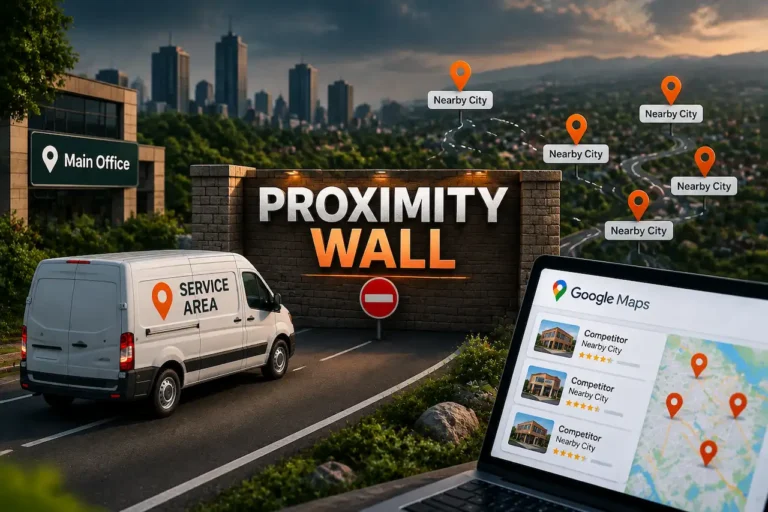
This is the layer most business owners never learn, and it’s why the plumber above ranks #2 near his office and disappears three miles out.
Google’s local algorithm weighs the searcher’s location heavily. There is no setting that expands your ranking radius “service area” configuration tells Google where you serve, not where you’ll rank. A realistic (illustrative, not universal) pattern looks like:
| Distance from business | Typical ranking range |
|---|---|
| Within 2 miles | Position 1–3 |
| ~5 miles | Position 5–10 |
| 10+ miles | Position 15+ or off-map entirely |
This also explains a pattern business owners notice constantly and rarely understand: ranking #1 for “[service] in [city]” while being nowhere for “[service] near me.” “Near me” is resolved almost entirely by the searcher’s live location proximity dominates that query type far more than a city-name search does, where relevance and content matching carry more relative weight.
Service area businesses — plumbers, electricians, cleaners, and similar trades that don’t host walk-in customers still provide Google a real physical address for verification purposes; it’s simply hidden from public view, replaced with a shaded service-area boundary on the map. But listing more cities in that service-area setting doesn’t expand where you rank. It’s informational, telling customers where you’ll travel — not a ranking lever. Ranking in a neighboring city still has to be earned through Layer 4 and 5 signals, which is exactly why doorway-style “one page per city with nothing unique” tactics fail; we cover that expansion problem specifically in our companion guide on ranking in multiple cities.
If your business genuinely needs visibility further out, the fix isn’t a GBP setting — it’s Layers 4 and 5 working together to build enough authority to compete despite the distance disadvantage, or in some cases, a genuine second location.
Layer 4 — Prominence / authority
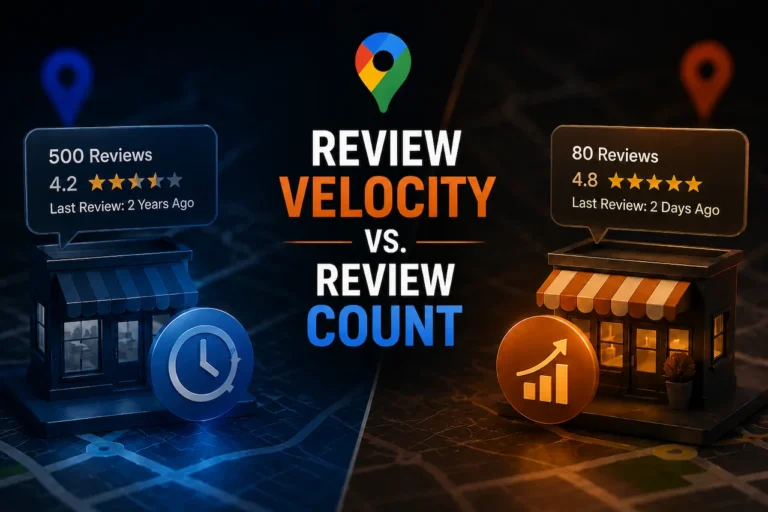
- Review count and review velocity — steady, ongoing reviews are a stronger signal than a large historical total with no recent activity.
- Review quality and specificity — reviews mentioning services and neighborhoods carry more relevance signal than “great service!”
- Citation consistency — across directories accuracy matters more than volume.
- Backlinks and local authority — press mentions, association listings, community references.
A business with 80 detailed, steadily-arriving reviews and a few solid local citations regularly outranks a competitor with 500 generic reviews and no authority signals elsewhere. Volume alone isn’t the whole story — Google is reading what the reviews say, not just counting stars.
Layer 5 — Website strength
GBP and your website aren’t separate disciplines Google cross-references them directly.
- Dedicated service pages, not one page trying to cover everything
- NAP (name, address, phone) consistency between your site and GBP, down to formatting
- Crawlability, indexing, and basic technical health
- LocalBusiness and Service schema
- Increasingly, content structured clearly enough for AI-driven local discovery the same AEO formatting principles covered in our AI search optimization guide now factor into how confidently both Google and AI assistants recommend a business by name.
Layer 6 — Competitive context
Once the first five layers are clean, the real question is: what does the business outranking you have that you don’t? Compare categories, review profiles, link authority, and location-page depth directly against the top 3 results not against a generic checklist. This is exactly the layer-by-layer comparison we run in a full local SEO audit.
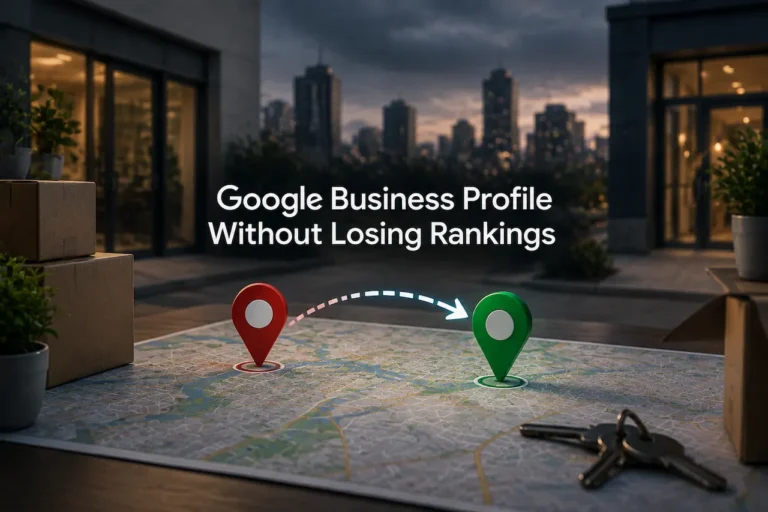
The safe way to change your business address
Address changes are one of the most common self-inflicted suspension triggers, because Google’s fraud detection watches location edits closely. The sequence that avoids a flag:
- Update the address across your website first (footer, contact page, schema).
- Sync the new address across major directories Yelp, YellowPages, industry-specific listings.
- Wait roughly a week for Google to crawl and index the new address on your own domain.
- Only then update the address in your GBP dashboard by that point, Google can cross-verify the change against already-indexed data instead of treating it as an isolated, unverified edit.
Why rankings sometimes drop after business hours
A pattern some business owners notice and few understand: a listing ranks well during open hours and drops or disappears after closing. For certain categories, Google deprioritizes closed businesses in favor of currently-open competitors, on the reasoning that a searcher wants somewhere they can act on immediately. If your rankings look strong at 2pm and vanish at 8pm, this not a technical problem is usually why.
The troubleshooting workflow
- Confirm the listing is claimed and verified
- Check for suspension or limited-visibility status
- Verify primary category matches actual search intent
- Compare grid rankings at 1, 3, 5, and 10 miles
- Compare your top 3 competitors directly, layer by layer
- Audit the landing page your GBP links to
- Evaluate review count, velocity, and specificity
- Check citation consistency across directories
- Assess backlinks and local authority
- Confirm organic (non-map) visibility for the same terms
- Check whether the drop correlates with a recent edit (name, category, address, hours)
- Measure actual calls and form submissions — not just ranking position
What usually doesn’t fix it
- Posting on GBP every day — posting frequency isn’t a major direct ranking factor; it doesn’t compensate for a relevance or proximity problem.
- Keyword-stuffing the business name — violates Google’s guidelines outright and risks suspension (see Layer 1).
- Buying hundreds of citations at once — inconsistent or low-quality citations can hurt more than help.
- Asking customers to stuff keywords into reviews — reads as inauthentic and can trigger review removal.
- Listing 20+ service-area cities hoping to rank in all of them — service areas are informational, not a ranking lever (see Layer 3).
- Creating near-identical city pages — a Layer 5 fix applied without genuine differentiation risks a doorway-page problem.
- Assuming more reviews always beats fewer, better reviews — see Layer 4.
FAQ
Why do I rank #1 near my office but disappear a few miles away?
This is Layer 3 proximity. Google weighs the searcher’s distance from your business heavily, and no GBP setting expands your ranking radius. Competing further out requires stronger authority and relevance signals to offset the distance disadvantage.
Why do I rank for “[service] in [city]” but not “[service] near me”?
“Near me” searches are resolved almost entirely by the searcher’s live location, so proximity dominates far more heavily than it does for a city-name search, where content relevance carries more relative weight.
Is a Google Business Profile free?
Yes creating, claiming, verifying, and optimizing a profile costs nothing. Google doesn’t charge placement or subscription fees for standard organic Maps visibility.
What’s the difference between a brick-and-mortar listing and a service area business?
A brick-and-mortar listing shows your exact address publicly, for businesses customers physically visit. A service area business (plumbers, electricians, cleaners) hides the address and shows a shaded service boundary instead, since customers are visited rather than visiting.
Can I set up a Google Business Profile without a public address?
You still must provide Google a real, verifiable address privately for verification you’re just given the option to hide it from public view by selecting “no” when asked if customers visit your location, which classifies you as a service area business.
Could my Google Business Profile be suspended or limited without me realizing?
Yes, “Limited visibility” is a quieter version of suspension that can trigger from category mismatches, virtual office or PO box addresses, spam-filter flags, or too many edits in a short window and a listing in this state will not rank until corrected.
Do Google Business Profile posts actually improve rankings?
Posting keeps a profile active and can support engagement, but it isn’t a major direct ranking factor. If posting is consistent but rankings still aren’t moving, look at Layers 1–5 instead.
Do citations still matter for Google Maps rankings?
Yes, primarily for consistency mismatched NAP data across directories creates confusion that can suppress rankings. Accuracy matters far more than raw citation volume.
Does review velocity matter more than total review count?
Both matter, but steady, ongoing reviews are a stronger signal than a large historical total with no recent activity. A business actively earning new reviews signals current relevance.
Why do competitors with fewer reviews outrank my business?
Usually category relevance, proximity to the searcher, or stronger backlink and citation authority review count is one signal among several, not the deciding one.
Should my GBP link to my homepage or a dedicated landing page?
A dedicated, service-specific landing page almost always outperforms a generic homepage, since it lets Google match page content directly to the search query.
Do service areas matter, and should I list every city I’m willing to drive to?
They matter for informing customers, but they are not a ranking lever listing 20 cities doesn’t make you rank in those 20 cities. Ranking further out has to be earned through authority and relevance, not configuration.
Why don’t I rank in nearby cities even though I clearly serve them?
The map pack is hyper-local by default, and you’ll rank strongest near your verified address. Reaching neighboring cities requires genuine local content, citations, and authority signals built over time not just adding the city to your service area list.
How do I safely change my business address without risking suspension?
Update your website and directories first, wait roughly a week for Google to index the change on your own domain, then update your GBP this lets Google cross-verify the edit instead of treating it as an isolated, unverified change.
Why do my rankings drop after business hours?
For some categories, Google deprioritizes closed listings in favor of currently-open competitors a pattern that looks like a technical problem but usually isn’t one.
How do I know if my local SEO is generating leads, not just rankings?
Track calls and form submissions from GBP and organic separately in Google Search Console and call tracking ranking position alone doesn’t confirm lead volume.
What matters most: proximity, reviews, GBP optimization, website SEO, or citations?
None of them independently they interact. A relevance problem can’t be fixed by more reviews, and a proximity disadvantage can’t be fully solved by GBP optimization alone. Diagnose in the order above.
How long should local SEO take before producing calls and leads?
Most businesses see initial GBP-related movement within 4–8 weeks; meaningful organic and citation-driven authority gains typically take 3–6 months to compound.
What should I check first when my ranking suddenly drops?
Layer 1 first check for a suspension, guidelines violation, or a recent edit to name, category, address, or hours before assuming it’s competitive or algorithmic.
By Taqweem Ahmad | Founder, Dexora Digital
We’ve applied this exact framework in engagements like our WNY Tennis local SEO and AI search case study and our Sacramento, California site plans case study — both diagnosed layer by layer rather than treated as a single generic optimization pass.