


By Taqweem Ahmad | Founder, Dexora Digital | 7+ Years SEO | 500+ Audits | July 2026
In 1999, Seth Godin published Permission Marketing and described something that most advertisers refused to accept: that interruption was failing.
Television ads interrupted the programme you were watching. Cold calls interrupted your afternoon. Direct mail interrupted whatever you were doing when you walked to the letterbox. Billboards interrupted your commute. The entire advertising model was built on capturing attention that was pointed somewhere else and redirecting it toward a commercial message the audience never asked to receive.
Godin’s argument was simple. Interruption marketing was getting noisier, more expensive, and less effective simultaneously. The alternative — marketing that is anticipated, personal, and relevant, delivered to people who have explicitly asked to receive it — would outperform interruption on every meaningful metric over time.
It took twenty-five years, but local SEO has become the most precise implementation of Godin’s permission marketing framework that has ever existed. And most local businesses using it are still running it like an interruption strategy.
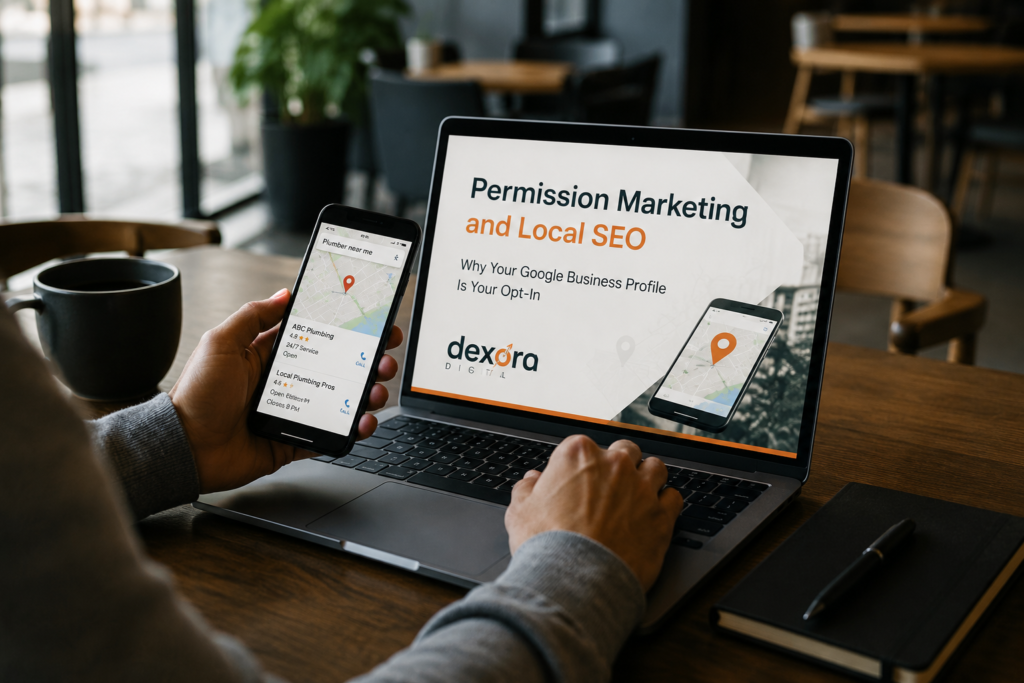
When a homeowner searches ’emergency plumber near me’ and your business appears in the Google Maps 3-pack, they are not being interrupted. They raised their hand. They gave you permission. That is the most valuable moment in local business marketing — and most businesses squander it.
This article applies Godin’s permission marketing framework to local SEO, Google Business Profile strategy, and the complete customer acquisition process for local service businesses. The framework clarifies not just what local SEO is, but why it works the way it does — and what most businesses are doing wrong by treating a permission channel as if it were an interruption channel.
Seth Godin’s Permission Marketing Framework — The Three Requirements
Godin defined permission marketing as marketing that is delivered only when three criteria are met simultaneously. The marketing must be:
1. Anticipated
The recipient is expecting to receive it. They have taken an action that signals readiness for the message. Not passive awareness — active anticipation. They searched for something. They subscribed. They clicked. They asked.
2. Personal
The message is relevant to that specific person in that specific moment. Not broadcast to the largest possible audience in hopes that some fraction is relevant. Addressed to someone whose specific need or interest has been identified.
3. Relevant
The content of the message directly addresses what the person cares about in the moment they receive it. Not a general promotional message. A specific response to a specific need that the recipient has already signaled.
Godin contrasted this with interruption marketing, where none of the three criteria are met. The television viewer did not anticipate a car commercial during the news. The message is not personal to them specifically. And whether it is relevant depends entirely on chance — a fraction of viewers happen to be in the market for a car.
The business that builds permission marketing assets — that earns the right to deliver anticipated, personal, relevant messages — outperforms the business buying interruptions at scale. Not because interruption has zero value, but because permission is more efficient at every stage of the conversion process.
Permission principle:
Godin described permission as a spectrum, not a binary. Some marketing has a little permission — you visited a website once. Some has a lot — you subscribed specifically to receive weekly tips. The more permission you have, the more efficiently your marketing converts.
Why Local SEO Is the Most Powerful Permission Marketing System Ever Built
Apply Godin’s three criteria to what happens when a local business ranks in the Google Maps 3-pack.
Is It Anticipated?
A homeowner’s boiler breaks at 9pm. They pick up their phone and search ’emergency boiler repair near me.’ They are not passively browsing. They have a specific, urgent problem and they are actively looking for a solution. The appearance of your business in the map pack is not an interruption — it is the answer to a question they just asked.
That is not just anticipated. That is peak anticipation. The prospect has never been more ready to receive your message than at the moment they have typed a search query that your business ranks for.
Is It Personal?
The map pack result is personalized to this specific user’s location, search history, and local relevance signals. It is not broadcast to everyone in the city. It appears to this specific person, at this specific location, at this specific moment, in response to their specific query. The level of personalization is far beyond anything possible in traditional advertising.
Is It Relevant?
The user searched ’emergency boiler repair near me.’ Your listing says ‘Emergency Boiler Repair — Available 24/7 — 4.9 stars — 127 reviews.’ The match between what they searched for and what you offer is direct. There is no audience filtering required. No demographic targeting. No lookalike modelling. The relevance is built into the channel — the person who sees your listing is the person who searched for exactly what you do.
Local SEO earns anticipation, personalization, and relevance simultaneously — the three requirements Godin said made marketing efficient. No other channel for local businesses achieves all three at the moment of highest buyer intent.
This is why local SEO converts at a higher rate than almost any other local marketing channel. Not because of any technical advantage. Because it is structurally a permission marketing channel — it only reaches people who have already opted into looking for you.
Interruption vs Permission — The Local Marketing Channel Comparison
Most local businesses run a combination of interruption and permission marketing without consciously categorising either. This comparison makes the distinction explicit.
| Channel | Interruption or Permission? | Why |
| Facebook / Instagram Ads | Interruption | User was scrolling for other content. Ad appeared uninvited. |
| Google Maps 3-pack | Permission | User searched specifically for this type of business. They initiated. |
| Cold calling | Interruption | Prospect did not request contact. Pure interruption. |
| Google organic search | Permission | User typed a query. Your result is a response to their request. |
| Direct mail | Interruption | Recipient did not request the material. Arrived unsolicited. |
| Google Business Profile | Permission | User clicked your listing. They chose to learn more. |
| Billboard advertising | Interruption | Audience was driving somewhere else. Message was forced into view. |
| Review request text | Permission — earned | Client completed a job. Message is expected, personal, and relevant. |
| Angi / HomeAdvisor leads | Near-interruption | Lead shared across multiple contractors. No specific choice made. |
| Email from organic opt-in | Permission — maximum | Visitor came from organic search, chose to subscribe. Double permission. |
The table reveals something important about where local businesses typically spend their marketing budget. Most small service businesses spend the majority of their marketing budget on interruption channels — Facebook ads, Angi lead packages, direct mail — while underinvesting in the permission channels that convert at the highest rate.
Your Google Business Profile Is Your Opt-In Mechanism
In Godin’s original framework, the opt-in was a subscription. The customer visited a website, saw an offer of value, and provided their email address in exchange for receiving future marketing. The email address was the permission asset. The subscriber list was the business’s most valuable marketing asset.
In local SEO, the Google Business Profile plays the structural role of the opt-in. Not an email opt-in — a discovery opt-in. When a prospect finds your GBP listing in the map pack and clicks on it, they have done something far more significant than most business owners recognise: they have chosen you over every other listing on the same page.
What Happens When Someone Clicks Your GBP
A map pack click is a micro-permission event. The prospect has seen your name, your rating, your review count, your photos, and your brief description. They have compared you against the two other businesses in the 3-pack. And they clicked on you.
That click is not passive. It is a decision. It signals:
-> I have enough initial trust to investigate further
-> Your rating and review count cleared my initial threshold
-> Your category and service description matched what I searched for
-> I have given you permission to make your case
Most businesses treat a GBP click as nothing more than a traffic event. The right mental model is to treat it the way an email marketer treats a new subscriber: this person has given me permission. Now I need to make the most of it.
The GBP Profile as a Conversion Asset
Godin’s insight about permission marketing was that once you have permission, the quality of your communication determines whether you keep it and deepen it, or lose it. A subscriber who receives poor emails unsubscribes. A prospect who clicks your GBP listing and finds incomplete information, no photos, a 3.2-star rating, and business hours that have not been updated since 2022 — that prospect leaves.
Optimising your Google Business Profile is not a technical SEO task. It is the act of honouring the permission you have been given. The prospect clicked. They gave you a moment. What you show them in that moment determines whether they call, or go back and click the next listing.
What a Permission-Optimised GBP Looks Like
| GBP Element | Interruption Approach | Permission Approach |
| Photos | 5-10 stock images or none | 50+ recent job photos, before-and-after, team, equipment |
| Description | Generic ‘we are a plumbing company’ | Specific services, specific service area, specific differentiator |
| Review count | Whatever happened organically | Active acquisition strategy — 3-5 new reviews per week |
| Review responses | None or generic ‘thanks’ | Specific, personal responses to every review within 24 hours |
| Services section | Primary category only | Every specific service listed with individual descriptions |
| Posts | Never updated | Weekly update — offer, project, tip, or seasonal message |
| Q&A section | Unanswered or empty | Pre-populated with your own questions and authoritative answers |
| Hours | Basic hours only | All hours accurate including holidays and emergency availability |
Local SEO Services — Google Business Profile optimization as part of every local campaign.
The Permission Chain — From Search Query to Recurring Client
Godin described permission as something that deepens over time. The first permission is shallow — the subscriber barely knows you. As the relationship develops and you consistently deliver value, permission deepens. The deeply permissioned customer buys repeatedly, refers others, and defends the brand.
Local SEO creates an identical permission chain. Every local business has the opportunity to build this chain systematically. Most stop at the first or second step.
The Five Steps of the Local Permission Chain
| Step | Event | What Is Happening | Permission Level | Most Businesses Stop Here |
| 1 | Search query typed | Prospect has a need. They are actively looking. They do not know you yet. | Potential permission | Most never reach step 2 |
| 2 | Map pack appearance | Your business is visible. Prospect sees your name and rating for the first time. | Awareness permission | Many stop here — never get the click |
| 3 | GBP profile click | Prospect chose to investigate you specifically. Trust threshold cleared. | Discovery permission | Most fail here with incomplete profiles |
| 4 | Phone call or form | Prospect contacted you directly. Maximum intent signal. | Contact permission | Many fail here with slow response times |
| 5 | Job completed — review request | Client received value. Request is anticipated, personal, relevant. | Relationship permission | Most never ask. Reviews happen by chance. |
| 6 | Review published + response | Public social proof. New prospects see evidence. Cycle begins again. | Community permission | Rarely managed actively |
| 7 | Email capture from website | Prospect subscribed for future value. Long-term relationship channel. | Deep permission | Almost no local businesses do this |
The businesses that dominate their local market are the ones who have built all seven steps into a system. Every step that fails is a permission relationship that was started and then abandoned.
Review Requests Are Permission Marketing — When Done Right
Godin’s three criteria for permission marketing apply directly to the post-job review request. Consider what a well-timed review request looks like from the client’s perspective.
The Text Message Sent Within Two Hours of Job Completion
Hi [Client Name], this is [Technician] from [Company]. Thank you for having us out today — the [job] is sorted and ready to go. If you have a moment, a Google review helps us a lot and takes about 60 seconds: [link]. No obligation at all — just wanted to say thanks. Have a great evening.
Does This Review Request Meet Godin’s Three Criteria?
-> Anticipated? Yes. The client just received a completed service. The relationship is active. A follow-up message from the business is entirely expected.
-> Personal? Yes. The message uses their name. References the specific job. Comes from the technician who was there. It is one of the most personal messages a business can send.
-> Relevant? Yes. The review request arrives at the exact moment the client’s experience is most vivid and most positive. It is directly relevant to what just happened.
This is pure permission marketing. It works not because of clever copywriting but because it is structurally a permission interaction: the client is expecting follow-up, the message is specific to them, and the timing makes it immediately relevant.
Compare this to a Facebook ad targeting homeowners in the area with ‘Leave us a Google review.’ That is an interruption. It has no anticipation (the user was not expecting it), no personal relevance (they may not even be a client), and no relevant timing. The permission review request converts at 15 to 25 percent. The interruption review request converts at near zero.
15-25% conversion rate on text message review requests sent within 2 hours of job completion — Dexora Digital local SEO client data
The Compounding Effect of Review Permission
Each review earned through this permission process does two things. First, it deepens the relationship with the reviewer — they have publicly endorsed you, which increases their likelihood of becoming a repeat and referral client. Second, it provides social proof that earns permission with the next prospect.
A prospect who sees 200 reviews averaging 4.9 stars is not seeing advertising. They are seeing 200 previous clients who gave permission to be associated with your business. That is the most credible form of social proof available — peer permission, not brand claims.
This is why review velocity matters as much as review rating. A business with 200 reviews did not generate them by accident. It built a permission system — a consistent process for requesting reviews at the right moment, in the right way, from clients who have genuine reason to say yes.
Result:
100+ US businesses ranked in the Google Maps 3-pack by Dexora Digital. In every case, a review acquisition system was part of the local SEO engagement. The businesses with the highest review velocity consistently outperform competitors with better domain authority because the review count and recency signals carry significant weight in local pack rankings.
Google Ads case study — HRS Birmingham, outranking Angi.com in auction.
Email Capture From Organic Traffic — The Deepest Local Permission
Most local businesses think of email marketing as something that large brands do. Newsletter campaigns, promotional emails, drip sequences — it feels disconnected from the immediate, transactional nature of local service business marketing.
This is a significant missed opportunity, and it is entirely a framing problem.
What Organic Traffic Represents
When a homeowner finds your plumbing business by searching ‘plumber near me’ and visits your website, they are in the highest possible permission state. They searched. They clicked. They are on your website reading about your services. They are not a cold lead. They have already given two layers of permission — the search and the click.
Most local business websites do nothing with this visitor except show them a phone number and a contact form. Some convert immediately by calling. Many do not — they are researching, comparing, or not quite ready to commit. They leave. The permission they gave is lost.
The Local Permission Capture Mechanism
Godin’s insight about email lists was that they convert permission into an asset. A subscriber list is valuable because each subscriber represents accumulated permission that you can deliver future messages to. The same logic applies to local businesses with organic traffic.
A simple email capture mechanism on a local business website — in exchange for something genuinely useful — converts visiting traffic into a permission asset:
-> A plumber: ‘Free guide — 5 things to check before calling a plumber for a common drain problem’ captures email addresses from research-stage visitors
-> A dentist: ‘Free guide — Understanding dental implant costs in [city]’ captures emails from people researching treatment options
-> An HVAC company: ‘Free pre-season checklist — get your system ready before the rush’ captures emails before the high-season surge
-> An SEO agency: ‘Free site audit in 60 seconds’ — this is precisely what Dexora does at /seo-audit/
These are not email list gimmicks. They are permission conversions — transforming a one-time visit into a sustained permission relationship. The visitor who downloads the guide is saying: I trust you enough to give you my email address. I would like to hear from you again.
That is the deepest form of local permission outside of an existing client relationship. And almost no local businesses are capturing it.
Free SEO Audit — Dexora’s own permission capture mechanism.
The Permission Mistakes Most Local Businesses Make
After 500-plus website audits, the same permission failures appear consistently across local service businesses in every market.
Mistake 1 — Treating Local SEO as an Interruption Channel
The most common mistake is running local SEO with an interruption mindset. This looks like: using the GBP description to broadcast a promotional message rather than to serve the information needs of someone who just searched. Writing service pages that talk about the business rather than answering the searcher’s questions. Treating Google as a billboard rather than as a response to a question that was asked.
Interruption trap:
A GBP description that says ‘We are the best plumbing company in Phoenix with 20 years of experience and competitive pricing’ is interruption marketing on a permission channel. It talks about the business. It does not serve the searcher who asked ’emergency plumber near me’ at 11pm with a flooded kitchen.
Mistake 2 — Not Asking for Reviews
Reviews are the permission currency of local SEO. They are what converts a first-time visitor into a qualified prospect — the evidence that 47 previous clients trusted this business enough to publicly endorse it.
Most businesses generate reviews only when a client volunteers to leave one, which happens for approximately 3 to 5 percent of happy clients unprompted. A business completing 20 jobs per week and not requesting reviews generates 3 to 5 reviews per month by chance. The same business with a systematic review request process generates 15 to 25 per month. The difference compounds month over month into a review count that separates them from every competitor in the map pack.
Mistake 3 — Abandoning Permission After the First Job
The most valuable permission a local business has is from its existing client base. Clients who have used your service once, had a good experience, and remember your name are the highest-permission audience you will ever have. They are more likely to hire you again, to refer you, and to leave a review than any cold prospect.
Most local businesses do not actively maintain this permission. There is no follow-up process. No seasonal communication. No reason for the client to think of them when the next need arises — which often goes to whichever competitor shows up first in a new Google search.
The businesses that dominate their local market long-term are the ones that treat existing clients as a permission asset to be cultivated, not a transaction to be completed.
Mistake 4 — Buying Interruption Leads While Underinvesting in Permission
Angi, HomeAdvisor, Thumbtack, and similar platforms sell leads — but they are not permission leads. The prospect on these platforms has not chosen your business. They have described a need and the platform has distributed it to multiple contractors simultaneously. The prospect did not anticipate hearing from you specifically. The message is not personal to a choice they made. The relevance depends on who responds fastest, not on any genuine match.
These platforms have their role, particularly for businesses without established local SEO. But a business that spends $2,000 per month on lead platform subscriptions while investing nothing in the permission channel that would generate higher-quality, lower-cost leads at a compounding rate — is choosing short-term interruption over long-term permission.
Building a Permission-First Local Marketing System
The practical implementation of permission marketing for a local service business is a sequence of systems, each building on the previous one.
Step 1 — Build the Permission Foundation (Months 1-3)
1. Optimise your Google Business Profile completely — every section, every photo, every service listed, hours accurate, description serving the searcher not broadcasting about you
2. Implement local citation consistency — NAP matching across every directory so Google can confidently identify your business as a real, specific entity
3. Build location-specific service pages on your website that serve the information needs of searchers in your market
4. Implement LocalBusiness schema on your website to confirm your entity signals to both Google and AI systems
Step 2 — Activate the Review Permission System (Month 1 onward)
1. Create a text message template for post-job review requests with a direct Google review link
2. Send within 2 hours of every completed job — anticipation is highest in that window
3. Respond to every review, positive and negative, within 24 hours — specifically and personally
4. Track weekly review velocity as a key performance metric alongside rankings and traffic
Step 3 — Add the Website Permission Capture (Month 2-3)
1. Create one genuinely useful lead magnet specific to your service category and local market
2. Add a simple email capture form to your homepage and key service pages
3. Set up a 3-email welcome sequence that delivers value before making any offer
4. Send a monthly email to the list with a genuinely useful tip, seasonal advice, or case update
Step 4 — Build the Existing Client Permission System (Month 3 onward)
1. Export your completed job list and segment by client type, last service date, and service category
2. Send a seasonal message before high-demand periods — HVAC before summer, plumbing before winter
3. Create a referral request process — existing clients who have given deep permission are your highest-converting referral source
4. Track client lifetime value against the permission depth — clients reached through organic local SEO vs platform leads
The permission-first local business does not just run SEO. It builds a system where every customer interaction deepens the permission relationship — from search to click to call to job to review to referral. That system compounds. The interruption approach resets to zero every month.
Why the Permission vs Interruption Gap Is Widening in 2026
Godin wrote Permission Marketing in 1999 because he could see that interruption channels were becoming less effective as the volume of interruptions increased. The same dynamic is accelerating in local marketing in 2026, for three specific reasons.
AI Search Is Pure Permission
ChatGPT, Perplexity, and Google AI Overviews respond to questions. A user who asks an AI system ‘who is the best electrician in Austin’ is giving maximum permission — they are explicitly requesting a recommendation. AI systems cite businesses based on their authority signals, entity clarity, and content quality. The permission-first businesses that have built strong GBP profiles, review counts, schema markup, and FAQ content are the businesses AI systems recommend. The interruption businesses that rely on paid platforms are invisible.
AI Search Optimization — AEO and GEO services.
Ad Costs Are Rising, Organic Compound Value Is Not
The cost per click for local service keywords on Google Ads has increased consistently year over year. The cost per lead from Angi and HomeAdvisor has increased as more contractors compete for the same lead pool. Interruption marketing costs are rising.
The businesses that invested in permission channels — local SEO, reviews, email lists, existing client relationships — are watching their cost per lead decrease as their organic presence compounds. The assets they built three years ago are still generating leads today without additional investment. The cost per lead from organic local SEO in year three is lower than in year one, and dramatically lower than equivalent paid channels maintained for the same period.
Consumer Trust in Interruption Is at an All-Time Low
Banner blindness. Ad blockers. Spam filters. Skip ads. ‘Do not call me’ registries. Every year, consumers develop new tools and habits for filtering out interruption marketing. The value of each interruption impression is declining as the filtering gets better.
At the same time, the trust value of permission marketing is increasing. A business with 300 Google reviews at 4.9 stars is more trusted than a business with a larger advertising budget and fewer reviews, because the reviews represent real permission events — clients who chose to publicly endorse the business.
Frequently Asked Questions
Q: What is permission marketing and how does it apply to local businesses?
A: Permission marketing, a concept described by Seth Godin in 1999, is marketing that is anticipated, personal, and relevant — delivered only to people who have signaled readiness to receive it. For local businesses, the clearest application is local SEO: when a prospect searches for your service and your business appears in Google Maps, they initiated the contact. They gave permission. This is structurally different from any interruption channel, which reaches people who did not ask for the message. The permission nature of local SEO is why it converts at higher rates than Facebook ads, direct mail, or lead platform purchases for most local service businesses.
Q: Is Google Business Profile actually an opt-in mechanism?
A: Structurally, yes. When a prospect finds your GBP listing in the map pack and clicks on it, they have made a deliberate choice to learn more about your business — specifically, from a list that included alternatives. That click is an opt-in decision. It signals that your name, rating, and brief description cleared their initial trust threshold. The GBP profile they land on is the equivalent of the landing page that either converts the opt-in into a lead or loses it. Most local businesses optimise their GBP as a directory listing rather than as the conversion asset it is.
Q: How does a review request qualify as permission marketing?
A: A text message review request sent within 2 hours of completing a job meets all three of Godin’s permission criteria. It is anticipated — the client just received a service and a follow-up message from the business is entirely expected. It is personal — the message references the specific job, uses the client’s name, and comes from the technician who was present. It is relevant — it arrives at the moment the experience is most vivid and positive. Compare this to a Facebook ad asking for a Google review targeted at homeowners in the area — that has no anticipation, no personalization, and no relevant timing. The permission request converts at 15 to 25 percent. The interruption request converts at near zero.
Q: Why do Angi and HomeAdvisor leads convert worse than local SEO leads?
A: Because they are interruption leads, not permission leads. On Angi or HomeAdvisor, the prospect described a need and the platform distributed it to multiple contractors simultaneously. The prospect did not choose you — the platform sent you their information along with 3 to 5 competitors. There is no anticipation (they did not expect you specifically), no personalization (you are one of several businesses they will hear from), and no genuine relevance beyond category match. A prospect who found you through a Google Maps search and clicked on your listing made a specific choice. That choice represents a higher permission level that converts at a higher rate.
Q: How can a local business capture email permission from organic traffic?
A: By offering something genuinely useful to a visitor who is in research mode. The most effective local business lead magnets are service-specific and locally relevant: a plumbing company’s guide to diagnosing common issues before calling; a dentist’s breakdown of implant costs in their city; an HVAC company’s seasonal maintenance checklist. The offer converts a one-time visit into a sustained permission relationship. The visitor is saying: I trust you enough to give you my email and I would like to hear from you again. That is a deeper permission level than a single website visit, and it creates a follow-up channel that most competitors are not using.
Q: What is the most common permission marketing mistake local businesses make?
A: Treating the Google Business Profile as a broadcast medium rather than a response to a permission interaction. The businesses that fail at local SEO tend to write GBP descriptions that talk about themselves — ‘we are the best in the city, 20 years of experience, competitive pricing.’ These are interruption messages on a permission channel. The businesses that win write GBP descriptions that serve the specific information needs of someone who just searched for their service at a specific moment of need — what they do, exactly where, and why the prospect can trust them to do it well. The same mistake appears in how businesses respond to reviews, write service pages, and structure their FAQ content.
Q: How long does it take to build a permission-first local SEO system?
A: The foundation — GBP optimisation, citation consistency, website service pages, schema markup — takes 30 to 60 days to build correctly. Review velocity builds over months as the acquisition process runs consistently. Email list growth from organic traffic is gradual in the first 6 months and accelerates as organic rankings improve. Existing client permission systems can be activated immediately since the client base already exists. Most local businesses see meaningful permission-driven lead flow within 90 days and compounding returns within 12 months. The system that takes 12 months to build then generates leads with decreasing cost per acquisition every subsequent month.
ABOUT THE AUTHOR
Taqweem Ahmad
Founder, Dexora Digital | Local SEO & AI Search Strategist | 7+ Years | 500+ Audits
Taqweem Ahmad founded Dexora Digital — a full-stack SEO and AI Search agency in Oulu, Finland. He has helped 100+ US local businesses rank in the Google Maps 3-pack and build organic lead generation systems that reduce dependency on paid advertising over time. His work covers Local SEO, Technical SEO, AI Search Optimization, and Google Ads.
Want to know where your local permission system stands right now?
We audit your Google Business Profile, review velocity, local citations, and AI search visibility — free, in 60 seconds.
Get My Free Local SEO Audit

Local SEO and AI Search (AEO & GEO) Specialist.
Building search visibility that converts into qualified demand.
Today, businesses need visibility on Google Maps and AI powered search and websites that actually convert visitors into leads. I am a Local SEO, AI Search & Conversion Rate Optimization (CRO) Specialist with 5+ years of hands on experience helping businesses turn underperforming websites into high converting growth engines. My work combines Local SEO, Technical SEO, Semantic SEO, GEO/AEO, and conversion focused landing page optimization to ensure brands are discoverable and profitable.
My Experience
I have delivered SEO and web growth projects across the US, UK, Australia, Canada, Finland, Germany, and the Czech Republic, working in industries such as local businesses (electrician, hvac, cleaning, Real estate, healthcare, B2B, eCommerce, SaaS, and environmental services.
Some Results
>> 200+ websites audited globally
>> specifically worked with 100+ local business (80% from USA)
>> 80+ websites improved through technical SEO & schema fixes
>> 20+ businesses featured in Google AI Overviews (SGE)
>> Multi million impression growth for eCommerce & SaaS brands
Book Free Consultation: calendly.com/dexora/30min