
By Taqweem Ahmad, Founder of Dexora Digital
June 24, 2026
Google released a spam update today and told us almost nothing about it.
That is not a complaint. That is the pattern. Spam updates are quiet by design. No new policy. No blog post. One line on a status dashboard at 9:03 a.m. Pacific time. And yet if your traffic moves in the next few days, this single line is the most likely reason.
Here is everything confirmed so far, what it means, and exactly what to check on your own site.
What Actually Happened
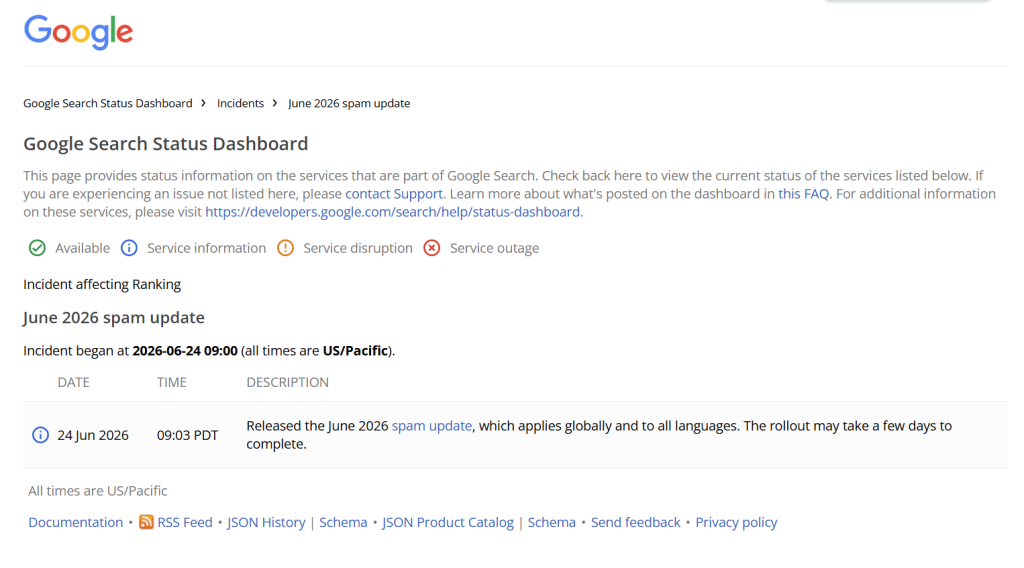
Google began rolling out the June 2026 spam update at 9:00 a.m. PT on June 24, 2026. The release note on the Google Search Status Dashboard reads simply: released globally, applies to all languages, rollout may take a few days to complete.
That is the entire announcement. No companion blog post. No named target. No new spam policy attached to it.
This is the second spam update of 2026, following the March 2026 spam update. Spam updates work differently from core updates — they are improvements to Google’s automated spam-detection systems, including SpamBrain, its AI-based spam-prevention system, rather than the broad ranking model changes a core update represents. The distinction matters because it tells you what to look for if your site is affected: not a content-quality recalibration, but a detection-system refinement.
For the full breakdown of how spam updates differ from core updates and what each one historically targets, see our Google Core Update 2025-2026 Complete Analysis.
How This Compares to Recent Spam Updates
The rollout duration of a spam update is itself a signal worth tracking. Here is the recent pattern.
| Update | Duration |
|---|---|
| March 2026 spam update | Under 24 hours — fastest on record |
| June 2026 spam update | In progress — rollout begun June 24 |
| August 2025 spam update | Nearly 4 weeks |
A rollout finishing in under a day, like March 2026, generally suggests a narrow, well-defined detection improvement. A rollout running nearly a month, like August 2025, generally suggests a broader recalibration touching more of the index. We will not know which pattern June 2026 follows until Google marks it complete on the status dashboard — but the duration itself, once known, will tell us something the announcement text did not.
Why This Matters for Your Business
If your rankings or traffic shift in the days following June 24, this rollout is the first place to look before assuming something else is wrong.
Google’s own guidance is consistent across every spam update: if you see a change, review the existing spam policies, because no new policy was introduced with this release. And critically — improvements can take months for Google’s systems to reassess. A quick recovery is not the realistic expectation even for sites that identify and fix a genuine issue immediately.
This is the detail most businesses get wrong after any update. They make a fix, check rankings three days later, see no change, and conclude the fix didn’t work. The fix may be working exactly as intended. The system simply has not re-evaluated the site yet.

What to Check on Your Own Site Right Now
Mark June 24, 2026 in your reporting. Before reacting to any ranking movement over the coming days, you need a clean before-and-after line. Pull your Google Search Console performance data and flag this date explicitly, so you can separate this update’s effects from anything that rolls out after it — including the possibility of another core update layering on top, which has been a recurring pattern through 2025 and 2026.
Review the existing spam policies, not a new list. Since no new policy was announced, the relevant question is whether your site already has exposure to an existing spam vector: thin auto-generated content, manipulative link patterns, cloaking, or scaled content abuse. If you have not audited against these in a while, now is the moment.
Check whether the movement is even about you. Spam updates can shift the competitive landscape without anything on your own site changing — a competitor who was previously benefiting from a spam pattern may simply disappear from the results around you, changing your relative position without any action of your own.
Do not chase a fix for a problem you have not confirmed. The fastest way to make things worse after any update is reactive, unfocused changes made out of anxiety rather than diagnosis. Run a proper audit first. For the complete framework on diagnosing whether a traffic change is a manual action, an algorithmic update, or a technical issue, see our Technical SEO Audit Guide 2026.
The Pattern Underneath Every Spam Update
I have watched enough of these rollouts now to notice the same thing every time. The sites that get hurt by spam updates are almost never sites doing one big, obvious bad thing. They are sites that accumulated a dozen small, technically-against-policy shortcuts over years, none of which felt risky in isolation.
A spam update is SpamBrain getting incrementally better at noticing patterns it could not reliably catch before. That is the entire mechanism. Nothing about your business changed. Google’s ability to see what was already there did.
This is also why I keep telling clients that genuine, durable SEO has almost nothing to do with reacting to individual updates and almost everything to do with not needing to. A site built on real expertise, clean technical infrastructure, and content nobody else could have written has very little exposure to a spam detection improvement, because spam detection is, by definition, looking for the absence of those things.
For the technical foundation that keeps a site out of this conversation entirely, see our Technical SEO Guide and What Is EEAT SEO 2026.
What Happens Next
Google will update the Search Status Dashboard when the rollout completes. Until then, this remains an open, monitored event — not a confirmed conclusion. We will update this article with the completion date and any observed patterns once site owners and analysts begin reporting effects, the same way the actual targets of the March 2026 and August 2025 spam updates only became clear after the fact.
If you want a second opinion on whether your traffic movement this week is related to this update or something else entirely, run a free audit at allinoneseoaudit.com or book a call at dexoradigital.com/consultation.
Frequently Asked Questions
Q: What is the Google June 2026 spam update?
A: A global, all-language update to Google’s automated spam-detection systems, released June 24, 2026. It is the second spam update of 2026, following the March 2026 spam update. No new spam policy was announced alongside it.
Q: How is a spam update different from a core update?
A: Spam updates improve Google’s systems for detecting spam, including SpamBrain. Core updates are broad changes to Google’s overall ranking systems evaluating content quality and relevance. For the full distinction with examples from 2025 and 2026, see our Google Core Update Complete Analysis.
Q: My traffic dropped on June 24. Is this update the cause?
A: It is the leading candidate if the timing lines up, but confirm before assuming. Check Google Search Console for the specific date, review whether you have any exposure to existing spam policies, and rule out unrelated technical issues. Our Technical SEO Audit Guide 2026 walks through the full diagnostic process.
Q: How long will the June 2026 spam update take to roll out?
A: Unconfirmed as of this writing. Recent spam updates have ranged from under 24 hours (March 2026) to nearly four weeks (August 2025). Google will mark the dashboard complete once finished.
Q: If I fix a spam policy violation, how fast will my rankings recover?
A: Google’s own guidance states that improvements can take months for its systems to reassess. There is no guaranteed fast recovery, even for a correctly identified and fixed issue. Patience and correct diagnosis matter more than speed here.
Q: Should I make changes to my site right now because of this update?
A: Only if you have specifically diagnosed an issue. Reactive, unfocused changes made out of anxiety after an update announcement are one of the most common ways businesses make their actual position worse. Diagnose first.
Related Reading
Google Core Update 2025-2026 Complete Analysis — MUVERA, the Graph Foundation Model, and every major update explained.
Google August 2025 Spam Update — The previous major spam update and what it targeted.
Google August 2025 Spam Update and AI Search — How that update intersected with AI search visibility.
Technical SEO Audit Guide 2026 — How to diagnose whether a traffic change is algorithmic, technical, or a manual action.
What Is EEAT SEO 2026 — The trust signals that keep a site outside the reach of spam detection entirely.
How Google’s Algorithm Works 2026 — The systems behind every update, explained.
Taqweem Ahmad is the Founder of Dexora Digital, a full-stack SEO and AI search optimization agency. 500+ SEO audits delivered. Top Rated on Upwork with 100% Job Success.
Free audit: allinoneseoaudit.com | Strategy call: dexoradigital.com/consultation
Want help putting this into practice? See our SEO services or book a free consultation.