




Google does not send you a warning.
One morning your traffic is normal. The next morning it is not.
That is what a core update feels like when you are not prepared for it. But here is the thing most people miss. A core update is not a punishment. It is a recalibration. Google is getting better at a question it has always been asking. Which pages most completely and trustworthily answer what this specific searcher actually needs?
When Google gets better at answering that question, pages that were overranked because they gamed older signals fall. Pages that were underranked because older signals could not detect their genuine value rise.
I have run 500 plus SEO audits across businesses ranging from local plumbers to engineering firms to eCommerce brands. I have watched three major core update cycles closely over the past 18 months. This article is the analysis I wish existed for every business owner and marketer trying to understand what is actually happening and what to do about it.
No SEO jargon for its own sake. No vague advice about “creating great content.” Specific analysis of specific mechanisms producing specific outcomes.
Before we go further, run a free complete audit of your website at allinoneseoaudit.com. It takes 60 seconds and shows you exactly where you stand across seven dimensions right now. That baseline will make everything in this article more actionable.
The Complete Google Update Timeline — 2024 to 2026
You need the full picture first. Google has been moving faster than at any point in its history.
2026:
- May 2026 Core Update — launched May 21, completed June 2, 2026 (11 days 21 hours)
- March 2026 Core Update — launched March 27, completed April 8, 2026 (12 days 4 hours)
- March 2026 Spam Update — launched March 24, completed March 25, 2026 (19 hours 30 minutes)
- February 2026 Discover Update — launched February 5, ran 21 days 17 hours
2025:
- December 2025 Core Update — launched December 11, ran 18 days 2 hours
- August 2025 Spam Update — launched August 26, ran 26 days 15 hours
- June 2025 Core Update — launched June 30, completed July 17 (16 days 18 hours)
- March 2025 Core Update — launched March 13, ran 13 days 21 hours
2024:
- December 2024 Core Update — launched December 12, ran 6 days 4 hours
- November 2024 Core Update — launched November 11, ran 23 days 13 hours
- August 2024 Core Update — launched August 15, ran 19 days 4 hours
- June 2024 Spam Update — launched June 20, ran 7 days 1 hour
- March 2024 Core Update — launched March 5, ran 45 days
That is thirteen significant ranking changes in less than two and a half years. Each one building on the last. Each one making Google more precise in its evaluation of what deserves to rank.
The businesses treating SEO as a quarterly task are being systematically filtered out. The businesses treating it as permanent infrastructure are compounding their advantage with every update cycle.
Understanding how Google’s algorithm actually works in 2026 is the prerequisite for everything that follows.
What Is a Google Core Update — The Honest Definition
Most definitions of a core update are too technical to be useful to a business owner.
Here is the honest version.
A core update is Google upgrading the tools it uses to answer a question it has always been asking. The question is: of all the pages on the internet that address this topic, which one would I give to my most trusted friend if they asked me this question directly?
That question has not changed since Google launched. What has changed is Google’s ability to answer it accurately. Each core update represents an improvement in that ability. When Google gets better at answering the question, the pages that were previously ranking because they successfully mimicked the signals of quality without actually delivering quality fall down. The pages that were genuinely high quality but were being suppressed because older signals could not detect their value rise up.
This is why core update advice that says “just create great content” is both correct and incomplete. It is correct because that is literally what Google is trying to measure. It is incomplete because it does not tell you what specifically about your content needs to change.
Read: What Is SEO in 2026 for the foundational context this article builds on.
The June 2025 Core Update — Deep Analysis
The June 2025 Core Update launched on June 30, 2025, and ran for 16 days 18 hours before completing on July 17, 2025.
Two specific technical developments at Google coincide with this period and partially explain the mechanisms behind the ranking shifts that occurred. Understanding these mechanisms is more useful than reading reports of which sites went up and which went down.
MUVERA — Why the Candidate Pool Shrank
MUVERA stands for Multi-Vector via Fixed Dimensional Encodings. The research paper was published in May 2024. Google’s formal announcement came in June 2025, coinciding closely with the core update.
Here is what MUVERA does in plain language.
When you search for something, Google does not evaluate every page on the internet. It first retrieves a set of candidate pages and then ranks within that set. The quality of the retrieval step determines the quality of the final ranking. A retrieval system that includes irrelevant pages creates noise in the ranking system. A retrieval system that precisely identifies only highly relevant pages makes the ranking system’s job easier and its output more accurate.
MUVERA dramatically improves the precision of retrieval. Google described it as achieving the same or better recall accuracy while retrieving five to twenty times fewer candidate documents. That is not a minor improvement. That is a fundamental change in how Google builds the list of pages it even considers for any given query.
What this means for your website is stark. If Google used to consider two hundred pages as potential results for a query and now considers ten, the margin for being a mediocre but technically acceptable page has collapsed almost entirely. You are either genuinely, specifically relevant to the query or you are not considered at all.
Pages that ranked because they were broadly associated with a topic cluster without being specifically excellent for any particular query within that cluster are what fell during the June 2025 update. Pages that are precisely, deeply, and demonstrably the best answer for the specific query that was typed are what rose.
This is the mechanism behind what many SEO practitioners observed as a dramatic narrowing of competitive fields during this period. The competition did not get smarter. Google got better at finding the pages that were always best.
For the complete technical foundation implications see our Technical SEO Guide and Technical SEO and GEO Checklist.
Google’s Graph Foundation Model — Trust Signal Accuracy at a New Level
The second development is Google’s Graph Foundation Model, announced in July 2025. A Graph Foundation Model is an AI model that generalizes across different graph structures and datasets in the same way large language models generalize across different text domains.
Previous approaches to evaluating link and entity relationships used Graph Neural Networks, which are effective but limited to the specific graph they were trained on. A Graph Foundation Model is not constrained in this way. It can identify patterns of trustworthiness and authority across graph structures it was not specifically trained to recognize, in the same way GPT-4 can answer questions about topics it was not explicitly trained on.
Google’s announcement reported that GFM produced three to forty times better precision than previous approaches in its initial application to spam detection in Google Ads. That range of improvement is substantial.
Applied to organic search ranking, this means Google can now evaluate the relationship signals between your website, your external citations, your entity mentions, and the trusted sources that reference you with dramatically greater accuracy. Manufactured authority patterns that previously resembled genuine authority signals are now significantly more detectable.
This is the mechanism behind what many site owners observed as a collapse of certain link building tactics during and after the June 2025 update. The links did not stop existing. Google got better at distinguishing which ones represented genuine authority transfer versus which ones were manufactured to simulate it.
For the implications of this on off-page strategy see our How to Build High Quality Backlinks 2026 guide and our Off-Page SEO Services.
What Specifically Changed in June 2025 Rankings
The directional pattern from the June 2025 update is clear in retrospect.
Pages that rose had in common: genuine specificity for the exact query they ranked for, verifiable authority signals from real sources, clear expertise indicators in the content itself, and direct relevance that MUVERA’s improved retrieval could identify.
Pages that fell had in common: broad topic coverage without specific excellence, manufactured link profiles that GFM identified as inauthentic, thin content that used the right keywords without delivering genuine depth, and entity signals that were inconsistent across the web.
If your site was affected by the June 2025 update, the recovery path is documented at How to Recover From Google June 2025 Core Update.
The May 2026 Core Update — The Second and Harder Hammer
The May 2026 Core Update launched on May 21, 2026 and completed on June 2, 2026. An 11-day 21-hour rollout.
Google described it as “a regular update designed to better surface relevant, satisfying content for searchers from all types of sites.” That language is deliberate understatement. The volatility tracking during this rollout showed major ranking shifts recorded over multiple weekends and on the final Tuesday before completion. The pattern of volatility clustering toward the end of a rollout suggests the update was making progressively refined adjustments rather than a single clean pass.
The March 2026 Setup
Understanding May 2026 requires understanding March 2026 first. The March update set the conditions May built on.
SE Ranking data from the March 2026 Core Update showed nearly 80 percent of top-three results shifted and approximately 24 percent of pages ranking in the top ten fell completely out of the top one hundred. For context, the December 2025 Core Update had produced only 14.7 percent of top-ten pages falling out of the top one hundred. March 2026 was almost twice as disruptive.
Independent analysis showed a clear directional shift across March that continued into May: visibility moved consistently away from intermediary and aggregator content toward stronger original source destinations.
Who Won in the May 2026 Update
Official and institutional domains gained significantly. Specialist and niche sites with genuine depth gained. Established brands with strong direct audience relationships gained. Sites where the content demonstrated first-hand expertise that could not have been produced by anyone without actually doing the work gained.
For businesses in competitive service categories, this means the content winning under May 2026 is content that reflects real cases, real outcomes, real client situations, and genuine service expertise. Not content that describes a service in general terms.
Our most dramatic case study of this principle is the Keentel Engineering GEO campaign where genuine technical expertise content outranked NERC.com and IEEE.org for specific engineering queries.
Who Lost in the May 2026 Update
Aggregators, directories, and comparison sites that summarize what better sources already say lost significantly. Broad consumer content portals covering everything without depth in anything lost. Sites producing content that could have been written by anyone with a search engine and a few hours lost.
This pattern specifically affects a category of content that has been common in digital marketing for a decade: the generic service page or blog article that covers a topic competently but without any distinguishing perspective or genuinely original insight.
For businesses in local service categories specifically, the implication is significant and practical. A plumber’s service page that looks like every other plumber’s service page in the country is at structural risk under the current direction. A plumber’s website that shows real job photos, real client outcomes, real service area knowledge, and real expertise in the specific types of plumbing work performed in their market is winning.
See how this plays out in practice in our SEO Case Study — 56% Clicks in 28 Days and Awayzing.no Case Study.
What Google’s Official AI Optimization Guide Told Us
In June 2026, alongside the post-update environment, Google published an official guide on optimizing for generative AI features. This document resolves significant confusion in the market about the relationship between traditional SEO and AI search optimization.
The single most important sentence is: “From Google Search’s perspective, optimizing for generative AI search is optimizing for the search experience, and thus still SEO.”
This is Google telling you directly that there is no separate track. There is no algorithm you can specifically target for AI Overviews that is different from the algorithm that determines organic rankings. The quality signals are the same. The content evaluation is the same. The EEAT assessment is the same.
This has profound implications for how businesses should be allocating their SEO investment. The businesses that split their budget into a “traditional SEO track” and an “AI search track” and treated them as parallel strategies were duplicating effort at best and confusing their content at worst.
The correct approach is what I have been building toward at Dexora Digital for the past two years: invest in genuine expertise content that earns traditional rankings, ensure the technical access and schema structure that allows AI systems to cite that content, and let the quality of the underlying material do the work across both channels.
For the conceptual framework of how these relate see GEO vs AEO vs SEO Explained and SEO, AEO and GEO — Why SEO Still Matters.
What Google Says Actually Works
Google’s guide lists: providing a unique point of view rather than a summary of what others already said, creating content based on real expertise or first-hand experience, organizing content for humans first and algorithms second, adding relevant images and video where they genuinely improve understanding.
None of these are new principles. All of them have been in Google’s guidelines for years. The update is that Google is now significantly better at measuring whether content actually delivers on these principles rather than just appearing to.
What Google Says to Ignore
LLMS.txt files are not required and receive no special treatment. Rewriting content specifically for AI systems is unnecessary. Chunking content into small pieces for AI retrieval is unnecessary. Seeking inauthentic brand mentions is caught by spam detection.
This matters because significant consulting and agency time has been spent on these tactics in the past 18 months. Some of that work was useful because it coincidentally improved underlying content quality. Most of it was addressing symptoms rather than causes.
For the technical side of what AI systems actually check see How to Rank Your Site in AI Search Engines and AI LLM SEO Guide.
The one AI-specific technical element that genuinely matters and that Google’s guide does not override is AI crawler access in your robots.txt. Check your current access at aiagentchecker.net right now. If GPTBot, ClaudeBot, PerplexityBot, or Google-Extended are blocked in your robots.txt, you are invisible to those AI systems regardless of content quality. This is a 10-minute fix.
FAQ Rich Results Dropped — What This Actually Means
In the June 2026 webmaster update, Google confirmed that FAQ rich results have been removed from traditional search results. This has caused significant confusion about whether FAQPage schema is still worth implementing.
The answer is unambiguous: yes, absolutely, FAQPage schema is more important than ever.
Here is the distinction that resolves the confusion. FAQ rich results were the visual expansion of FAQ content in the traditional SERP — the drop-down question cards that appeared below certain results. Those visual elements are gone from traditional search.
FAQPage schema as a structural signal for AI citation eligibility is completely unaffected and in fact more valuable precisely because of this change.
When ChatGPT, Perplexity, or Google AI Overviews decide whether to extract and cite content as a direct answer to a question, FAQPage schema is one of the primary signals they evaluate. The schema explicitly labels your content as designed to answer specific questions. AI systems treat schema-labeled content differently from unstructured content because the schema is a direct signal about the content’s intent.
The removal of visual FAQ rich results from traditional search actually increases the relative value of FAQPage schema as an AI signal because it no longer has a competing visible application in traditional search. SEOs who remove FAQPage schema because rich results are gone are making a significant strategic error.
Check your current schema implementation at allinoneseoaudit.com — the Schema Markup module shows exactly which schema types are present and valid on your key pages.
For the complete schema strategy see Schema Markup for SEO and AI SEO Audit Guide 2026.
The New Search Console AI Performance Reports
On June 3, 2026, Google announced AI performance reports in Search Console giving site owners dedicated visibility into how their pages perform inside AI features.
The reports show impressions inside AI Overviews, AI Mode, and generative Discover features. They show which specific pages appeared within AI features, which countries AI impressions are coming from, which devices, and data at hourly, daily, weekly, and monthly granularity.
This is one of the most significant data developments for SEO practitioners in years. For the first time you can measure whether your content is being surfaced in AI responses and track how that changes over time.
When you get access, this data becomes your new primary performance signal alongside traditional organic metrics. The critical insight is that a page appearing in AI Overviews without generating clicks is not necessarily failing. It is doing brand visibility work. But you need to understand the ratio before making optimization decisions.
A page that generates significant AI Overview impressions with low click-through likely means the AI Overview is answering the query fully without requiring the searcher to click through. That is valuable for brand recognition but not for traffic. Understanding which of your pages are in this position allows you to make strategic decisions about which content to deepen with additional value that pulls searchers through to your site.
For learning to navigate Search Console effectively see How to Use Google Search Console for SEO.
The Preferred Sources Expansion — A New Audience Loyalty Signal
Google expanded its Preferred Sources feature into AI Overviews and AI Mode, allowing users to select websites they want to see more of in their results. More than 345,000 sources have been selected so far and users are twice as likely to click through to a Preferred Source when it appears.
This represents a new signal category entering Google’s ranking and citation algorithm: direct audience preference.
The implication for businesses is that the audience you build today through email newsletters, social media, returning visitors, and community becomes an active influence on your search performance. The people who visit your site repeatedly, who subscribe to your newsletter, who follow you on LinkedIn are the people most likely to add you as a Preferred Source. When they do, your content becomes more likely to appear in their personalized search results and they are twice as likely to click through.
This is not a signal you can manufacture. You can only earn it through consistently valuable content that builds genuine audience relationships over time. The businesses that have been investing in audience development for years now have a compounding advantage in search visibility that cannot be replicated quickly.
This development also means that the distinction between SEO and audience marketing is collapsing. They are becoming the same function measured by the same outcomes.
What These Updates Mean for Every Business Category
Local Service Businesses — Plumbers, HVAC, Electricians, Roofers, Contractors
The June 2025 and May 2026 updates specifically reward business-specific content over generic local service page templates. The MUVERA retrieval improvement is particularly relevant here because local service queries are very specific and the candidate pool compression means only the most specifically relevant pages get retrieved.
For a plumbing company this means: service pages that reflect real local knowledge of your service area, real completed job documentation, real pricing context for your market, and real emergency response capabilities. Not a page that describes plumbing services in language that could apply to any plumber anywhere.
The Guide to Local SEO for Plumbers covers the complete strategy. The specific AI search implications are at AI Search Optimization for Plumbers. For HVAC businesses see SEO for HVAC Companies Complete Guide and Local SEO for HVAC Companies. For electricians see SEO for Electricians Complete Guide and Local SEO for Electricians. For roofers see SEO for Roofers Complete Guide. For contractors see SEO for Contractors Complete Guide.
The local SEO signals that determine Google Maps rankings alongside traditional organic are covered at Local SEO Ranking Factors and How to Rank on Google Maps 2026.
Law Firms
Legal content is YMYL — Your Money or Your Life — and carries the highest EEAT scrutiny. The combination of MUVERA’s improved precision retrieval and GFM’s enhanced trust signal mapping means legal content without verifiable expert authors is being systematically deprioritized.
Attorney profile pages with specific practice area experience, documented case history, bar association credentials, and local market knowledge are winning. Generic law firm service pages with no author attribution and no demonstrated expertise are falling.
See Law Firm SEO Audit for the full strategy specific to legal practices.
Medical and Healthcare
The healthcare EEAT requirements have tightened with every update cycle since the August 2018 Medic Update established the precedent. The June 2025 and May 2026 updates continue this direction.
Author attribution with verifiable medical credentials is now mandatory not optional. Content produced anonymously or attributed to generic agency writing teams is losing regardless of technical quality. The GFM’s ability to map trust relationships means Google is evaluating whether the author’s credentials are verified across the entity graph, not just whether a name appears in the byline.
eCommerce Businesses
The pattern that began with the August 2024 Core Update continued through June 2025 and May 2026. Thin product and category pages that could exist on any eCommerce site in a given category are being outranked by pages with genuine expertise signals.
Product pages need original photography, genuinely unique product descriptions reflecting actual product knowledge, specific technical specifications where relevant, and schema-validated product data. Category pages need editorial content that demonstrates genuine knowledge of the product category, not just a grid of products with manufacturer descriptions.
For the technical implementation see eCommerce SEO Audit Guide 2026.
SaaS and B2B Technology Companies
The aggregator and comparison content that dominated software category rankings for years has been hit hard by MUVERA’s candidate set compression. Pages that were broadly relevant to a software category without being the definitive resource on any specific aspect are being eliminated from the candidate pool.
SaaS companies with genuine product expertise content, real customer outcome data, documented use cases, and deep coverage of specific problems they solve are rising. Content that describes software features in generic terms available from any source is falling.
The semantic SEO strategy that performs in this environment is documented at Semantic SEO Future Strategy and Topical Authority SEO.
The Complete Action Plan — What to Do in Order
This is not a checklist of best practices. It is a prioritized action sequence based on impact per hour of work invested.
Step 1 — Run Your Technical Baseline
Before making any content or strategy decisions, establish your technical baseline. Run the free seven-dimension audit at allinoneseoaudit.com and check AI crawler access at aiagentchecker.net.
Technical barriers suppress rankings regardless of content quality. MUVERA’s improved retrieval cannot surface your page if your technical foundation prevents Google from properly crawling and understanding it. Fix technical issues first.
For a structured technical audit approach see Technical SEO Audit Guide 2026 and Technical SEO Audit Checklist 2026.
Step 2 — Fix Your AI Crawler Access
Check aiagentchecker.net and verify that GPTBot, ClaudeBot, PerplexityBot, Google-Extended, and Applebot-Extended are all explicitly allowed in your robots.txt. If any are blocked this is a 10-minute fix that can produce AI search visibility within two to four weeks.
Most websites built before 2023 have legacy robots.txt configurations that accidentally block AI crawlers. This is the highest impact-to-effort ratio fix available in 2026.
For the complete robots.txt strategy for AI visibility see How to Get Recommended by AI Search and Best Practices to Optimize Website for AI Search Engines.
Step 3 — Apply the Commodity Content Test
Pull your Google Search Console data. Identify every page that lost impressions or clicks during the May 21 to June 2, 2026 rollout window. For each one, apply a single test: could this page have been written by any competent writer who spent two hours researching the topic?
If yes, the page failed the MUVERA precision test. It is broadly relevant but not specifically excellent. Under the current algorithm direction it is at structural risk regardless of its historical performance.
For understanding how to identify and address content quality gaps see Content Gap Analysis Complete Guide and How to Do Content Gap Analysis.
Step 4 — Implement Schema Markup Across All Key Pages
Every service page needs Service schema. Every local business page needs LocalBusiness schema. Every page with FAQ content needs FAQPage schema. Every inner page needs BreadcrumbList schema. The homepage needs Organization schema.
Despite the removal of FAQ rich results from traditional search, FAQPage schema is critical for AI citation eligibility. Do not remove it. The channel that benefits has shifted from visual rich results to AI citation. The implementation is the same. The payoff is different.
For the complete schema implementation guide see Schema Markup for SEO and AI SEO Audit Guide 2026.
Step 5 — Build EEAT Signals Explicitly and Visibly
EEAT — Experience, Expertise, Authoritativeness, and Trustworthiness — is not a checklist you complete once. It is a continuous signal that accumulates over time. The businesses with three years of consistent EEAT investment have an advantage that cannot be replicated in 90 days.
What EEAT implementation looks like practically: author attribution with verifiable credentials on every piece of content, client results documented with specific numbers not vague claims, industry credentials and professional associations displayed clearly in accessible locations, consistent entity signals across your website, Google Business Profile, and all directory listings.
For the complete EEAT framework see What Is EEAT SEO 2026.
Step 6 — Strengthen Your Internal Linking Architecture
Internal linking is how you distribute the authority that arrives on your high-performing pages across your entire website. The GFM’s improved graph evaluation means the internal link architecture of your website is being assessed with greater accuracy than before.
Links between pages should be topically logical and genuinely useful for a reader navigating the content, not manufactured for SEO. The pages that most deserve to rank for important commercial queries should receive the most internal link authority from your supporting content.
For the complete internal linking strategy see Internal Linking SEO Guide.
Step 7 — Deepen Your Core Service Pages
The pages that should be prioritized for content investment are your core commercial pages: the pages that directly represent your services and that you most need to rank for buyer-intent queries.
These pages need to answer every relevant question a potential client has before they decide whether to contact you. What exactly is included? What is the process? How long does it take? What does it cost? What results have similar clients achieved? What credentials do you hold? These are not just conversion questions. They are the content signals that MUVERA uses to identify whether your page is the genuinely comprehensive answer to the commercial query.
For how to structure service page content see our SEO Services, Local SEO Services, Technical SEO Services, and AI Search SEO Services as reference examples.
Step 8 — Monitor the New Search Console AI Reports
When Google’s AI performance reports are available in your Search Console, add this as a new primary data source. Track which pages generate AI Overview impressions, what the click-through rates are from AI surfaces versus traditional results, and how your AI visibility changes over time.
This data will reveal whether your content investment in FAQPage schema and direct answer content is producing AI citation results and will guide your content priorities going forward.
The August 2025 Spam Update — Context You Need
The August 2025 Spam Update ran for 26 days, the longest spam update in recent history. This duration suggests Google was applying more sophisticated detection rather than a simple rule-based filter.
The GFM technology discussed above is the likely explanation. A Graph Foundation Model can identify patterns of spam across link graphs and content relationships that simple rule-based systems would miss, and the comprehensiveness of its evaluation requires more time to propagate across the full index.
The businesses affected by the August 2025 Spam Update were predominantly using one of three approaches: scaled AI-generated content without expertise signal injection, purchased link schemes that previous detection systems had not caught, and parasite SEO content hosted on authoritative domains.
For understanding the spam update implications see Google August 2025 Spam Update and Google August 2025 Spam Update and AI Search.
The August 2026 Spam Update — What Changed and What to Do
On August 18, 2026, Google released its third spam update of the year, after the March and June 2026 spam updates. It was a global rollout across all languages, and Google said it would complete within a few days.
This was a “normal” spam update: a refinement to SpamBrain, Google’s AI-based spam detection system, rather than a response to one specific tactic. It targets broad violations of Google’s search spam policies, such as scaled content abuse, cloaking and other manipulative techniques. It does not target link spam or the site reputation abuse policy. Those are handled by separate, dedicated updates.
If your traffic dropped around August 18
- Check the date first. Open the Search Console Performance report and confirm the drop lines up with August 18, 2026. If it started earlier, the cause is likely something else.
- Don’t assume the worst. Most sites see no change from a spam update. It targets a defined set of manipulative practices, not the general ranking algorithm.
- If you were hit, fix and wait. Review the spam policies, remove what violates them, and expect recovery to take several months. There is no resubmission button that speeds it up.
- Lost link value does not come back. Once Google discounts spammy links, the ranking benefit they created is gone, not paused.
The pattern matters more than any single update. March 2026 completed in a single day and June 2026 in about two. Spam updates are becoming more frequent and faster to deploy, which shows Google’s automated detection is getting more confident. The sites that never worry about spam updates are the ones already doing what these updates reward: real content, real signals and nothing built to game rankings. If a drop lines up with this update, a full SEO audit is the fastest way to find the cause.
The February 2026 Discover Update — Why Local Businesses Need to Care
The February 2026 Discover Core Update specifically targeted the Google Discover feed rather than traditional search, running for 21 days 17 hours.
Discover is a significant traffic channel for local businesses that most SEO strategies do not account for. Google Discover surfaces content to users based on their interests and location history without requiring a search query. For local service businesses, Discover can be a significant source of awareness-stage traffic from people in your service area who have been researching topics related to your services.
The February 2026 update applied stricter quality evaluation to Discover content, further emphasizing freshness, topical relevance, and genuine user value over click-driven content.
For the local business implications see February 2026 Google Update and AI Search for Local Businesses.
What Sundar Pichai Said That SEOs Need to Hear
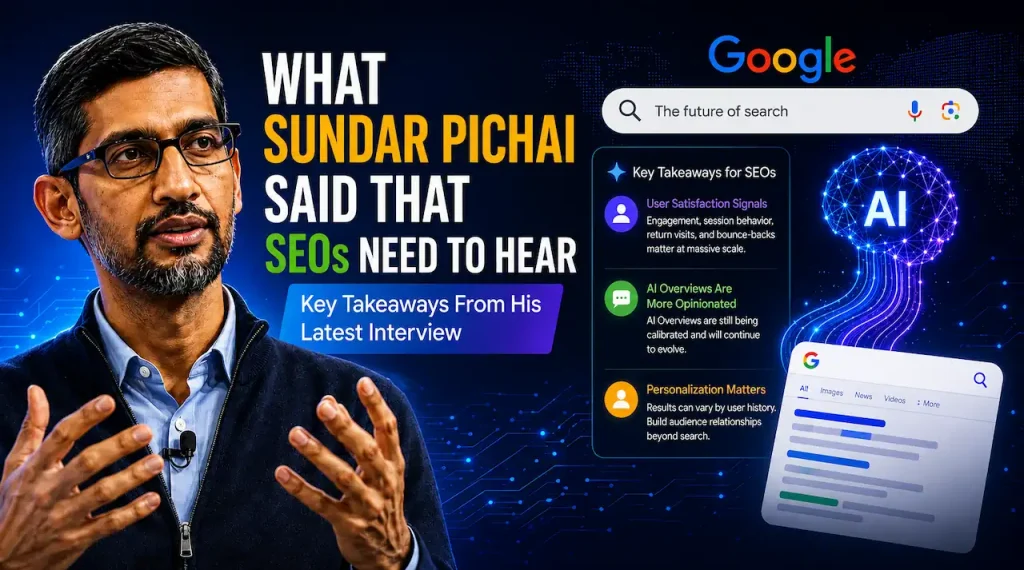
Google’s CEO sat down with The Verge’s Decoder podcast in an interview recorded May 26, 2026, days after Google I/O. Three specific points from that conversation have direct implications for SEO strategy.
On quality signals: Pichai confirmed that Google uses user satisfaction metrics including engagement, session behavior, return visits, and bounce-backs to calibrate both traditional and AI search. These are long-term signals measured at massive scale. They reflect what users actually think of content after spending time with it, not what the content appears to promise from the search result.
On AI Overviews being “more opinionated”: When shown an example where AI Overviews gave a specific recommendation while other sources gave different recommendations, Pichai acknowledged the answer was “probably more opinionated than it should be.” This is an important admission that AI search is still being calibrated and that the behavior of AI Overviews will continue to evolve significantly.
On personalization: Pichai suggested AI Overviews results can vary based on a user’s personal history. This means no business can guarantee its content will surface for every user typing the same query. It reinforces the importance of building audience relationships through Preferred Sources and direct subscriptions rather than relying exclusively on search traffic.
The Bigger Picture — Where Google Is Going
These updates are not isolated changes. They are steps in a long-term trajectory that has been consistent for years and is accelerating.
Google is building a search system where the question being answered is not “which page most successfully mimics the signals of quality” but “which page would a knowledgeable, trustworthy expert recommend to someone asking this exact question.” Every update is Google getting better at answering the second question.
The businesses winning in this environment share certain characteristics. They have genuine expertise in what they do and they communicate that expertise specifically. They have documented results from real work with real clients. They have consistent entity signals across their entire digital presence. They have direct audience relationships that are growing independently of search traffic.
These are not SEO characteristics. They are business quality characteristics that happen to be increasingly well-measured by Google’s improving algorithms.
The insight I keep coming back to after 500 plus audits: the businesses most vulnerable to core updates are the ones whose digital presence is primarily a performance for search engines rather than genuine communication with real customers. The businesses most resilient to core updates are the ones whose digital presence would be worth something even if Google stopped ranking them tomorrow.
That is what it means to be why technical SEO is the foundation of long-term search success. Not the absence of technical issues but the presence of genuine value that the technical foundation enables Google to find and reward.
For the strategic implications see Why SEO Is a Long-Term Strategy and What Businesses Should Expect and Is AI Replacing SEO.
Frequently Asked Questions
Q: Did the May 2026 core update target AI-generated content?
Not specifically. The update targeted derivative and commodity content regardless of production method. AI-generated content providing genuine original insight from real expertise can rank well. AI-generated content summarizing what other sources already say cannot — not because it is AI-generated but because it is derivative. The distinction is originality and genuine expertise, not the production method. Google confirmed this in their official AI optimization guide.
Q: Why does Google keep updating so frequently in 2026?
Google is deploying new AI infrastructure including MUVERA for retrieval and the Graph Foundation Model for trust signal evaluation. Each new capability enables more precise quality assessment and requires calibration. The increase in update frequency reflects the pace of Google’s underlying technical development, not a change in strategy. Each update is Google getting better at the same question it has always been asking. For the historical context see How Google’s Algorithm Works 2026.
Q: How long does recovery from a core update take?
Recovery from a core update typically becomes measurable after the next major core update acknowledges the improvements made. This means three to six months of consistent improvement work before significant traffic recovery. There are no shortcuts. The path forward is documented at How to Recover From Google June 2025 Core Update.
Q: Should I still implement FAQPage schema even though FAQ rich results are gone?
Yes, absolutely. FAQPage schema is critical for AI citation eligibility in AI Overviews, ChatGPT, and Perplexity. The removal of visual FAQ rich results from traditional search does not affect this. Continue implementing FAQPage schema on every relevant page. Check your current schema at allinoneseoaudit.com. For the complete schema guide see Schema Markup for SEO.
Q: Do I need a separate GEO or AEO strategy for Google?
No. Google’s own AI optimization guide explicitly states that optimizing for generative AI search is optimizing for the search experience and is still SEO. Build excellent content that ranks in traditional search and ensure AI crawlers can access your website. Check access at aiagentchecker.net. For the conceptual framework see GEO vs AEO vs SEO.
Q: What is MUVERA and why does it matter?
MUVERA is a retrieval algorithm that allows Google to surface more precisely relevant results while considering five to twenty times fewer total candidate pages. This means the margin for being a broadly acceptable but not genuinely excellent page has collapsed. You are either a precise match for the specific query or you are not retrieved at all. For the content implications see How to Write SEO Content That Ranks.
Q: What is the Graph Foundation Model and what does it mean for link building?
The GFM is an AI model that evaluates trust and authority relationships across Google’s entire link and entity graph with dramatically greater accuracy than previous systems. It can distinguish genuine authority signals from manufactured ones with precision that previous Graph Neural Network approaches could not achieve. For link building implications see How to Build High Quality Backlinks 2026.
Q: My local service business lost traffic in May 2026. What should I do?
Run the free audit at allinoneseoaudit.com to identify technical issues. Check AI crawler access at aiagentchecker.net. Then audit your core service pages against the commodity content test. For your specific service category see the relevant guide in our local service business content cluster. For local SEO foundations see Local SEO Guide and Local SEO for Home Services.
Q: Is AI replacing SEO as a traffic channel?
No. AI search is adding a new visibility channel that works alongside traditional search. Businesses need to be visible in traditional organic results, Google Maps, and AI search recommendations. These are three distinct but related channels, all fed by the same quality signals. For the full analysis see Is AI Replacing SEO and How Google AI Overviews Affect SEO.
Q: What is the single most important thing I can do right now after these updates?
Run the free audit at allinoneseoaudit.com and check your AI crawler access at aiagentchecker.net. These two steps in five minutes will show you your most critical gaps and the fastest fix available. Then book a free consultation at dexoradigital.com/consultation to discuss your specific situation.
Taqweem Ahmad is the Founder of Dexora Digital, a full-stack SEO and AI search optimization agency serving businesses across the USA, UK, Australia, and Europe. He has delivered 500 plus SEO audits and helped 50 plus businesses appear in ChatGPT, Perplexity, and Google AI Overviews. Top Rated on Upwork with 100 percent Job Success Score.
Run a free complete SEO audit at allinoneseoaudit.com. Check your AI search visibility at aiagentchecker.net. Book a free consultation at dexoradigital.com/consultation.