
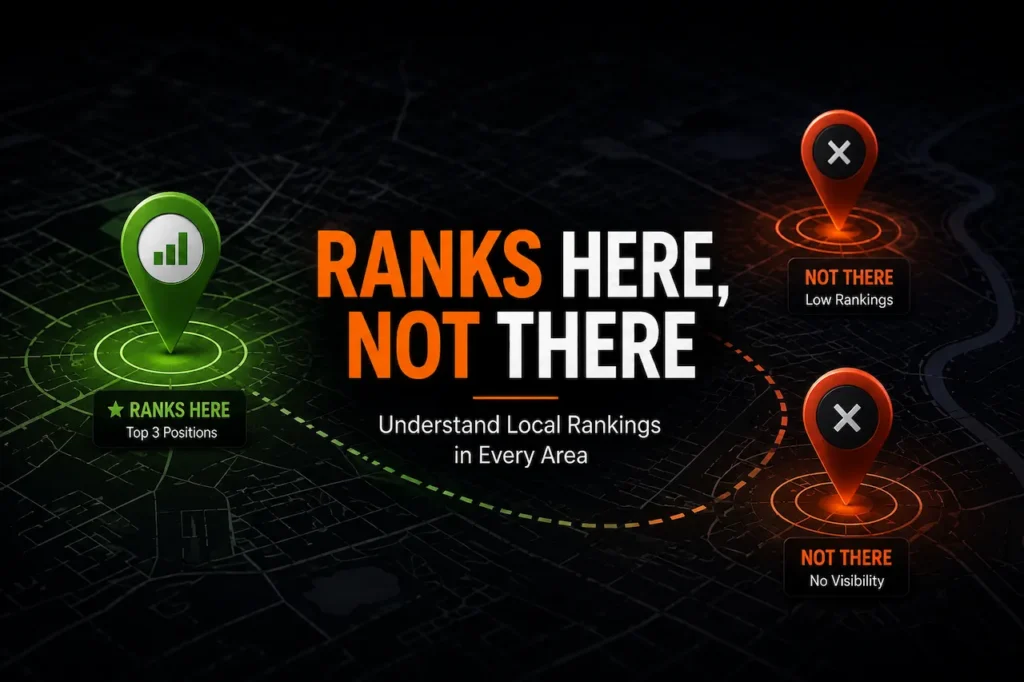
Google Maps ranking by location can confuse even businesses that already perform well in local search. A company may appear in the top three positions when someone searches near the office, drop to position eight a few miles away, and disappear completely on the opposite side of the city.
That does not automatically mean something is wrong with the Google Business Profile. It is often a normal result of how Google’s local ranking systems evaluate distance, relevance, and prominence. At Dexora Digital, I have seen businesses waste months trying to “rank everywhere” when the better goal was to understand where they were competitive, where they were weak, and which geographic gaps could realistically be improved.
How Google’s Proximity Algorithm Actually Works
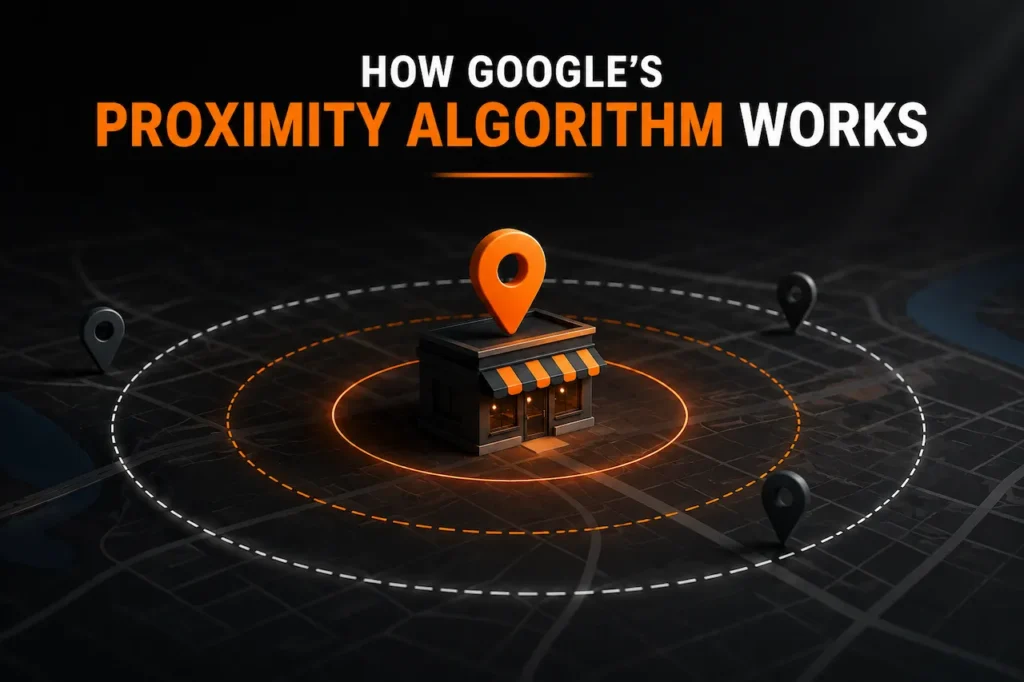
Google explains that local search results are mainly based on relevance, distance, and prominence. Distance refers to how far each business is from the person performing the search. If Google does not have the searcher’s exact location, it estimates location using the information available to it.
This means two people can search exactly the same phrase and see different Maps results.
A homeowner standing two miles from your office may see your business in the local pack.
Another homeowner ten miles away may see several competitors ahead of you.
A third person searching from another part of the metropolitan area may not see your business in the first page of Maps results at all.
That difference is not unusual.
It reflects geographic competition.
Distance Is Not a Fixed Ranking Radius
Business owners often imagine Google Maps as a circle around the business.
Inside the circle, they rank.
Outside the circle, they do not.
Local search is not that simple.
Your practical ranking radius changes according to the query, competition, searcher location, relevance, prominence, business category, and other local conditions.
A highly prominent business may remain competitive farther away than a weaker competitor.
A specialized business may also rank across a larger area when fewer equally relevant competitors exist.
For example, a highly established foundation repair company may compete across a large metropolitan area because fewer businesses offer the exact service.
A general plumber in a dense city may face dozens of equally relevant competitors within a few miles.
The same physical distance can therefore produce very different rankings.
This is one reason a Google Maps ranking diagnostic should never depend on a single manual search.
Why Manual Searches Can Be Misleading
Searching from your office computer does not tell you how the entire market sees your business.
Your location affects the result.
Search history may affect the result.
Device location may affect the result.
The wording of the query affects the result.
Google may also interpret explicit city names differently from near me searches.
If you search “plumber Los Angeles” from one neighborhood and then assume the ranking represents the entire city, the conclusion can be misleading.
A better local SEO process uses geographic rank grids.
Instead of testing one point, you measure visibility from many coordinates across the target area.
That produces a map showing where your business is strong and where visibility fades.
A grid might show:
Strong rankings within three miles.
Moderate rankings between three and six miles.
Weak rankings farther west.
Strong rankings near one suburban area because competition is lighter.
Almost no visibility in another city despite that city being listed as a service area.
This is much more useful than saying:
“We rank number four.”
Google Maps SEO should be measured geographically.
Relevance and Prominence Still Matter
Distance is important, but proximity is not the only factor.
Google says relevance reflects how closely the Business Profile matches the search, while prominence reflects how well known the business is. Prominence can include signals such as links and reviews.
This explains why the closest business does not always rank first.
Imagine three HVAC contractors.
Contractor A is one mile from the searcher but has an incomplete profile, few reviews, and a weak website.
Contractor B is three miles away with strong category alignment, detailed services, hundreds of reviews, locally relevant content, and an established website.
Contractor C is six miles away with a well known regional brand.
Google has to balance proximity against relevance and prominence.
The closest option has a geographic advantage.
It does not have an automatic guarantee.
That distinction is central to understanding local SEO ranking factors.
Why Ranking Everywhere Is Not the Goal
Many local businesses begin SEO with an unrealistic objective:
“We want to rank number one across the whole city.”
That sounds reasonable until you consider how local search actually works.
Google is trying to return nearby relevant businesses.
If your company is physically based on the northern side of a major city, expecting identical visibility twenty miles south can conflict with the purpose of local results.
The better objective is profitable geographic coverage.
Measure Revenue Territory, Not Ego Territory
A plumbing company may serve thirty zip codes.
But perhaps eighty percent of its profitable jobs come from ten of them.
A dental practice may technically attract patients from across a county.
But most patients may live within fifteen minutes of the office.
A roofing company may travel farther because project values are higher.
Your SEO geography should reflect the economics of the business.
Ask:
Which areas produce the highest value customers?
Which neighborhoods contain the strongest search demand?
Where does the company actually want more work?
Which locations can the business serve efficiently?
Where is Google Maps visibility already close to improving?
Where are competitors substantially stronger?
The answer may show that ranking everywhere is unnecessary.
Build a Geographic Opportunity Map
A useful local SEO strategy normally separates geographic areas into three groups:
- Core areas where the business already ranks strongly and should defend visibility
- Growth areas where rankings sit near the local pack and improvements may produce meaningful gains
- Low feasibility areas where distance and competition make Maps visibility difficult
This approach prevents budget from being wasted.
Suppose you rank positions one to five throughout your main suburb.
Eight miles away, rankings sit between positions seven and twelve.
Twenty miles away, the business averages position thirty.
The middle zone may deserve attention first.
Moving from position eight to position three can be commercially realistic.
Moving from position thirty to position one may require much stronger local relevance, prominence, a legitimate second location, or a different acquisition strategy.
That does not mean the distant city should be ignored.
Organic location pages, local service pages, paid search, Local Services Ads, partnerships, and other channels can still generate customers there.
Google Maps is only one component of local search.
Geographic Rankings Should Support Business Goals
This is where a local SEO guide becomes useful.
Local SEO should coordinate Maps rankings, organic rankings, website content, reviews, citations, links, service pages, and conversion performance.
A business that ranks number three everywhere but converts poorly can still underperform.
A business ranking number five in a smaller but high value service area may generate excellent revenue.
The correct KPI is not:
“How many green dots are on our grid?”
The better KPI is:
“Are we increasing qualified visibility in the locations that matter commercially?”
Service Area Business Settings That Hurt Local Visibility
Service area businesses create some of the most persistent Google Maps misconceptions.
Google defines a service area business as a business that visits or delivers to customers but does not serve them at its business address. Plumbers and cleaning companies are common examples.
A hybrid business serves customers at its address and also travels or delivers to customers.
These settings need to reflect the real business.
They should not be used as ranking hacks.
Adding More Service Areas Does Not Create More Proximity
Google allows eligible businesses to specify up to twenty service areas using cities, postal codes, or other supported areas. Google also says the overall area should generally remain within about two hours of driving time from the business base.
This does not mean every selected service area becomes equivalent to the business location.
That is one of the biggest misconceptions in local SEO.
Adding another city tells customers that the business serves that location.
Google does not say that the setting makes your business physically closer to searchers in that city.
Distance remains one of the primary local ranking considerations.
A plumber based in Pasadena cannot simply add Santa Monica as a service area and expect the profile to behave as if the business were physically located there.
Service area settings describe operating coverage.
They are not a proximity override.
Common Service Area Configuration Problems
I often see service area businesses weaken their profiles through inaccurate setup.
Common problems include:
- Showing a residential address even though customers are never served there
- Listing cities the company does not realistically serve
- Using an office that does not meet Google’s storefront requirements
- Creating duplicate profiles for areas that are not genuine staffed business locations
- Using virtual offices to manufacture additional locations
- Setting service areas so broadly that they no longer reflect actual operations
- Failing to update service areas when the business changes its operational territory
Google says that businesses without storefronts that travel to customers should generally have one Business Profile for the central location. Virtual offices are not eligible unless they meet Google’s requirements for a real staffed location.
Google also says that if customers are not served at the business address, the address should be removed from the public profile.
Accuracy is safer than trying to manipulate geography.
Multiple Locations Must Be Real Locations
A legitimate second location can create a new geographic opportunity.
But it must actually be a real operating location.
Google allows separate profiles for service businesses with distinct locations, separate service areas, and separate staff at each location.
That is different from renting a mailbox or virtual office simply to appear closer to another city.
If the company opens a genuine staffed branch that meets Google Business Profile requirements, that location may compete independently in its surrounding market.
This can materially change Maps visibility because the underlying geography has changed.
But creating fake proximity is risky.
Google’s guidelines require businesses to represent their actual real world locations accurately.
Location Pages Are the Real Fix for Organic Geographic Expansion
If adding cities to a Google Business Profile does not make you rank everywhere, how do you target additional locations?
One of the strongest scalable options is location pages.
A location page is a website page designed to serve people searching for your service in a specific geographic market.
For example:
Roof repair in Sacramento.
Emergency plumber in Scottsdale.
HVAC repair in Tampa.
Commercial landscaping in Austin.
The important distinction is that the page must provide genuine local value.
Creating hundreds of thin city pages with only the city name changed is not a strong strategy.
Maps Visibility and Organic Visibility Are Different
This distinction is critical.
Google Maps has a strong proximity component.
Organic search is not constrained in exactly the same way.
A company located outside a city can sometimes rank an excellent location page for searches in that city even when its Business Profile is not competitive in the local three pack.
That creates two separate opportunities.
Maps visibility may be strongest near the business base.
Organic location pages can expand the website’s reach into additional service markets.
This is why location pages can become the real fix when businesses ask:
“Why do I rank in one city but not another?”
You may not be able to eliminate the distance disadvantage in Maps.
You can build stronger organic relevance for that city.
What Makes a Strong City Page
A useful location page should demonstrate that the business genuinely serves the area.
It may include local service information, project examples, neighborhood context, testimonials from customers in that market, unique service considerations, local regulations where relevant, travel or response expectations, and clear evidence that the company works there.
Avoid changing only:
City name.
Title.
Heading.
A few references.
Google’s systems are designed to reward helpful content rather than pages created primarily to capture search variations.
City pages should therefore answer real local questions.
For a plumber, one city may have older housing stock and common galvanized plumbing issues.
Another area may have newer developments with different service demand.
A contractor may face different permitting requirements across municipalities.
A roofing company may experience different weather or building conditions by region.
A useful page reflects those differences.
Build City Pages Around Actual Opportunity
Do not create a location page for every city within a two hour drive simply because Google allows that service area.
Prioritize locations using:
Search demand.
Revenue potential.
Current rankings.
Existing customers.
Competition.
Business capacity.
Local proof.
Profit margins.
The strongest city pages often correspond to areas where the company already has customers and operational experience.
Blog 9 in this content cluster will cover location pages in much more detail, including how to build city pages without creating thin or doorway style content.
Citation Radius and NAP Consistency by Zip Code
Citations are another area where local SEO advice often becomes exaggerated.
A citation is an online reference to a business, normally containing information such as the business name, address, and phone number.
NAP consistency refers to keeping those core business details accurate across important sources.
Google says Business Profile information can come from the business owner, publicly available web content, third party licensed data, users, and Google’s own interactions with a place. This makes clear entity information valuable even though Google does not publish a simple citation count ranking formula.
The goal is accuracy and corroboration.
Not directory quantity.
What Citation Radius Actually Means
Some SEO practitioners use the phrase citation radius to describe the geographic distribution of local mentions around a business.
For example, a contractor serving several nearby cities may have references in:
Local chambers.
Regional business directories.
Industry associations.
Supplier websites.
Municipal contractor lists.
Neighborhood organizations.
Local news publications.
Community sponsorship pages.
These mentions can strengthen the business’s broader local footprint.
But there is no Google documented rule saying:
“Acquire ten citations in every zip code and rankings will expand five miles.”
That is not how this should be presented.
Citation building works better as local entity reinforcement.
If a business genuinely operates across a region, credible references from that region can support its prominence and legitimacy.
They do not erase physical distance.
NAP Consistency Still Matters
A business should not have one phone number on its website, another on major directories, and an outdated address on older profiles.
Conflicting business information creates unnecessary ambiguity.
Google explicitly advises businesses to maintain accurate information on their Business Profile.
The website, Google Business Profile, major directories, social profiles, and important industry sources should reinforce the same real entity.
For multi location companies, each legitimate location should maintain its own accurate information.
A company with three branches should not mix addresses and phone numbers between locations.
This becomes particularly important when building local SEO for home services or multi location organizations.
Prioritize Citation Quality Over Volume
I would rather see a business with fifty credible, accurate citations than five hundred low quality directory listings.
Prioritize sources that customers and search engines are likely to trust.
Relevant citation opportunities often include:
- Major mapping and business platforms
- Recognized industry directories
- Local chambers of commerce
- Professional associations
- Local news and community websites
- Supplier and manufacturer directories
- Regional business organizations
- Legitimate sponsorship and partnership pages
Local citations should reflect the real business ecosystem.
They should not exist only because an SEO tool produced a list of directories.
A local citations strategy can support prominence and entity consistency.
It cannot manufacture a new physical location.
What to Do When You Rank in One Area but Not Another
The first step is not adding more cities to the service area.
Start with evidence.
Check a geographic rank grid.
Identify where rankings weaken.
Compare competitors in those locations.
Review whether the problem is primarily proximity, relevance, prominence, or website coverage.
Then choose the appropriate solution.
If the business ranks well near its location but weakly farther away, proximity may be the dominant limitation.
If it performs poorly even near the business location, there may be a broader Google Maps ranking problem.
If competitors have far stronger reviews and local authority, prominence needs work.
If the website barely mentions the target city, local relevance may be weak.
If the target market is commercially important but physically distant, city pages may provide a better organic opportunity than trying to force the Business Profile to rank there.
That is the difference between a local SEO strategy and random GBP optimization.
The objective is not to manipulate Google Maps.
The objective is to make the business more relevant, prominent, trustworthy, and visible wherever it has a realistic reason to compete.
Frequently Asked Questions
Why does my business rank on Google Maps in one area but not another?
Distance is one of Google’s main local ranking factors. Someone searching near your business may see you prominently, while a searcher farther away may see closer competitors. Relevance and prominence also affect results, so geographic visibility can vary significantly across the same city.
Does Google Maps ranking change depending on the searcher’s location?
Yes. Google specifically says distance considers how far each business is from the customer performing the search. When the searcher’s exact location is unavailable, Google estimates location using available information.
Why do I rank in one city but not another?
The second city may be farther from your business base, more competitive, or less relevant to your website and overall local footprint. Adding the city to your service area does not guarantee Maps rankings there.
Does adding a city to my Google Business Profile service area improve rankings there?
Google says service areas tell customers where a business provides products or services. Google does not state that selecting a city makes the business physically closer to searchers there. Distance remains part of local ranking.
How many service areas can I add to Google Business Profile?
Google currently allows eligible service area and hybrid businesses to select up to twenty service areas. Google also recommends keeping the overall coverage reasonably close to the business base, generally within about two hours of driving time.
Can a service area business rank far from its address?
It can, depending on competition, relevance, prominence, and search context. However, physical distance can make ranking increasingly difficult as the searcher moves farther from the business base.
Will location pages help me rank in nearby cities?
Strong location pages can improve organic search relevance for nearby markets. They do not automatically make the Business Profile rank in the local pack, but they can create additional organic visibility for city specific searches.
Do citations help expand my Google Maps ranking radius?
Citations can reinforce business information, prominence, and local entity signals, but Google does not publish a citation radius formula. Accurate, relevant citations should support the real business rather than be used as a way to manufacture proximity.
Should every city I serve have its own location page?
No. Build location pages where there is meaningful search demand, commercial value, genuine service coverage, and enough unique information to create a useful page. Creating thin pages for every nearby city can produce low value content.
How can I improve Google Maps rankings farther from my business?
Improve the factors you can control: Business Profile relevance, reviews, website authority, local links, accurate citations, service content, local proof, and city specific website coverage. If the target market remains too distant for competitive Maps visibility, focus more heavily on organic location pages or other acquisition channels.
Improve Your Google Maps Visibility Where It Matters Most
Ranking well beside your office but disappearing a few miles away is not automatically an SEO failure. It often reflects how proximity interacts with relevance, prominence, competition, and the searcher’s exact location.
Dexora Digital helps businesses analyze Google Maps ranking by location using geographic visibility data, Business Profile signals, competitor analysis, website relevance, local authority, citations, and location content. Instead of chasing rankings everywhere, we identify the areas where stronger visibility can realistically produce more calls, enquiries, and revenue.
If your business is visible in one neighborhood but missing across important parts of your service territory, a structured local SEO assessment can show whether the real issue is proximity, profile relevance, weak local authority, missing city pages, or a broader Maps visibility problem. Book a consultation to identify the right opportunities for improving your visibility.