

We help Georgia dental practices get recommended by AI search tools and Google AI Overviews, not just ranked in traditional blue-link results.
What AI Search Optimization Means for Dental Practices
AI search optimization, often called Generative Engine Optimization (GEO) or Answer Engine Optimization (AEO), is the process of structuring your business information so AI tools and AI-generated search results recommend you directly. This includes how your practice appears in Google AI Overviews, ChatGPT, and other AI-driven search experiences.
We have seen firsthand that dental practices optimized only for traditional search rankings are increasingly invisible in AI-generated answers, even when they rank well in standard results. Getting recommended by AI search depends on structured data, clear service information, and content written to directly answer the questions AI tools are trying to resolve for patients.
Why AI Search Optimization Matters for Georgia Dental Practices
Search behavior is shifting. More patients are asking AI tools directly for recommendations, like “who’s a good family dentist near me,” instead of typing a traditional search query. If your practice isn’t structured for AI tools to understand and recommend, you become invisible in an increasingly important part of how patients find care.
Georgia’s dental market is competitive across Atlanta and surrounding suburbs, and early adoption of AI search optimization gives practices a meaningful advantage before this becomes standard practice across the industry. Given how heavily trust signals matter in healthcare-related AI recommendations, our guide on E-E-A-T in 2026 is especially relevant for dental practices entering this space.
AI search optimization directly affects:
- Whether AI tools recommend your practice by name in response to relevant queries
- Visibility in Google AI Overviews for dental-related searches
- How accurately AI tools represent your services and practice locations
- Long-term discoverability as AI search adoption continues to grow
Core AI Search Optimization Services We Provide
Our approach covers the specific factors that influence whether AI tools recognize and recommend your dental practice. Our AI/LLM SEO guide explains the technical and content factors behind this process in more depth.
- Structured Data and Schema Markup — clear, machine-readable information about your services, practice locations, and business details
- Answer-Focused Content — content written to directly answer common patient questions in a format AI tools can extract and use
- llms.txt Implementation — a structured file that helps AI crawlers understand and prioritize your site’s content
- Entity Consistency — ensuring your practice information is consistent everywhere AI tools pull data from
- AI Overview Targeting — optimizing specific pages to appear in Google’s AI-generated answer summaries
How We Build AI Visibility for Georgia Dental Practices
AI tools pull recommendations from structured, verifiable information rather than persuasive marketing copy. We restructure your website content to clearly answer specific patient questions, since this is the format AI systems prioritize when generating responses.
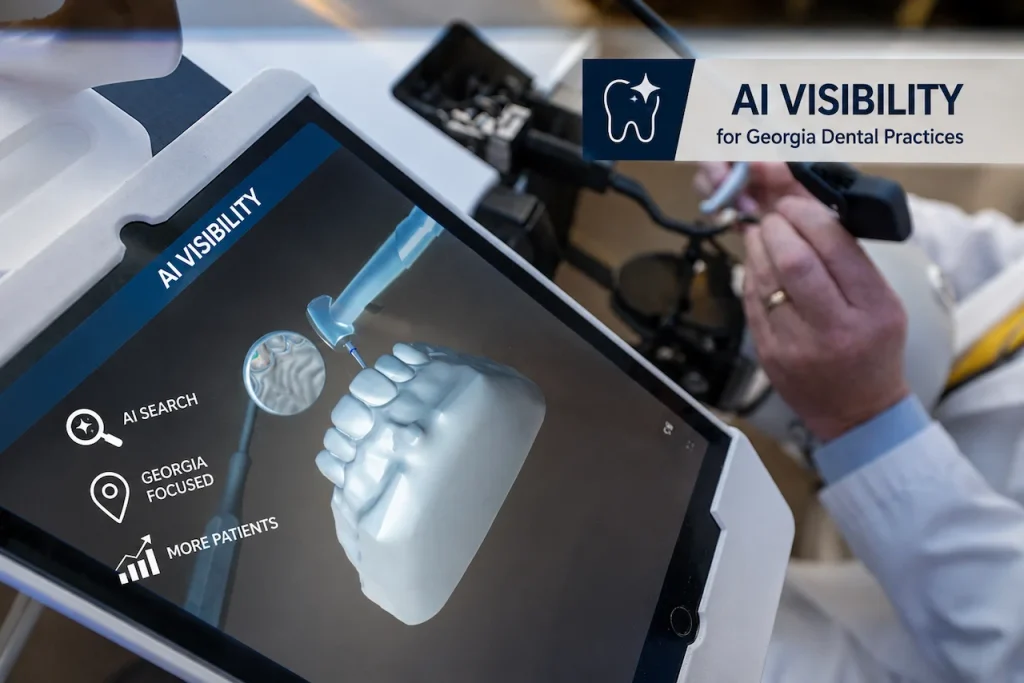
This means rewriting service pages to lead with direct, factual answers, implementing schema markup that clarifies what your practice offers and where you’re located, and ensuring your practice information is consistent across every platform AI tools reference. Our llms.txt AI SEO guide explains this technical implementation step by step.
Practical Steps We Take Before Optimization
Before any AI search optimization begins, we always advise clients to audit how their practice currently appears across AI tools and platforms. This step identifies specific gaps in how AI systems understand your practice.
- Testing how AI tools currently respond to relevant dental queries in your area
- Reviewing existing schema markup and structured data
- Auditing content for answer-focused clarity versus marketing-heavy language
- Checking practice information consistency across platforms AI tools reference
This groundwork determines the optimization strategy we build next, since AI tools weigh consistency and clarity far more heavily than traditional ranking signals like backlinks alone.
Common Mistakes Dental Practices Make With AI Search Optimization
Many dental practices either ignore AI search entirely or approach it the same way they approach traditional SEO, which limits results.
- Writing marketing-heavy content instead of direct, answer-focused content
- Ignoring schema markup, which AI tools rely on heavily for accuracy
- Inconsistent practice information across directories and platforms
- Assuming traditional SEO rankings automatically translate to AI visibility
- Failing to implement llms.txt or other AI-crawler-specific signals
We always advise clients to treat AI search optimization as a distinct strategy, not an extension of existing SEO efforts, since the two systems prioritize different signals.
Why Choose Dexora Digital
We focus on positioning Georgia dental practices for visibility in both traditional search and emerging AI-driven search experiences.
- Early, specialized experience in GEO and AEO strategy
- Technical implementation of schema, structured data, and llms.txt
- Content rebuilt specifically for AI answer extraction
- Transparent reporting on AI visibility, not just traditional rankings
- A strategy built around how AI tools actually select recommendations
FAQs
Q: How long does AI search optimization take to show results?
Most practices see initial changes in AI tool responses within 30 to 60 days, though this varies based on how AI platforms update their data sources. This is a newer field, so timelines continue to evolve as AI search matures.
Q: Is AI search optimization different from traditional SEO?
Yes. While they share some overlapping signals, AI search optimization prioritizes structured data, answer clarity, and consistency in ways traditional SEO does not weigh as heavily.
Q: Do I still need traditional SEO if I invest in AI search optimization?
Yes. Traditional search still drives significant traffic, and the two strategies work best together rather than as a replacement for one another.
Q: What is llms.txt and why does it matter?
Llms.txt is a structured file that helps AI crawlers understand and prioritize your site’s content, similar to how robots.txt guides traditional search crawlers. It’s a relatively new but increasingly relevant signal.
Q: Can AI search optimization help with Google AI Overviews specifically?
Yes. Structuring content to directly answer common questions significantly improves the likelihood of being featured in Google’s AI-generated answer summaries.
Ready to Get Recommended by AI Search Tools
AI search optimization determines whether AI tools recommend your dental practice or skip it entirely. We build strategies around how these systems actually select recommendations, not generic SEO tactics. The result is stronger visibility across both traditional and AI-driven search.
Get your free SEO audit or book a call at calendly.com/dexora/30min.