

By Taqweem Ahmad, Founder and CEO of Dexora Digital
Updated: November 20, 2026
Local SEO for HVAC companies helps heating and cooling contractors appear in Google Search and Google Maps when nearby customers need AC repair, furnace maintenance, heat pump installation, or emergency HVAC services. It combines Google Business Profile optimization, service-specific website content, genuine reviews, accurate business information, and technical SEO to improve local visibility and support qualified service calls.
Imagine a homeowner in Phoenix whose air conditioner stops cooling during a heat wave. They search “AC repair near me,” compare nearby companies, and choose one that appears relevant, trustworthy, and available.
If your HVAC company is missing from those results, potential customers may contact competitors before discovering your business.
This guide explains how HVAC local SEO works, why some contractors struggle to attract calls, and which improvements can help turn search visibility into booked appointments.
Why Is Local SEO Important for HVAC Companies?
HVAC customers search for different reasons, and their needs change throughout the year.
Some need immediate repairs. Others compare installation costs, schedule preventive maintenance, or research equipment efficiency.
For example:
- “Emergency AC repair Houston” indicates an urgent cooling problem.
- “Furnace repair near me” suggests a heating system failure.
- “Heat pump installation Charlotte” indicates installation interest.
- “AC tune-up Tampa” suggests preventive maintenance.
- “HVAC contractor Dallas” indicates a search for a local provider.
These searches differ in urgency, commercial value, and the information customers need before contacting a company.
An effective local SEO strategy connects each search with an appropriate page or Google Business Profile listing.
The objective is not to attract every visitor searching for HVAC information. It is to reach customers within the company’s genuine service territory who need services it can provide.
Why Isn’t My HVAC Company Showing on Google Maps?
An HVAC business may have an established customer base and a professional website but still struggle to appear for important local searches.
Possible reasons include inaccurate business information, weak service relevance, competition, geographic distance, or problems with the Google Business Profile.
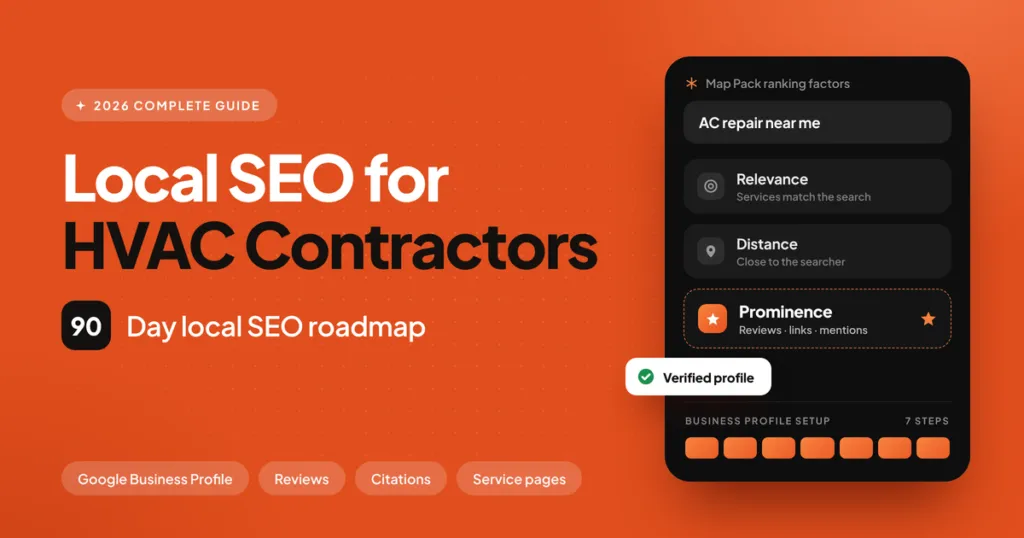
Google identifies three main factors behind local rankings.
Relevance
Relevance describes how well a business matches the customer’s search.
If your company provides furnace repairs, that service should be accurately represented in its profile and website content.
Distance
Distance considers how far the business is from the location associated with the search.
An HVAC contractor based in Dallas may appear more frequently in nearby searches than in distant communities.
Adding more service areas does not automatically overcome geographic distance.
Prominence
Prominence relates to how established and well-known a business appears online.
Relevant links, genuine reviews, and information about the business across the web may contribute to its prominence.
These factors work together, and no SEO provider can guarantee a particular Google Maps ranking.
Google explains these principles in its official local ranking guidance.
How Should HVAC Companies Optimize Google Business Profile?
Google Business Profile is an important starting point for businesses that qualify for a local listing.
It allows customers to discover business information, view reviews, visit the website, and contact the company through available profile features.
A practical optimization process includes the following steps.
Choose an Accurate Primary Category
For many heating and cooling contractors, “HVAC contractor” is an appropriate primary category.
Additional categories should reflect services the business genuinely provides.
Avoid selecting unrelated categories simply to target more keywords.
Complete the Services Section
List actual heating and cooling services, such as AC repair, furnace installation, heat pump maintenance, ductless systems, and indoor air quality services.
Descriptions should help customers understand what the company offers.
Verify Contact Details and Hours
Make sure the telephone number, website, operating hours, and service areas are accurate.
If the company offers emergency assistance outside normal hours, clearly distinguish emergency call availability from regular office hours.
Follow Service-Area Business Rules
Many HVAC contractors visit customers rather than serving them at a storefront.
If the company operates without a customer-facing business location, configure the profile according to Google’s service-area requirements.
Do not create fake offices or use virtual locations to manufacture additional Google Maps coverage.
Add Genuine Project Photos
Use authentic photographs of technicians, equipment, vehicles, and completed HVAC installations where permission has been obtained.
Avoid presenting stock photographs as actual company projects.
For eligibility, address, and representation requirements, consult Google’s Business Profile guidelines.
Understanding these factors helps HVAC businesses focus on improvements they can influence without relying on misleading ranking promises.
Which HVAC Keywords Generate Qualified Calls?
Effective keyword research begins with customer situations rather than search volume alone.
A homeowner with no heating in January needs a different answer from someone comparing high-efficiency air conditioning systems.
| Search category | Example keyword | Customer need | Best page type |
| Emergency | Emergency AC repair near me | Immediate assistance | Emergency service page |
| Heating repair | Furnace repair Chicago | Fix a heating problem | Furnace repair page |
| Cooling installation | AC installation Phoenix | Compare installation providers | Installation page |
| Maintenance | HVAC tune-up Tampa | Schedule preventive care | Maintenance page |
| Equipment research | Heat pump vs furnace | Understand options | Educational guide |
| Local provider | HVAC contractor Dallas | Find a trustworthy company | Homepage or relevant local page |
A business should prioritize searches matching its actual services, location coverage, and commercial goals.
For instance, targeting heat pump installation may be valuable for a contractor offering that service, but irrelevant for a company focused exclusively on repair work
What Website Pages Does an HVAC Company Need?
A single general services page may not adequately answer every customer question.
Most HVAC websites benefit from clearly differentiated pages for their principal services.
These may include air conditioning repair, AC installation, furnace repair, heat pump installation, HVAC maintenance, and emergency services where available.
Each page should explain the problems the service addresses, what customers can expect, where the business operates, and how to request an appointment.
Example: An Effective AC Repair Page
An AC repair page might answer questions about warm air, unusual noises, leaking equipment, and systems that stop cooling.
It should also explain the contractor’s diagnostic process, relevant service availability, and how customers can schedule repairs.
Example: An Effective Installation Page
A heat pump installation page requires different information.
Customers may want to understand equipment options, system sizing, installation processes, operating costs, and available financing or incentives.
These topics help customers compare solutions before requesting a quote.
Internal links should connect related information naturally. An article about an AC system blowing warm air, for example, can link to the appropriate repair service page.
Should HVAC Companies Create Separate Service-Area Pages?
Location pages can be valuable when an HVAC company genuinely operates in several communities.
However, a separate page for every ZIP code is not required.
Consider a contractor serving Houston and Katy, Texas.
A useful Katy service-area page could explain actual service availability, relevant local projects, customer experiences, and practical booking information.
It should not claim the company maintains an office in Katy unless that is true.
Location pages should offer meaningful information beyond replacing city names in an identical template.
Avoid creating dozens of near-duplicate pages that exist only to target search variations.
A local page is worth publishing when it helps a customer understand a genuine difference in service coverage or availability.
How Do Customer Reviews Help HVAC Local SEO?
Reviews influence how customers evaluate HVAC contractors, and review signals can contribute to local prominence.
This is particularly relevant when homeowners are deciding whom to trust with expensive equipment or urgent repairs.
An HVAC business can build a compliant review process by sending a polite request after completed service.
Customers should be invited to leave honest feedback regardless of whether their experience was positive or negative.
Avoid offering rewards for reviews, purchasing ratings, or telling customers which keywords to include.
Responding professionally to reviews can also help prospective customers understand how the company handles communication and problems.
Reviews should support customer trust, not become a keyword manipulation strategy.
How Can HVAC Companies Improve Website Performance?
A slow or difficult-to-use website can discourage customers from contacting an HVAC contractor.
This is particularly important during emergency searches.
Start by checking that the website works properly on smartphones, service information is readable, and call buttons function correctly.
Use Google PageSpeed Insights to evaluate important service pages.
Focus on Core Web Vitals and problems affecting real visitors, rather than trying to achieve an arbitrary perfect score.
Other important technical checks include:
- Indexability of commercial service pages.
- Correct canonical URLs and redirects.
- Working contact forms and booking links.
- Descriptive internal links.
- Appropriate image compression.
- Accurate business structured data.
- Secure HTTPS pages.
Structured data can help search engines interpret supported business information, but it does not guarantee higher rankings or AI recommendations.
Google’s Core Web Vitals documentation explains how page loading, responsiveness, and visual stability are measured.
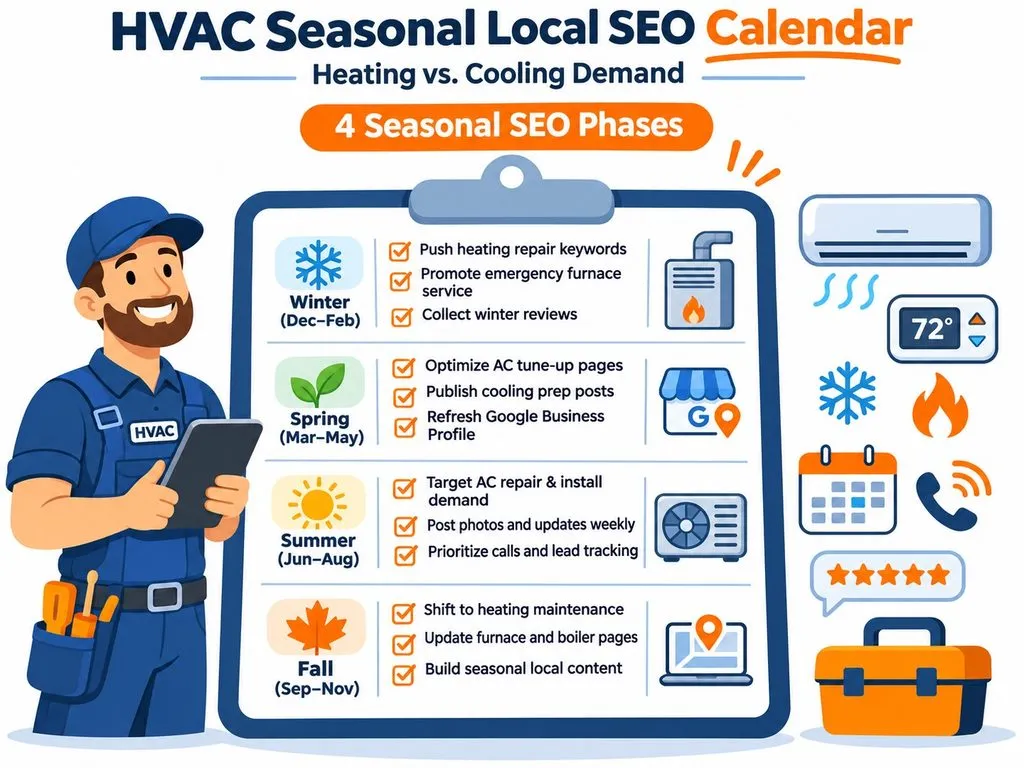
How Should HVAC Companies Plan SEO Around Seasonal Demand?
HVAC search demand changes according to climate, season, weather events, and the services customers need.
A useful content strategy prepares relevant information before demand rises.
For example, an HVAC company should improve its AC repair and installation pages before the main cooling season instead of waiting until the first heat wave.
Northern markets may need to prioritize furnace inspections and heating repairs before winter, while warmer climates may maintain strong cooling demand for much of the year.
Seasonal content should answer useful customer questions without creating repetitive articles for minor keyword variations.
For instance, a guide explaining why an AC system runs but does not cool can link naturally to the company’s repair service page.
An article comparing heat pumps and furnaces can support relevant installation pages.
These connections help visitors move from research to a service enquiry.
Practical Example: Improving Local SEO for a Phoenix HVAC Company
Imagine a Phoenix HVAC company that performs AC repairs, installations, and seasonal maintenance.
It has positive customer feedback and a functioning website but receives fewer Google Maps enquiries than expected.
A local SEO review might identify several issues.
First, its Google Business Profile contains incomplete service information.
Second, the website has one general HVAC page but no dedicated AC repair page.
Third, its phone number is difficult to find on mobile devices.
Fourth, some directory listings contain an outdated business number.
An effective improvement plan would begin by correcting the profile and contact information.
Next, the company could strengthen its AC repair page with useful information about common symptoms, repair availability, and booking options.
It could also improve mobile contact buttons and check whether enquiries are reaching the appropriate team.
Finally, it would monitor relevant organic traffic, Business Profile interactions, qualified phone calls, and scheduled jobs.
The aim is to improve both discoverability and the customer’s ability to contact the business.
This Phoenix example is illustrative and does not describe an actual Dexora Digital client campaign.
What Results Has Dexora Digital Achieved for an HVAC Business?
Dexora Digital has published a case study involving a residential HVAC company in Austin, Texas.
The campaign addressed the company’s initial organic visibility through website improvements, local search work, and a more developed online presence.
The published campaign reported 44,700 Google search impressions over five months.
This is a specific campaign outcome, not a typical result or a guaranteed number of enquiries.
Search impressions also do not represent completed service calls or booked appointments.
Read the Austin HVAC SEO Case Study
The case study demonstrates why performance should be measured over time, with attention to relevant searches and genuine business outcomes.
How Can HVAC Companies Turn Website Calls Into Booked Jobs?
More website visitors do not automatically mean more completed HVAC jobs.
A customer may click a call button but receive no answer. Another may submit a form that goes unanswered for several hours.
A business may also receive enquiries from locations it does not serve.
To evaluate conversion performance, monitor:
- Answered and missed calls.
- Relevant customer enquiries.
- Appointment bookings.
- Response times.
- Completed service jobs.
- Revenue attributable to marketing, where measurable.
For example, an HVAC company receiving calls outside office hours may benefit from improving its call-handling process before increasing advertising or content production.
Local SEO should be evaluated as part of the complete lead-generation process, from discovery through booked service.
How Much Does Local SEO Cost for HVAC Companies?
Pricing depends on the size of the company, market competition, number of genuine locations, website condition, and services included.
A single-location HVAC company may require a smaller engagement than a contractor operating across several metropolitan markets.
Common services include Google Business Profile optimization, website improvements, service-page content, technical SEO, citation management, and reporting.
Dexora Digital offers local SEO services starting at $500 per month, with pricing adjusted to the agreed scope.
Before hiring an agency, ask what work is included, how progress will be reported, and which business outcomes the campaign will measure.
For additional information, see Dexora Digital’s Local SEO Services.
How Long Does HVAC Local SEO Take?
Local SEO is an ongoing process, and results vary by market.
Some corrections, such as fixing an incorrect phone number or broken contact form, can improve the customer experience immediately.
Search ranking changes may take longer, depending on competition, existing website authority, search engine processing, and the improvements made.
A practical 90-day implementation plan could be:
Days 1–30: Audit the website, Google Business Profile, service coverage, and technical problems.
Days 31–60: Improve important service pages, business information, and mobile conversion paths.
Days 61–90: Review search performance, customer enquiries, and opportunities for further improvement.
This is an implementation schedule, not a guarantee that rankings or calls will increase within 90 days.
Frequently Asked Questions
1. Is local SEO worth it for HVAC companies?
Local SEO can be worthwhile when it helps an HVAC contractor attract relevant enquiries and booked jobs. Its value depends on competition, service margins, customer demand, and the cost of acquiring customers.
2. How can I improve my HVAC company’s Google Maps ranking?
Start with an accurate Google Business Profile, relevant services, genuine customer reviews, and useful website content. Google considers relevance, distance, and prominence, so results will also depend on the customer’s location and competing businesses.
3. Do HVAC companies need separate pages for every service area?
No. Dedicated location pages can be useful when they provide genuinely distinct local information. Avoid publishing near-identical pages for every city or ZIP code.
4. How long does HVAC SEO take to generate more calls?
The timeline varies according to the business’s existing visibility, competition, website quality, and implementation work. Some improvements can be noticed quickly, but meaningful search growth may take several months.
5. Can AI search optimization help HVAC contractors?
Clear service descriptions, accurate business information, helpful content, and a credible online presence may support visibility in AI-powered search experiences. However, AI recommendations and citations cannot be guaranteed.
Conclusion: Build HVAC Visibility That Leads to Real Enquiries
Local SEO for HVAC companies works best when it connects customer search behavior with accurate business information, useful service pages, technical improvements, and reliable lead tracking.
Google Business Profile optimization can support local discovery. Dedicated service content helps customers find relevant answers. Genuine reviews build confidence, while mobile-friendly contact options make it easier to request service.
The goal is not simply to rank for more keywords.
It is to help customers discover your HVAC company when they need heating or cooling services and make contacting your business straightforward.
Get a Free Local SEO Audit for Your HVAC Company
Is your HVAC business missing from important Google Maps searches or struggling to turn website traffic into qualified calls?
Dexora Digital can review your local search presence, Google Business Profile, website visibility, and important SEO problems to identify opportunities for improvement.
Request a free SEO and AI search audit and receive your written report within 24 hours.
About the Author
Taqweem Ahmad is the Founder and CEO of Dexora Digital, an agency specializing in SEO, local search, AI search optimization, and website development. With more than seven years of SEO and digital marketing experience, he works with a team supporting businesses across the United States and international markets.
Related Reading
- HVAC SEO services: packages, city pages and AI search
- SEO for Contractors: the complete 2026 guide
- Case study: Austin HVAC company, 44,700 impressions in 5 months
- Google Business Profile ranking factors in 2026
- Can a service-area business rank in nearby cities?
- Why your business ranks in one area but not another