
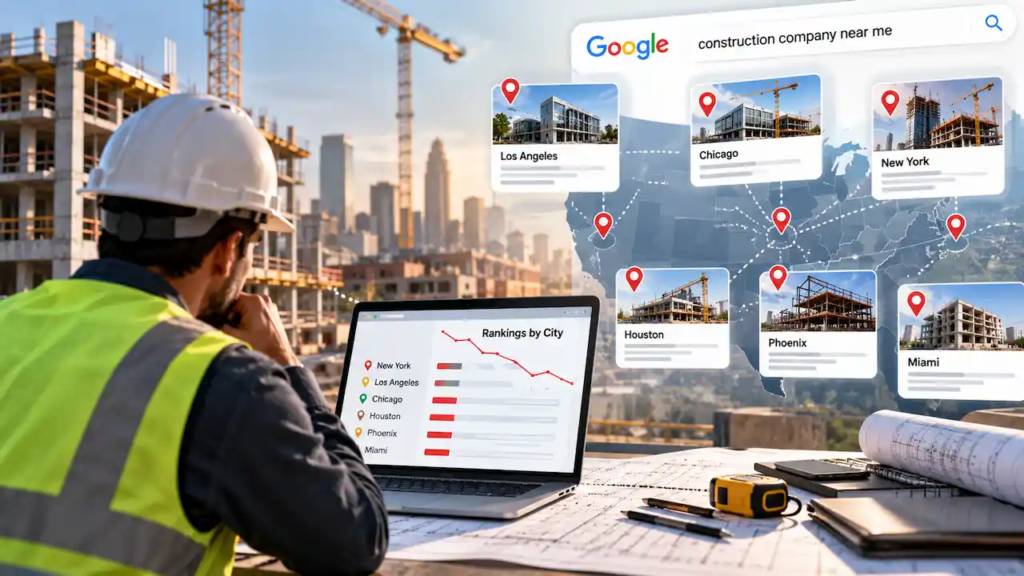
A general contractor may have established operations in one city and the capacity to take on projects in three neighboring markets, yet its website generates almost every inquiry from its original location. The company can mobilize crews, coordinate subcontractors, and manage projects across the region, but prospective clients searching in those expansion markets rarely find it.
For construction owners and business development teams, this creates a gap between operational reach and market visibility. Multi location SEO for contractors addresses that gap by aligning real service coverage, location-specific website content, and eligible business listings with the markets the company wants to serve.
Why Construction Companies Struggle to Rank Beyond Their Primary City
Expanding a service area does not automatically expand a contractor’s presence in local search. Search engines and prospective clients need credible information connecting the business to the locations and services it actually supports.
Operational Coverage and Search Visibility Are Different
A contractor based in Dallas might regularly complete commercial tenant improvements in Fort Worth and Arlington. However, its website may discuss only Dallas, while its project portfolio offers no clear evidence of work elsewhere. Someone searching for a commercial renovation contractor in Fort Worth may therefore encounter competitors with more relevant local content.
This does not necessarily mean the expanding contractor lacks experience or capability. Its website simply may not communicate that experience effectively. A structured contractor SEO strategy should distinguish the company’s headquarters, operational service areas, and target expansion markets.
Why Adding City Names Is Not Enough
A common response to weak regional rankings is creating dozens of pages with nearly identical content. One page targets Dallas, another Fort Worth, and another Arlington. Aside from the city name, the services, descriptions, and calls to action remain unchanged. These pages provide little additional value to prospective clients. They also risk becoming doorway pages when created primarily to capture similar searches and funnel visitors toward the same destination.
The business consequence is significant: marketing resources are spent publishing pages that fail to demonstrate local project experience, while genuinely useful service information remains difficult to find.
How to Build an Effective Multi-Market SEO Strategy
A successful expansion strategy begins with commercial reality rather than a list of cities the company hopes to rank for.
Evaluate Which Markets the Contractor Can Actually Serve
Before developing location pages, assess whether the company can consistently deliver projects in each target market. Consider crew availability, subcontractor relationships, travel requirements, licensing obligations, project size, and operational capacity. A specialty contractor handling large industrial installations may reasonably serve a broader geographic area than a company focused on small residential repairs.
Prioritize markets where the company has credible delivery capacity and where relevant project demand aligns with its services. This approach keeps construction local SEO connected to viable opportunities instead of pursuing rankings in locations that are commercially impractical.
Create Location Pages With Genuine Local Value
A dedicated city page should explain why the contractor is relevant to that market. Useful information might include the services available locally, applicable project types, geographic coverage, and examples of completed work where permission allows. For instance, a Fort Worth commercial construction page could describe the company’s tenant improvement capabilities and link to documented Fort Worth projects, if such projects exist.
If the contractor has no local project history, the page should not imply otherwise. It can explain its actual service coverage and capabilities without inventing an established presence. Dexora Digital’s location pages SEO guide provides further context on developing useful geographic content.
Understand Google Business Profile Eligibility
Website location pages and Google Business Profiles serve different purposes. A contractor may legitimately serve several cities without qualifying for a separate Google Business Profile in each one. Google generally requires a genuine, eligible business location for an additional profile. A virtual office, rented mailing address, or city-specific landing page does not establish eligibility.
Service area businesses should follow Google’s rules for their actual business location, customer contact arrangements, and permitted service area settings. Adding cities to a profile’s service area does not guarantee rankings in those locations. Contractors considering additional listings should review Google’s official Business Profile guidelines before making changes.
Avoid Duplicate Pages and Misleading Local Claims
The strongest location pages are not necessarily the longest. They are the pages that provide useful, accurate distinctions. Avoid publishing large numbers of near-identical pages, displaying addresses where the company does not operate, or describing hypothetical projects as completed work. Also avoid creating separate Google Business Profiles for temporary job sites or unsupported locations.
A practical local SEO strategy should connect legitimate business information with relevant search intent and consistent website navigation. Where several nearby cities share the same services and evidence, a regional service page may be more useful than separate thin city pages.
Measure Expansion Success Through Qualified Project Opportunities
Rankings alone cannot establish whether a new market is commercially productive. Contractors should evaluate organic search impressions and clicks by relevant location queries, landing page engagement, and inquiries associated with target cities. More importantly, business development records should show which inquiries become qualified opportunities, bid invitations, proposals, or awarded projects.
A new market generating fewer inquiries may still be valuable if those projects align with the company’s capabilities and preferred contract sizes. Dexora Digital can help construction companies assess geographic search targeting, location page quality, and inquiry pathways through its local SEO services and broader SEO services. The objective is to build visibility around markets the contractor can genuinely serve, not manufacture a local presence.
Conclusion
Expanding into new cities requires more than adding geographic keywords or creating additional business listings. Contractors need to demonstrate real service coverage, publish useful market-specific information, and respect Google’s business representation guidelines.
The most effective approach connects search visibility with operational capacity and qualified project demand. That gives construction companies a stronger basis for deciding where to invest in expansion.
Request a multi-market SEO assessment. If your construction company serves multiple cities but receives most of its organic inquiries from one location, Dexora Digital can evaluate your market targeting, location pages, and local search setup. Contact Dexora Digital to identify practical opportunities for improving visibility across your genuine service areas.
Frequently Asked Questions
How can a construction company rank in multiple cities without having an office in each location?
A contractor can build organic search visibility through accurate service area information, relevant location pages, and evidence of its work in those markets. However, appearing in local map results depends on additional factors, including proximity and Google Business Profile eligibility. Serving a city does not automatically qualify a business for a separate local listing.
Should contractors create a separate SEO page for every city they serve?
Not necessarily. Dedicated city pages are useful when they provide meaningful information about the company’s services, project experience, or operations in that location. When several cities share the same information and there is little to distinguish them, a regional page may be more appropriate than publishing multiple repetitive pages.
Can a contractor create multiple Google Business Profiles for different service areas?
Only when each profile represents a separately eligible business location under Google’s guidelines. Simply serving several cities does not justify multiple profiles. Contractors should not create listings using virtual offices, temporary job sites, or addresses where they do not maintain an eligible business presence.
What is the difference between multi location SEO and contractor service area SEO?
Multi location SEO commonly involves businesses operating from multiple legitimate locations. Contractor service area SEO focuses on communicating the geographic markets a business serves, even when it operates from a single base. The strategies can overlap, but website location pages and Google Business Profile eligibility should be evaluated separately.
How long does it take to improve construction SEO rankings in a new city?
There is no fixed timeline. Results depend on competition, website condition, existing visibility, content quality, and the contractor’s relevance to the target market. Construction companies should establish baseline performance and review search visibility alongside qualified project inquiries over time rather than expecting immediate rankings from newly published city pages.