
Do location pages still work in 2026?
Yes, but not because adding city names to URLs creates local rankings. Location pages work when each page deserves to exist for a real audience in a real market.
The skepticism around them is justified. Search results have been flooded for years with pages that change little more than the city name. At Dexora Digital, I have seen both sides. Well-built location pages can expand qualified organic visibility across genuine service areas. Thin city pages can create duplication, indexation problems, weak engagement, and a site architecture that looks manufactured for search engines instead of customers.
The difference is not whether you create location pages.
The difference is what is actually on them.
Why the Location Pages Are Spam Myth Started
The idea that all location pages are spam came from a very real SEO problem.
For years, businesses and agencies created hundreds of pages using a simple template.
A page might target:
“Plumber in Sacramento”
Then the same content would be copied for:
“Plumber in Fresno”
“Plumber in Oakland”
“Plumber in San Jose”
“Plumber in Bakersfield”
Only the location names changed.
The services stayed identical.
The introduction stayed identical.
The FAQs stayed identical.
The testimonials stayed identical.
The images stayed identical.
Sometimes even the driving directions and local claims were generated automatically.
These pages were technically different URLs, but they did not provide meaningfully different information.
That is where the reputation of location pages became damaged.
The Problem Was Never the City Name
A city name in a title, heading, URL, or page does not make the page low quality.
The problem begins when the city name is the only reason the page exists.
Consider a contractor that genuinely performs work in three cities.
Customers in each city may have different questions.
Permitting requirements can vary.
Housing stock can differ.
Travel times can differ.
Common project types can differ.
Local regulations can differ.
The contractor may have different completed projects, testimonials, service examples, and customer expectations in each area.
A page that explains those differences can be useful.
Now compare it with a company creating 150 city pages despite having no projects, customer evidence, local knowledge, or meaningful differences across those locations.
Both businesses technically use location pages.
They are not using the same strategy.
Why Search Engines Became Skeptical
Search engines have spent years fighting pages created primarily to capture keyword variations.
That includes pages built around nearly identical combinations of services and locations when the pages ultimately lead users to the same business and provide little distinct value.
This is why local SEO city pages duplicate content became such a common concern.
Duplicate wording itself is not the entire issue.
Most websites naturally repeat some information.
Contact details repeat.
Service explanations repeat.
Legal language repeats.
Calls to action repeat.
Navigation repeats.
The larger issue is whether the page offers a unique reason for users to land there.
If someone searching for roofing services in Sacramento receives exactly the same information as someone searching in San Diego, with only the city changed, the page has weak information value.
The right response is not to conclude that location pages are dead.
The right response is to build fewer, stronger pages.
Google’s Actual Stance: Thin Pages vs. Genuinely Useful Pages
Google does not have a rule saying businesses cannot create pages for individual locations.
A business with multiple branches can obviously create pages for each legitimate location.
A service area business can also create useful pages explaining services available in different markets.
What matters is whether the content primarily exists to help users or primarily exists to capture additional search queries.
That distinction should guide the entire local SEO strategy.
A Location Page Needs Its Own Search Intent
Before creating a page, ask whether people genuinely search for that service in that location.
If the answer is yes, then ask a second question:
Can we create a page that is meaningfully useful to those searchers?
Search demand alone is not enough.
Suppose a roofing company serves twenty towns.
Creating twenty location pages automatically may not be the right decision.
Perhaps five cities account for most revenue.
Three additional cities have strong search demand and existing customers.
The remaining twelve have almost no customer history, weak demand, and no unique local information.
The first eight may deserve pages.
The other twelve may not.
A California local SEO master checklist should therefore include page qualification before page creation.
What Genuine Local Value Looks Like
A useful location page can include local information such as:
- Services that are particularly relevant in that city
- Real projects completed in the area
- Testimonials from customers in that market
- Local permitting or regulatory considerations where applicable
- Neighborhoods and communities genuinely served
- Response expectations and service coverage
- Local photos or project imagery
- Common customer problems specific to the location
Not every page needs every element.
The goal is not to create a checklist and mechanically populate it.
The goal is to prove that the business understands and serves that market.
For example, a plumbing company may discuss older galvanized pipes in one neighborhood where that problem is common.
A roofing company might explain wind or storm conditions relevant to a particular region.
A site planning company may discuss differences in local permit processes.
A restoration contractor may highlight building types commonly found in that city.
Those details create information gain.
Location Pages Are Not Google Business Profile Locations
This distinction is important.
A website location page does not create a physical Google Business Profile location.
If you serve a city from another location, the page can help the website become relevant for organic searches in that city.
It does not change the physical proximity of your Business Profile.
This is why businesses should separate organic location page strategy from Google Maps strategy.
A company may struggle to rank in Maps twenty miles away because distance is a strong local factor.
The same company may still rank an excellent organic page for a valuable city specific service query.
That is one reason location pages still matter.
They create an organic acquisition opportunity even when Maps proximity works against the business.
The Duplicate Content Trap and How to Avoid It
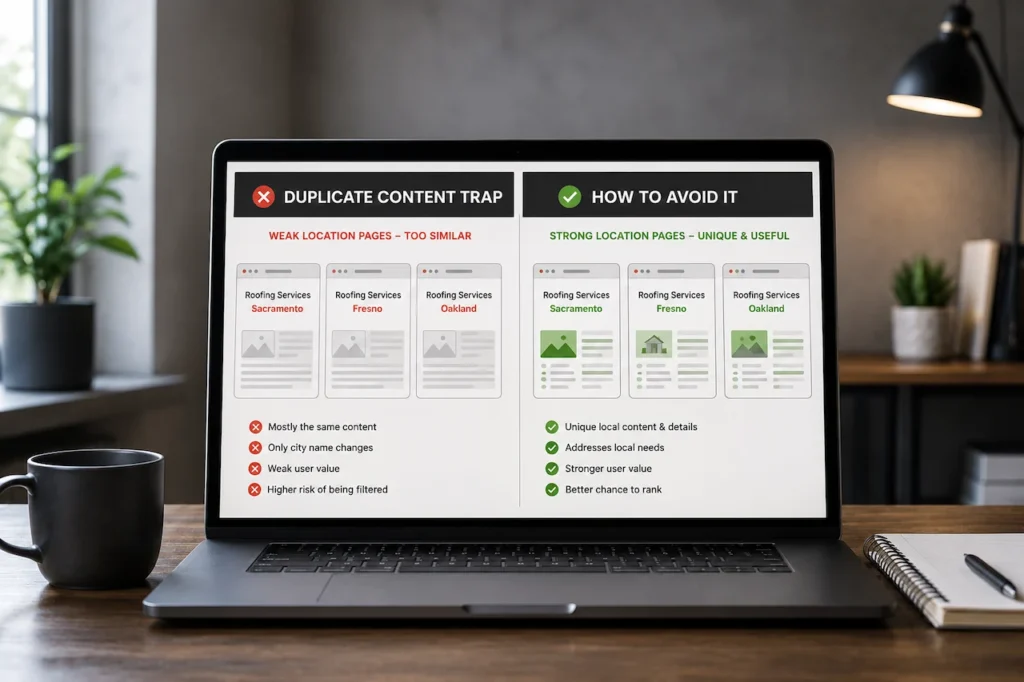
Duplicate content is usually where location page strategies fail.
The easiest way to create ten pages is to write one page and replace the city name ten times.
It is also one of the weakest approaches.
The problem is not that two pages share a service definition or similar call to action.
The problem is when the majority of each page is interchangeable.
Think in Terms of Information Difference
Ask this simple question:
If the city name disappeared from the page, could a reader still identify which location the content was written for?
If the answer is no, the page probably needs more local substance.
A strong page should contain signals that are naturally tied to its target location.
The text should not feel as if the location name was inserted into a generic template.
This does not mean every sentence has to be unique.
Some service information will naturally overlap because the business provides the same service everywhere.
The objective is meaningful differentiation, not artificial rewriting.
Do Not Spin the Same Paragraph
Weak local SEO often looks like this:
“We proudly provide professional roofing services in Sacramento.”
Then another page says:
“We proudly provide reliable roofing solutions throughout Fresno.”
Then another says:
“Our experienced roofers provide trusted roofing services across Oakland.”
Technically, the wording changed.
Semantically, nothing changed.
This is not meaningful uniqueness.
A better approach starts with location specific customer needs.
Why would a Sacramento customer need this service?
What types of properties do you commonly work on there?
What problems occur frequently?
What proof do you have?
What does the customer need to know before hiring?
What service areas surrounding the city genuinely make sense?
The answers create useful differences naturally.
Avoid the Service and City Matrix
One of the biggest risks is creating every possible combination.
For example:
Roof Repair Sacramento
Roof Replacement Sacramento
Emergency Roofing Sacramento
Commercial Roofing Sacramento
Roof Inspection Sacramento
Then duplicating all five pages across twenty cities.
You now have one hundred pages.
The question is whether one hundred distinct search experiences actually exist.
Sometimes a dedicated service and city page is justified.
Often it is not.
A stronger architecture may use one comprehensive Sacramento roofing page that covers the important service set, while the main service pages target broader service intent.
A content gap analysis can help determine whether users need another page or whether the existing page simply needs stronger coverage.
Use Canonical Architecture, Not Keyword Architecture
Every URL should have a clearly defined job.
For example:
The main roofing service page targets the service nationally or across the primary market.
The Sacramento location page targets roofing services specifically for Sacramento customers.
A roof repair guide answers informational questions.
A project case study proves experience.
A Google Business Profile page supports Maps visibility.
Each asset serves a different intent.
Problems emerge when six URLs all try to rank for:
“roofing company Sacramento”
That creates cannibalization rather than topical authority.
How We Avoid Duplicate Location Pages
Before approving a location page, we check:
- Whether meaningful search demand exists
- Whether the company genuinely serves the area
- Whether the page can include location specific proof
- Whether another existing URL already targets the same intent
- Whether enough unique information exists to justify indexation
- Whether the page supports the overall site architecture
- Whether local internal links can connect it naturally
- Whether the business can maintain the information over time
If most answers are no, we usually do not create the page.
This is more sustainable than producing hundreds of URLs and trying to fix quality problems later.
A Realistic Before and After Location Page Example
Consider a hypothetical home services company serving Sacramento and several surrounding cities.
The business already ranks reasonably well in its home city but wants more organic leads from Roseville.
The original Roseville page contains approximately 450 words.
Its structure looks like this:
“Home Services in Roseville”
A short paragraph saying the company serves Roseville.
A generic list of services.
The same company description used everywhere.
The same three testimonials from customers outside Roseville.
A generic contact form.
A short FAQ copied from the Sacramento page.
The city name appears frequently, but almost nothing else distinguishes the page.
Before Improvement
The page receives impressions but struggles beyond positions twenty to thirty.
Users rarely engage with it.
It has very few internal links.
No local project information appears.
No customer proof comes from Roseville.
No explanation exists for why the company is relevant to the area.
The page is technically optimized.
It has the city in the title.
It has the city in the H1.
It has the city in the meta description.
It has the city in the URL.
Yet it performs poorly.
That is because keyword placement is not the same as local authority.
After Improvement
The business does not simply add another thousand generic words.
Instead, it rebuilds the page around actual Roseville experience.
The revised page explains which services customers in Roseville request most often.
It includes two completed local projects.
One customer testimonial comes from Roseville.
Project photography is added.
The page identifies genuine nearby communities the company regularly serves.
The copy explains common local property conditions relevant to the service.
The page links naturally to the appropriate service pages and a relevant project case study.
The company also earns a local mention through a community organization and corrects several outdated citations.
Over time, the page begins receiving more impressions for Roseville related service queries.
Rankings improve for a broader range of terms.
More importantly, the traffic is better qualified because the page aligns with a real service market.
This is how location pages should work.
The improvement did not come from inserting the location name more frequently.
It came from building a page with better relevance, evidence, and local usefulness.
Why This Strategy Supports Topical Authority
Location pages should not exist alone.
They should connect to a wider topic structure.
A roofing location page connects to roofing services.
Roof repair content connects to the service page.
Project case studies prove experience.
Supporting guides answer related questions.
The local page ties these assets to a geographic market.
That creates topical authority around the business, service, and location relationship.
A location page therefore works best when it is part of a coherent website rather than an isolated SEO landing page.
Checklist for a Location Page That Deserves to Exist
Not every city you serve needs its own indexable page.
Before publishing, ask whether the URL has a legitimate reason to exist independently.
Location Page Quality Checklist
A strong page should meet most of these conditions:
- Real search demand exists for the service in the target location
- The business genuinely serves customers there
- The page has a unique primary search intent
- Local information goes beyond replacing city names
- Genuine projects, customers, testimonials, or experience support the location
- The content answers questions relevant to people in that market
- The page does not compete unnecessarily with another existing URL
- Service information is detailed enough to support customer decisions
- Local photos or evidence are included when available
- The page is connected through relevant internal links
- Title and headings accurately describe the page without keyword stuffing
- Contact and service information is consistent with the actual business
- The page remains useful even if rankings are removed from the discussion
That last test is particularly useful.
Ask:
Would we still want a prospective customer to land on this page if Google did not exist?
If the answer is yes, the page probably has a legitimate purpose.
If the answer is no because the entire page exists only to capture a city keyword, reconsider it.
How Many Location Pages Should a Business Create?
There is no correct number.
A business serving five cities may deserve five pages.
Another business serving fifty cities may only need ten.
A multi location company with twenty genuine physical branches may legitimately need a page for each branch.
The right number depends on:
Demand.
Service coverage.
Customer evidence.
Business capacity.
Content quality.
Search intent.
Site architecture.
The wrong approach is deciding the number first and trying to manufacture enough content afterward.
Start with the best opportunities.
Build one excellent page.
Measure performance.
Learn what customers respond to.
Then expand where evidence supports expansion.
Start With Revenue Markets
I usually prioritize markets where the business already has proof.
Existing customers are valuable.
Completed projects are valuable.
Local testimonials are valuable.
Sales data is valuable.
Those signals show that the business has a genuine relationship with the location.
A city with strong keyword volume but no operational value may be less important than a smaller market where customers are profitable and easy to serve.
Local SEO should follow business economics.
Not just keyword volume.
When You Should Merge or Remove Location Pages
Sometimes the right local SEO decision is not creating a new page.
It is reducing the number of existing pages.
If several location pages are nearly identical and receive no impressions, clicks, links, or conversions, assess whether they deserve to remain separate.
Potential actions include:
Improving the page.
Merging overlapping markets.
Redirecting the weaker URL to a stronger relevant page.
Removing obsolete pages.
Keeping a page but excluding it from indexation if it still serves a user purpose.
Do not mass redirect every weak location page to the homepage.
Each URL should be evaluated according to intent and value.
A location page that has backlinks or historical rankings may require a different treatment than a page that has never generated any search visibility.
This is where Search Console data becomes essential.
Content decisions should be based on performance and intent rather than assumptions.
Frequently Asked Questions
Do location pages still work for local SEO in 2026?
Yes. Location pages can still generate strong organic visibility when they target genuine local demand and contain useful, differentiated information. Thin pages that only change city names are much less defensible.
Are location pages considered spam?
Not automatically. A legitimate location page can help users understand services available in their city. Problems arise when large numbers of near identical pages are created mainly to capture keyword variations without providing distinct value.
Is duplicate content bad for local SEO city pages?
Some repeated information is normal, especially service descriptions, contact information, and calls to action. The concern is when most of each city page is interchangeable and there is no meaningful local information.
How unique should each location page be?
There is no useful percentage requirement. Focus on meaningful information difference instead. Each page should contain enough local context, proof, customer information, and service relevance to justify a separate URL.
Should I create a location page for every city I serve?
No. Prioritize cities with genuine service coverage, commercial value, search demand, and enough unique information to build a useful page.
Can location pages help me rank outside my Google Business Profile area?
They can improve organic visibility in markets where Maps proximity makes ranking difficult. A city page does not move your Business Profile or eliminate Google’s distance factor.
How long should a local SEO location page be?
There is no required word count. The page should be long enough to satisfy local search intent and customer questions without adding filler merely to increase length.
Can I use the same service descriptions on multiple city pages?
Some overlap is natural because the underlying service remains the same. However, the overall page should contain meaningful local differences rather than being a duplicated template with location names replaced.
What should I include on a city page?
Useful elements can include locally relevant services, real projects, customer testimonials, neighborhoods served, local images, market specific considerations, FAQs, proof of experience, and clear contact information.
Should weak location pages be deleted?
Not automatically. Review rankings, impressions, backlinks, conversions, intent, and historical performance first. Some pages should be improved, others consolidated, redirected, or removed depending on the evidence.
Build Location Pages That Earn Their Place in Search
Location pages still work when they help real customers understand why your business is relevant to their market. The goal is not to create the largest possible city page footprint. It is to build the strongest useful coverage of the locations that matter to your business.
Dexora Digital helps businesses evaluate existing location pages, identify geographic content gaps, remove duplicate intent, strengthen local relevance, and build scalable location strategies around real search demand and customer evidence.
If your location pages are indexed but not ranking, or you are planning to expand into additional cities, the right next step is a structured local SEO assessment that identifies which pages deserve to exist and what each one needs to compete.