




AI search is no longer a single destination. Businesses often talk about “AI visibility” as if every platform works the same way, but ChatGPT, Google AI Overviews, and Perplexity analyze information differently and produce answers using different systems. A page that earns visibility in one AI platform may receive little or no visibility in another.
I have seen firsthand that businesses create strong content, optimize their websites, and expect the same strategy to work everywhere. The reality is different. AI platforms have different retrieval methods, source preferences, and ways of understanding authority. Winning in AI search requires understanding each platform instead of treating AI search as one single channel.
Why Different AI Platforms Show Different Sources
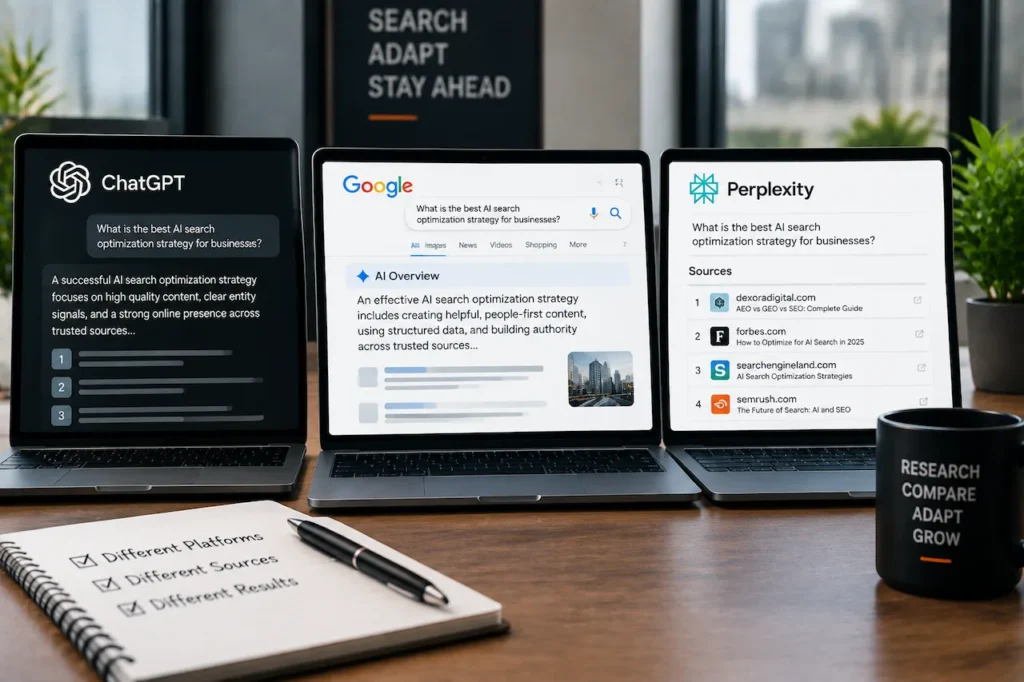
Traditional SEO focuses on ranking pages inside one search ecosystem. AI search introduces a more complex environment where different platforms select, interpret, and summarize information differently.
ChatGPT, Google AI Overviews, and Perplexity may answer the same question but choose completely different sources.
For example:
“What is the best AI search optimization strategy for businesses?”
ChatGPT may prioritize sources that provide strong contextual answers and demonstrate expertise.
Google AI Overviews may rely heavily on its existing search ecosystem, ranking signals, and indexed content.
Perplexity may focus on fresh sources and provide multiple citations with visible references.
The result is three different answers from the same question.
This is why a business cannot simply optimize one article and assume it will dominate every AI platform. Understanding the difference between AEO vs GEO vs SEO helps businesses create strategies that match how each search environment works.
AI search is becoming a multi-platform visibility challenge.
A successful strategy requires understanding how each platform discovers information, evaluates sources, and determines which content deserves attention.
How ChatGPT Selects Sources
ChatGPT works differently from traditional search engines because it combines conversational understanding with information retrieval capabilities.
When users ask questions, ChatGPT does not simply return a list of rankings. It attempts to generate a complete answer by understanding context, user intent, and available information.
For businesses, this creates several important considerations.
Entity Understanding Matters
ChatGPT needs to understand what your business represents.
A company with scattered information may struggle to build strong recognition.
For example:
One page describes your company as an AI SEO agency.
Another page describes you only as a digital marketing company.
A third source describes different services.
The information exists, but the entity relationship is unclear.
AI systems need consistency.
They need to understand:
- Who are you?
- What topics are you associated with?
- Why should your information be trusted?
This is why businesses need stronger entity signals rather than only publishing more content.
An entity SEO strategy helps create clearer connections between your brand, expertise, and online information.
Context and Content Depth Influence Visibility
AI platforms need content that provides useful answers, not just keyword-focused pages.
A strong AI-friendly resource usually includes:
- Clear definitions
- Expert explanations
- Practical examples
- Supporting evidence
- Structured information
The goal is creating content that AI systems can easily understand and extract.
I prioritize creating resources that answer complete user questions instead of targeting only isolated keywords.
A page should not only tell AI what topic it covers.
It should demonstrate why the brand behind that page deserves recognition.
How Google AI Overviews Choose Sources
Google AI Overviews are connected with Google’s broader search ecosystem.
This means traditional SEO fundamentals still matter.
A website’s:
- Search visibility
- Content quality
- Technical foundation
- Authority signals
- User experience
can influence whether information becomes part of AI-generated results.
However, ranking traditionally on Google does not guarantee inclusion in AI Overviews.
AI-generated answers require additional considerations.
The content needs to be easy to understand, extract, and summarize.
Google AI Overviews may select information differently from standard search results because the goal is not only finding a ranking page. The goal is generating a useful answer for the searcher.
Businesses need content that is structured clearly and provides direct answers. A strong rank your site in AI search engines strategy focuses on making information easier for AI systems to understand, retrieve, and reference.
Search Intent Becomes More Important
AI systems focus heavily on understanding what the user actually wants.
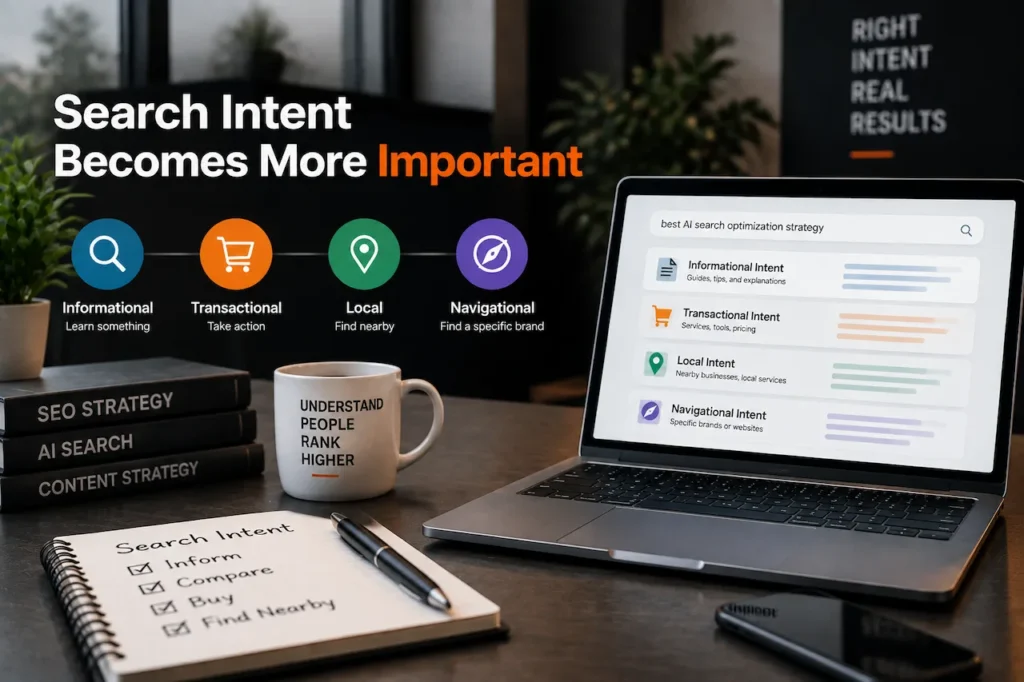
A page targeting:
“AI SEO”
may not perform well for a user asking:
“How can my company appear in ChatGPT recommendations?”
The intent is different.
The second question requires deeper information about:
- AI visibility
- Brand authority
- Citations
- Recommendations
- Entity recognition
I always advise businesses to create content around real customer questions, not only keywords.
AI systems are becoming better at understanding meaning.
Content must match the reason behind the search.
A strong semantic search strategy helps businesses create content that focuses on meaning, relationships, and user intent instead of only matching individual keywords.
Technical Foundation Still Matters
AI visibility depends on accessibility.
If AI systems cannot properly understand your website, strong content alone may not be enough.
Important foundations include:
- Crawlable pages
- Clear website structure
- Internal relationships
- Structured information
- Fast performance
Technical SEO remains important because AI systems still need reliable access to information.
A complete AI search optimization approach combines technical foundations with content and authority signals.
AI search optimization is not replacing traditional SEO. Instead, it expands the way businesses think about visibility by combining technical accessibility, content quality, entity understanding, and authority signals.
How Perplexity Uses Citations Differently
Perplexity approaches AI search differently because citations are a central part of its answer experience.
Instead of only generating a response, Perplexity commonly shows supporting sources directly with the answer. This makes source visibility a major part of how users evaluate information.
However, businesses should understand that citation visibility on Perplexity does not automatically translate to visibility on ChatGPT or Google AI Overviews.
Each platform has different source selection behavior.
A page that receives visibility on one AI platform may not receive the same visibility elsewhere because different AI systems evaluate authority, freshness, and relevance differently.
Source Freshness Plays a Bigger Role
Perplexity is often used for research-focused queries where users expect current information.
This means freshness can become an important factor.
For example:
A company publishes an article about AI search trends in January.
Another company publishes a similar article with updated examples in June.
For a time-sensitive query, Perplexity may prefer the newer information because it better matches user expectations.
Businesses need to maintain content freshness, especially for topics where information changes quickly.
Updating existing resources with new examples, insights, and data can improve the chances of being considered a reliable source.
Why One GEO Strategy Is Not Enough
Many businesses approach GEO as a single optimization process.
They optimize one article, add structured data, improve content, and expect every AI platform to respond the same way.
This approach creates limitations.
AI platforms are not identical.
They differ in:
- Retrieval systems
- Source preferences
- Citation behavior
- Freshness requirements
- User intent interpretation
A strategy that improves visibility in Google AI Overviews may not produce the same results in ChatGPT.
A page cited by Perplexity may not become a recommended source in another AI platform.
This is why businesses need a cross-engine GEO strategy.
The foundation remains similar:
- Strong content
- Technical accessibility
- Authority signals
- Clear entity information
But the execution requires platform-specific adjustments.
A complete generative engine optimization guide should focus on understanding how different AI systems discover and evaluate information instead of treating all AI search platforms as one channel.
Building a Cross Engine GEO Strategy
A strong cross-engine GEO strategy starts with understanding where your business currently appears and where visibility gaps exist.
The process should include several important areas.
Test The Same Prompts Across Multiple AI Platforms
The first step is comparison.
Use identical commercial prompts across:
- ChatGPT
- Google AI experiences
- Perplexity
Then compare:
- Which websites appear
- Which sources are cited
- How often your brand appears
- Which competitors receive visibility
- Whether the answers recommend specific companies
This reveals whether your visibility problem is platform-specific or broader.
Create Content That Works Across Retrieval Systems
Content should be structured so different AI systems can understand it.
Strong AI-focused content usually includes:
- Clear definitions
- Direct answers
- Organized sections
- Expert insights
- Original data
- Practical examples
AI systems need information that can be extracted accurately.
A well-structured article helps multiple platforms understand the same expertise.
Strengthen Brand Entity Signals
AI platforms need to understand your business identity.
Your website should clearly communicate:
- Who you are
- What you specialize in
- Which topics you are associated with
- Why your expertise matters
A brand should not have disconnected information across the internet.
Consistency helps AI systems connect information with the correct entity.
Track Performance Across Engines
Visibility should be measured separately.
A business should monitor:
- ChatGPT mentions
- Google AI Overview appearances
- Perplexity citations
- Competitor visibility
- Source frequency
Businesses that track AI search visibility can identify which platforms recognize their expertise and where improvements are needed.
Real World Example: Testing One Prompt Across AI Platforms
I worked with a business that wanted to understand why its content appeared in some AI answers but not others.
The team tested the same commercial prompt across multiple platforms:
“What is the best company for improving AI search visibility?”
The results were different.
One platform referenced educational content from the company.
Another platform showed competitors.
A third platform provided sources but did not mention the brand.
The business initially assumed the issue was content quality.
The analysis showed something different.
The content was valuable, but the platform-specific signals were incomplete.
The improvements focused on:
- Strengthening entity relationships
- Creating clearer service positioning
- Improving content structure
- Expanding supporting authority content
- Monitoring AI responses regularly
The lesson was simple:
AI visibility is not controlled by one ranking system.
Each platform creates its own interpretation of authority.
Businesses that want consistent visibility need to measure performance across different AI systems instead of relying on assumptions.
Why Choose Us
I help businesses build AI search visibility strategies that are designed around how different platforms discover, evaluate, and represent information.
Our approach combines technical SEO, content strategy, entity optimization, and AI search principles to help businesses improve their presence across changing search environments.
AI search success requires more than publishing content. Businesses need a structured approach that connects technical accessibility, useful information, brand authority, and platform-specific optimization.
Businesses looking to understand their current opportunities can start with an expert SEO consultation to identify visibility gaps, content opportunities, and technical improvements.
Our approach focuses on:
- Experience creating SEO and AI search strategies focused on measurable visibility
- Platform-specific approach for ChatGPT, Google AI Overviews, and Perplexity
- Focus on building strong brand authority across AI systems
- Data-driven testing to identify citation and recommendation gaps
- Combination of technical SEO, content strategy, and entity optimization
Conclusion
AI search is not one single ecosystem.
ChatGPT, Google AI Overviews, and Perplexity each evaluate information differently, which means one GEO strategy cannot deliver maximum visibility everywhere.
Businesses that want consistent AI visibility need to understand platform differences, test performance across engines, and build content systems that strengthen authority across multiple AI experiences.
A successful strategy requires more than creating content. It requires understanding how AI systems interpret entities, evaluate sources, and decide which information deserves visibility.
By combining technical foundations, strong content structure, authority signals, and platform-specific optimization, businesses can improve their chances of being discovered across multiple AI search experiences.
The future of search will not depend only on ranking positions. Businesses will need to become trusted sources that AI systems can understand, verify, and recommend.
FAQs
Why do ChatGPT and Google AI Overviews show different sources?
Different AI platforms use different retrieval systems, ranking signals, and methods for selecting information. The same query can produce different sources across platforms.
Is ranking on Google enough to appear in AI answers?
No. Traditional rankings help create visibility, but AI systems also evaluate factors such as content structure, authority, relevance, and how easily information can be understood and extracted.
Should businesses optimize separately for ChatGPT and Perplexity?
Yes. The foundation can be shared, but each platform has different source selection behaviors and visibility opportunities.
What is cross-engine GEO?
Cross-engine GEO is the process of optimizing content and brand signals to improve visibility across multiple AI platforms instead of focusing on only one system.
How can I measure AI search performance?
Businesses can test commercial prompts across different AI platforms and measure citations, mentions, recommendations, and competitor visibility.
Does GEO replace traditional SEO?
No. GEO builds on SEO foundations. Technical SEO, content quality, internal linking, authority signals, and structured information remain important because AI systems still depend on accessible and reliable information.
How long does it take to improve AI search visibility?
AI visibility depends on many factors, including website authority, content quality, competition, indexing, and how frequently AI platforms update their systems. Continuous testing and improvement are required.
Can small businesses compete in AI search results?
Yes. Small businesses can improve their chances by building strong expertise signals, creating detailed helpful content, maintaining accurate business information, and developing authority around specific topics.
Improve Your AI Search Visibility With Dexora Digital
AI search is changing how customers discover businesses.
If your brand is not being understood, cited, or recommended by AI platforms, you may be losing visibility before potential customers ever reach your website.
At Dexora Digital, we help businesses build AI-ready websites, strengthen authority signals, improve technical foundations, and create content strategies designed for modern search experiences.
Whether you want to improve ChatGPT visibility, appear in Google AI Overviews, or build a stronger GEO strategy, our team can help identify opportunities and create a practical roadmap.
Get your AI search visibility strategy started today.