



AI search has created a new challenge for businesses that invest heavily in content. Your website can become a trusted source for AI-generated answers, yet your brand may remain completely invisible to the people reading those answers. This hidden visibility problem is known as ghost citations, where AI platforms use your information but fail to connect that information with your company.
I have seen firsthand that many businesses celebrate AI citations without checking whether those citations create brand recognition. A citation proves that AI found value in your content, but it does not always mean users discover your business. The next stage of AI search success is becoming the brand that AI systems recognize, mention, and recommend.
What Are Ghost Citations in AI Search?
Ghost citations happen when an AI search engine references information from your website but does not mention your brand name in the generated response.
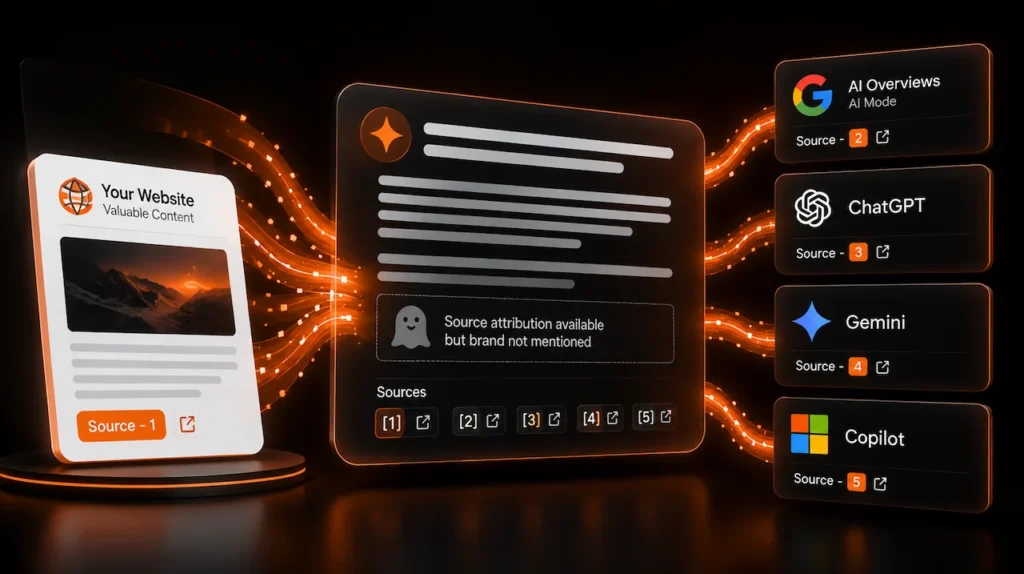
This creates a unique visibility gap.
Your content influences the answer, but your business identity disappears.
For example, imagine your company publishes a detailed guide about improving online visibility. An AI platform uses your research when answering a user question about SEO strategies. The response may include information from your article, but instead of mentioning your company, the AI answer simply presents the information as general knowledge.
The website receives a citation.
The brand receives no recognition.
This is why traditional measurement methods are becoming incomplete. A business may believe it has strong AI visibility because its pages appear as sources, but the audience may never know who created the valuable information.
Ghost citations are not a sign that your content failed. In many cases, they show that your content is useful enough for AI systems to reference. The problem is that the connection between your expertise and your brand is not strong enough.
The goal is not only to be the source behind an answer. The goal is to become the recognized authority behind that answer.
Why AI Cites Websites Without Mentioning Brands
AI systems do not copy content directly from webpages. They analyze information, compare multiple sources, identify useful concepts, and generate responses based on user intent.
During this process, brand identity can become separated from the information being extracted.
One common reason is that many websites explain topics without creating strong connections between their expertise and their brand.
A page may contain excellent information about a subject, but if the content structure does not clearly communicate who created the knowledge, why that source is trustworthy, and what experience supports the information, AI systems may extract the information without maintaining the brand association.
I prioritize a strategy where every important piece of content strengthens both topical authority and entity recognition.
Content should answer two questions:
What information does this page provide?
Who should receive credit for providing this information?
Many businesses focus only on the first question.
AI visibility requires both.
Citation, Mention, and Recommendation: Three Levels of AI Visibility
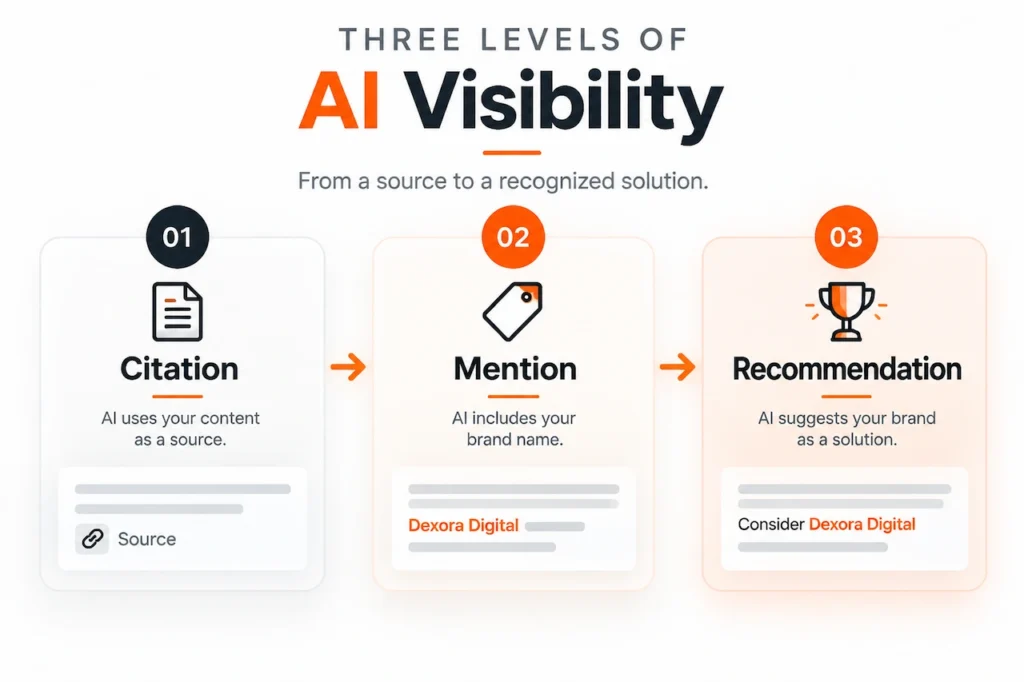
Not every AI appearance creates the same business value.
Understanding the difference between citation, mention, and recommendation helps businesses measure real AI performance.
Citation
A citation happens when an AI platform references your website as a source of information.
This means your content contributed to the answer.
For example, an AI response may include your webpage as a supporting source after explaining a topic.
A citation demonstrates content relevance, but it does not guarantee that users will remember your brand.
Mention
A mention happens when the AI response includes your company name while explaining an answer.
This creates brand awareness.
For example:
“According to Dexora Digital, businesses improving AI visibility should focus on entity optimization and structured content.”
The user now connects the information with a specific company.
Recommendation
A recommendation is the highest level of AI visibility.
This occurs when AI systems connect your brand with a solution.
For example:
“A company looking to improve AI search visibility may consider Dexora Digital.”
At this stage, AI is not simply using your information. It is positioning your business as a relevant option.
The journey looks like this:
Citation means AI found your information.
Mention means AI connected your information with your brand.
Recommendation means AI connected your brand with customer intent.
Businesses should not only ask, “Is AI citing my website?”
The better question is:
“Is AI connecting my expertise with my brand?”
Why Ghost Citations Are Becoming a Business Problem
Traditional SEO focused heavily on rankings, clicks, and impressions.
AI search introduces another layer.
A business can influence search results without receiving direct visibility.
This creates a new challenge because users increasingly rely on AI-generated answers before visiting websites.
If AI uses your content but removes your brand identity, another company may benefit from the awareness you created.
I always advise clients to think beyond traffic metrics. Visibility is valuable only when it supports recognition, trust, and business growth.
A website that receives thousands of AI citations but few brand mentions has an opportunity gap.
The information is working.
The branding connection needs improvement.
How to Find Ghost Citations
Finding ghost citations requires a different approach from traditional keyword tracking.
Instead of only monitoring rankings, businesses need to test how AI systems represent their expertise.
The first step is creating a list of commercial and informational prompts related to your industry.
For example:
“What are the best companies for AI search optimization?”
“How can businesses improve visibility in AI platforms?”
“What experts understand generative search strategies?”
These questions reveal whether AI introduces your brand naturally.
I recommend testing across multiple AI platforms because each system processes information differently.
A proper AI visibility review should measure:
- How often your website appears as a citation
- How often your brand name appears
- How often competitors are mentioned instead
- Whether AI recommends your company for relevant searches
A business should not rely on one prompt or one platform.
AI visibility requires continuous testing because models, datasets, and ranking systems continue to evolve.
Businesses that want to understand their position can use systems that track AI search visibility to measure citations, mentions, and recommendation patterns over time.
Creating a Ghost Citation Measurement System
Businesses cannot improve what they do not measure.
Traditional SEO has clear measurements such as rankings, impressions, clicks, and conversions. AI search requires additional visibility measurements because appearing inside an AI answer is not the same as being recognized by the audience.
I recommend using a measurement framework called Ghost Citation Rate.
The purpose of this framework is to identify how often AI systems use your website without connecting that information to your brand.
The formula is:
Ghost Citation Rate = AI citations without brand mentions divided by total AI citations
For example, imagine a business tests 100 relevant AI search prompts.
The results show:
- 70 answers include the website as a source
- 30 answers mention the brand
- 40 answers cite the website without mentioning the brand
The Ghost Citation Rate would be approximately 57 percent.
This means the business has strong content influence, but more than half of its AI visibility is hidden from users.
This measurement helps identify an important question:
Is your content building brand authority, or is it only providing information for others to benefit from?
A strong AI search strategy improves both.
How to Test AI Platforms for Ghost Citations
AI visibility cannot be measured through a single search query.
I always advise clients to test multiple types of prompts because different searches reveal different levels of brand recognition.
The first category is educational prompts.
Examples:
“What are the important factors for improving online visibility?”
“What strategies help businesses appear in AI search?”
These show whether your expertise influences AI answers.
The second category is commercial discovery prompts.
Examples:
“What is the best company for AI search optimization?”
“Who helps businesses improve visibility in ChatGPT results?”
These reveal whether AI connects your expertise with customer decisions.
The third category is competitor comparison prompts.
Examples:
“Compare companies offering AI search optimization services.”
“What agencies specialize in generative search visibility?”
These show whether competitors are receiving mentions while your website remains only a hidden source.
A proper test should include multiple AI platforms and dozens of prompts. I recommend testing at least 25 to 50 commercial prompts because one or two searches cannot represent your overall visibility.
The purpose is not to chase a temporary mention.
The purpose is to understand how AI systems perceive your brand category.
How to Fix Ghost Citations and Improve Brand Recognition
Fixing ghost citations requires more than adding your company name throughout content.
Artificially inserting brand mentions does not create authority.
The solution is building stronger connections between your expertise, information, and entity identity.
Strengthen Brand Entity Signals
AI systems need context to understand who is behind valuable information.
Your website should clearly communicate:
- Your expertise
- Your experience
- Your areas of specialization
- Your original perspectives
- Your proven results
A page should not feel like anonymous information.
It should feel like knowledge created by a credible expert.
I prioritize creating content where expertise is visible throughout the customer journey.
This means connecting educational content with real experience, practical examples, and unique business insights.
Create Original Frameworks and Research
Generic information is easier for AI systems to separate from brands.
Original ideas create stronger associations.
For example, instead of publishing another article explaining AI visibility, create a unique framework that your company owns.
A framework such as:
- AI Citation Analysis
- Brand Mention Tracking
- Recommendation Monitoring
- Ghost Citation Rate
creates a recognizable methodology.
When AI systems repeatedly encounter unique concepts connected with your brand, the relationship between topic and entity becomes stronger.
Improve Content Attribution
Many websites hide their strongest insights inside content without clearly connecting those insights to the company.
A better approach is making expertise visible.
For example, instead of saying:
“Businesses should optimize content for AI search.”
A stronger approach is:
“Based on our experience analyzing AI search visibility, businesses should optimize content around entities, structured information, and trusted sources.”
The difference is not promotional language.
The difference is ownership.
AI systems need to understand who developed the knowledge.
Build Supporting Topic Authority
A single article rarely creates strong AI recognition.
AI systems evaluate broader patterns.
If your website consistently publishes expert content around related topics, the connection becomes stronger.
For example, a company focused on AI search visibility should build authority around:
- AI search optimization
- Generative engine optimization
- Entity SEO
- Semantic search
- AI content evaluation
- Search behavior changes
A complete topic ecosystem helps AI understand your expertise.
Businesses looking to improve how AI platforms understand and represent their information should focus on a complete generative engine optimization strategy rather than isolated content updates.
Connect Technical SEO With AI Visibility
AI visibility still depends on a strong technical foundation.
Search engines and AI systems need to access, understand, and process your content correctly.
Important areas include:
- Clear website architecture
- Structured data
- Internal linking
- Consistent entity information
- Crawlable content
- Strong page relationships
AI optimization is not separate from SEO.
It builds on the same foundation while adding new considerations around brand understanding and answer generation.
A complete AI search optimization strategy combines technical SEO, content quality, and entity recognition to improve how AI systems interpret your business.
Real World Example: Turning Hidden AI Visibility Into Brand Recognition
I worked with a business that had already invested heavily in educational content.
The website had valuable resources, detailed explanations, and strong search visibility. From a traditional SEO perspective, the content was performing well.
However, when we tested AI responses using commercial questions, we noticed a different problem.
The website appeared as a source.
The information was being used.
But the brand was rarely mentioned.
The company had influence without recognition.
The analysis showed that AI systems trusted the information but did not strongly connect the knowledge with the business entity.
The improvement process focused on strengthening the relationship between expertise and brand identity.
We improved:
- Expert attribution
- Content structure
- Internal topic relationships
- Entity signals
- Original strategic frameworks
The objective was not simply increasing citations.
The objective was improving the percentage of times AI connected valuable information with the company responsible for creating it.
This is the difference between being a hidden contributor and becoming a recognized authority.
Why Choose Us
I help businesses adapt to the changing search environment by combining SEO expertise, AI visibility strategies, and practical measurement systems that focus on real business outcomes.
- Experience developing SEO and AI search strategies across different industries
- Data-driven approach to measuring citations, mentions, and recommendations
- Focus on building long-term brand authority, not temporary visibility
- Strategies based on technical SEO, content systems, and entity optimization
- Practical frameworks designed to improve how AI understands your business
Conclusion
AI citations are valuable, but they are only the beginning of AI search visibility. A website can influence AI answers while the brand behind that information remains unknown. Businesses that succeed in the future of search will not only be referenced by AI systems; they will be recognized as trusted sources. Measuring and improving ghost citations helps transform hidden influence into meaningful brand authority.
FAQs
What does ghost citation mean in AI search?
A ghost citation occurs when an AI platform uses information from a website but does not mention the brand responsible for creating that information.
Why does AI cite my website but not mention my company?
AI systems often extract useful information while generating neutral answers. Without strong entity signals, the connection between the content and the brand may become weaker.
How can I check if my website has ghost citations?
You can test relevant commercial and informational prompts across AI platforms and compare how often your website is cited versus how often your brand is mentioned.
Are AI citations more important than rankings?
AI citations and rankings measure different things. Rankings show search visibility, while AI citations show that your information influences generated answers.
Can ghost citations be fixed?
Yes. Improving entity signals, creating original frameworks, strengthening content attribution, and building topical authority can increase brand recognition in AI responses.
Ready to Improve Your AI Search Visibility?
AI platforms are already using valuable content from businesses, but many brands are missing the recognition they deserve. Dexora Digital helps companies improve AI visibility through GEO, entity optimization, semantic SEO, and advanced search strategies designed to help AI systems understand and recommend your brand.
Get a personalized strategy to identify visibility gaps and build a stronger presence across modern search platforms.