
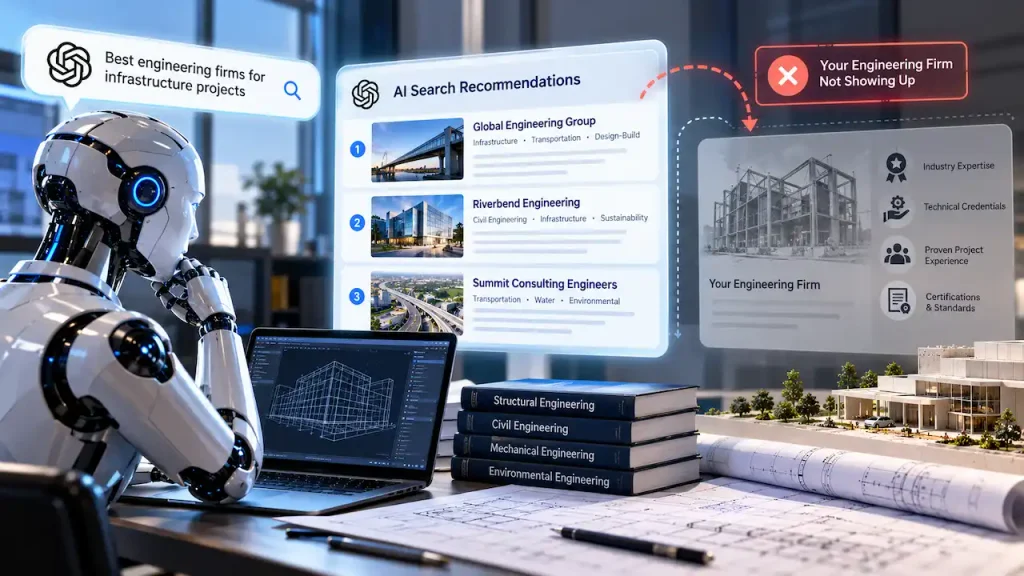
An engineering firm may employ licensed professionals, contribute to complex infrastructure projects, and maintain decades of technical documentation, yet remain absent when a prospective client asks an AI assistant to recommend qualified engineering consultants. For firm principals and business development directors, the concern extends beyond website traffic. Buyers researching structural engineering, utility interconnection, or specialized MEP services may encounter competing firms before discovering equally capable providers.
AI search visibility for engineering firms depends partly on whether publicly accessible information clearly communicates a firm’s identity, specialties, project experience, and relevant evidence. Strong credentials matter, but those credentials must also be understandable and discoverable online.
Why Technical Credentials Do Not Automatically Translate Into AI Recommendations
Engineering qualifications establish professional capability. They do not guarantee that an AI search system can identify a firm as a relevant recommendation for a particular project.
Technical Authority Can Be Difficult to Interpret Online
Consider a power engineering consultancy with extensive experience in protection coordination, load flow analysis, and utility interconnection studies. Its website may describe these capabilities under a broad heading such as “Engineering Solutions,” while detailed project experience exists primarily in proposal documents or internal presentations. A buyer asking an AI assistant for firms specializing in generator interconnection studies needs more specific information than that general description provides.
The issue is not necessarily insufficient expertise. It is a disconnect between technical knowledge and publicly accessible service information. Dexora Digital’s article on engineering firms ranking in Google but remaining invisible in ChatGPT explores this distinction between conventional search performance and AI-generated recommendations.
Missing Recommendations Can Affect Early Vendor Discovery
Engineering procurement rarely depends on a single search result. Buyers may evaluate technical qualifications, geographic coverage, project experience, professional licensing, and suitability for an RFP. AI-generated recommendations can contribute to that initial research, although they are not a substitute for professional due diligence.
When an engineering firm’s specialties are poorly documented, it may receive less consideration during early discovery. This is especially relevant to firms pursuing specialized industrial, infrastructure, or commercial engineering opportunities. However, absence from one AI response is not proof of a technical website problem. Recommendations can vary by platform, prompt, available sources, and response conditions.
How Engineering Firms Can Improve Their AI Search Visibility
An effective implementation process should identify specific information gaps before adding new content or technical features.
Assess Visibility Against Real Engineering Buyer Questions
Start with the questions prospective clients would realistically ask when evaluating engineering consultants. For example:
- Which engineering firms provide protective relay coordination studies for industrial facilities?
- What consultants specialize in utility interconnection studies for renewable energy projects?
- Which structural engineering firms have experience with existing commercial buildings?
Test these questions across relevant AI search platforms, keeping the wording and evaluation method consistent. Record whether the firm appears, how its capabilities are described, which competitors are mentioned, and whether sources are cited. Distinguish a direct recommendation from a passing mention. A system naming the firm in an unrelated context is not equivalent to recommending it for a relevant engineering assignment.
Make the Firm’s Identity and Specialties Explicit
AI systems may encounter information from websites, search indexes, third-party sources, and other available material. Clear and consistent business information helps reduce ambiguity. An engineering website should accurately identify the firm’s legal or trading name, locations, service regions, engineering disciplines, and industry sectors. Specialty pages should connect technical terminology with recognizable project requirements.
For example, a protection engineering page might explain relay coordination studies, applicable electrical systems, typical project circumstances, and deliverables, without disclosing confidential methods or client information.
Relevant standards and technical terminology in engineering SEO should be used accurately rather than inserted simply to attract searches. Structured data can reinforce information already visible on the page, but schema markup alone does not secure AI recommendations.
Connect Public Project Evidence to Engineering Services
Engineering firms frequently maintain substantial project documentation that never becomes useful website content. A project portfolio stored only in downloadable PDFs may be less accessible or less straightforward to interpret than well-organized HTML pages, depending on the platform and document.
Dexora Digital’s discussion of engineering portfolios and the PDF visibility problem addresses this specific content challenge. Where confidentiality agreements permit, engineering firms should connect service pages to relevant project summaries explaining:
- The facility or infrastructure type and engineering scope.
- The technical problem, study, or design responsibility.
- The firm’s documented contribution and applicable project context.
Do not invent project outcomes, disclose restricted client information, or imply responsibility for work performed by other consultants. Professional registrations, memberships, and certifications should also be described precisely and only where they can be substantiated.
Monitor Citations and Recommendation Quality
Engineering GEO, or generative engine optimization, should be evaluated through evidence rather than a single visibility score. Maintain a repeatable set of buyer questions and review results periodically. Record direct recommendations, cited URLs, competitor references, inaccurate descriptions, and changes across platforms.
A cited engineering service page can be useful evidence of source visibility, but citation and recommendation are different outcomes. Some systems provide citations; others may not. Dexora Digital’s guide to tracking AI search visibility offers related measurement context.
Where possible, combine these observations with referral traffic, relevant service page engagement, and qualified inquiries. Avoid attributing a project opportunity to AI search without supporting evidence.
Connect AI Visibility Improvements to Engineering Business Development
The objective is not to make every engineering firm appear in every AI answer. It is to improve the clarity and accessibility of information that helps qualified buyers evaluate the firm’s actual capabilities.
An effective AI SEO for engineering firms strategy can combine specialty page improvements, entity consistency, project evidence, technical SEO, and disciplined recommendation monitoring.
Dexora Digital’s AI SEO services for engineering firms can help evaluate these connected issues. The focus should remain on accurately communicating expertise and identifying measurable visibility gaps rather than promising AI placements.
Conclusion
Engineering firms should not assume that technical credentials alone will produce AI search visibility. Their websites must also communicate what they do, where they operate, which projects they support, and what publicly verifiable evidence demonstrates their capabilities.
By auditing recommendations, clarifying specialties, connecting project proof, and monitoring citations, firms can develop a more informed approach to AI search discovery while preserving technical accuracy and professional credibility.
Request an AI search visibility assessment. If your engineering firm has strong technical qualifications but rarely appears in relevant AI-generated recommendations, Dexora Digital can assess your service content, public trust signals, and AI visibility patterns. Contact Dexora Digital to identify where your firm’s expertise may be difficult for prospective buyers to discover.
Frequently Asked Questions
Why is my engineering firm not appearing in ChatGPT recommendations?
There may be several reasons, including limited publicly accessible information about your specialties, unclear service descriptions, insufficient relevant project evidence, or differences in the sources available to the AI system. A missing recommendation does not establish a single cause. Review multiple relevant prompts and compare the firm’s public information with the sources being cited.
Is AI search optimization different from traditional SEO for engineering firms?
Yes, although the approaches overlap. Traditional SEO focuses on improving website discoverability through search engines. AI search optimization also examines whether AI systems can accurately identify, describe, cite, or recommend a firm. Clear technical content, accessible pages, consistent business information, and credible evidence can support both approaches.
Does schema markup help engineering firms appear in AI search results?
Schema markup can provide machine-readable information about a business, its website, and relevant content. However, it does not guarantee inclusion in AI-generated answers or recommendations. Engineering firms should prioritize accurate visible information, appropriate structured data, and accessible technical content rather than treating schema as a standalone solution.
Should engineering firms publish confidential project details to improve AI visibility?
No. Firms should respect confidentiality agreements, contractual restrictions, intellectual property obligations, and client approval requirements. Useful project summaries can describe permitted engineering responsibilities, facility types, and technical challenges without exposing sensitive designs, proprietary calculations, or restricted project information.
How can an engineering firm measure AI search visibility?
Use a consistent collection of buyer-oriented questions across relevant AI platforms. Track direct recommendations, citations, source URLs, accuracy of technical descriptions, and changes over time. Compare these observations with website referral traffic and qualified business inquiries where attribution is possible. Individual AI responses should not be treated as stable ranking positions.