
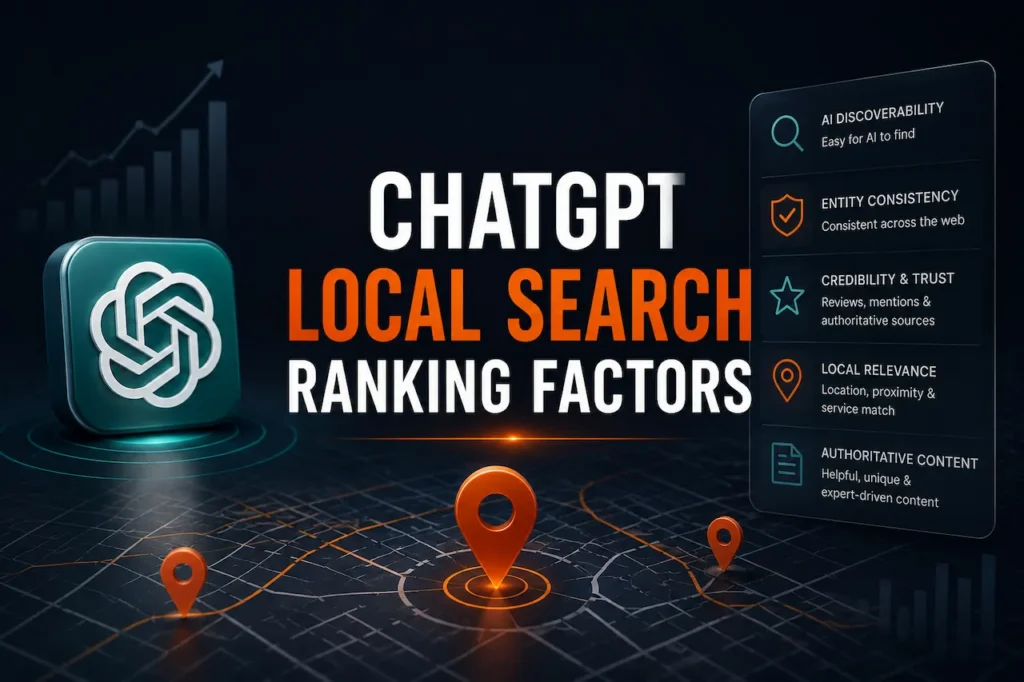
ChatGPT local search ranking factors are becoming an important question for businesses that already understand Google SEO but are beginning to notice a different problem: their competitors appear in AI recommendations even when they do not always outrank them in traditional search.
That does not mean SEO has stopped working. It means AI-assisted discovery introduces another layer of retrieval, entity understanding, source selection, and recommendation confidence.
At Dexora Digital, we do not treat ChatGPT visibility as a separate trick or a replacement for SEO. We treat it as an information consistency problem. A business needs to be discoverable, understandable, corroborated, relevant to the request, and supported by information that an AI system can retrieve and trust.
There is also an important limitation to state clearly.
OpenAI does not publish an official list of ChatGPT local search ranking factors comparable to Google’s published relevance, distance, and prominence framework for local results.
What follows is therefore not a secret ChatGPT algorithm.
It is a practical framework based on how modern AI search retrieves information, how entities are corroborated across the web, and what businesses can improve to become easier to discover and recommend.
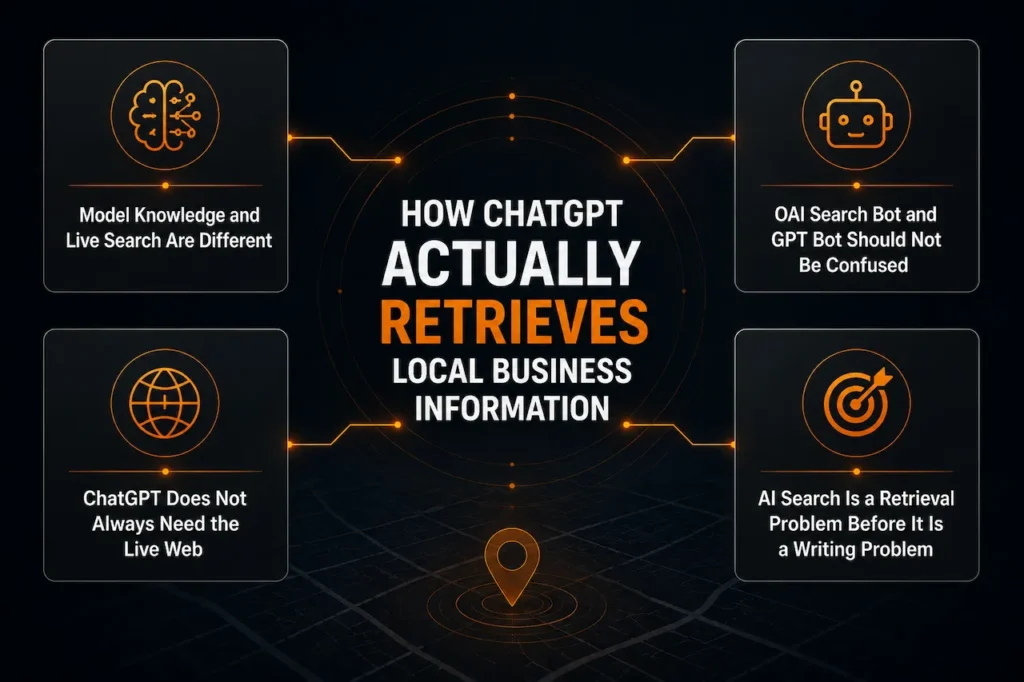
How ChatGPT Actually Retrieves Local Business Information
The first mistake in AI search strategy is assuming every ChatGPT response comes from the same information source.
It does not.
There is an important distinction between information represented in a model’s learned knowledge and information retrieved from the live web during a search-enabled response.
That distinction changes how businesses should approach AI visibility.
Model Knowledge and Live Search Are Different
Large language models are trained using large collections of information so they can learn patterns, relationships, language, concepts, and associations.
That does not mean ChatGPT is continuously reading every business website in real time.
A business changing its homepage this morning does not automatically mean every future ChatGPT response immediately reflects that change.
Search-enabled ChatGPT experiences are different.
When current or web-based information is needed, ChatGPT can search the web and use retrieved sources to construct an answer.
This creates two different visibility challenges.
First, can the system understand what your business is?
Second, can it retrieve credible current information that supports recommending your business for the user’s specific request?
Those are related questions, but they are not identical.
OAI Search Bot and GPT Bot Should Not Be Confused
Crawler terminology has created significant confusion in AI SEO.
OAI SearchBot is associated with surfacing web content in ChatGPT search experiences.
GPTBot is associated with OpenAI’s controls around model training.
A business can therefore make different decisions about search visibility and training access.
Blocking a training-related crawler should not automatically be treated as equivalent to blocking ChatGPT search discovery.
This distinction matters for any AI search optimization strategy.
When auditing a site, check crawler access deliberately.
Do not simply search robots.txt for the word GPT and assume that tells you whether the website can appear in ChatGPT search.
This is one reason technical AI discoverability requires more precision than simply publishing an llms.txt file.
ChatGPT Does Not Always Need the Live Web
A local query can potentially be answered from existing model knowledge, retrieved web information, user-provided context, or some combination depending on the product experience and query.
Consider:
“What are some well-known restaurants in Manhattan?”
That question may involve established entities.
Now compare it with:
“Which emergency plumbers near downtown Austin are open right now?”
That request depends much more heavily on current, local, and time-sensitive information.
The more current and specific the request becomes, the more valuable reliable live information becomes.
For local businesses, this means freshness and retrievability matter.
Your current service availability matters.
Your location matters.
Your hours matter.
Your website matters.
Your external business profiles matter.
Your reviews and public reputation may matter as corroborating information.
The system needs evidence that the business being recommended actually fits the user’s need.
AI Search Is a Retrieval Problem Before It Is a Writing Problem
Many businesses respond to AI Search by publishing hundreds of new articles.
That can miss the real problem.
If the system cannot reliably determine:
Who you are.
What you do.
Where you operate.
Whether you still exist.
Whether the business is reputable.
Whether your services match the request.
Whether independent sources confirm your claims.
Then publishing another generic article about your industry may have limited value.
AI discoverability begins with making the business entity clear.
Content then strengthens the entity by explaining expertise, services, problems solved, markets served, and evidence.
That is why AI search optimization for local businesses should combine technical discoverability, entity consistency, traditional SEO, local SEO, and third-party corroboration.
The Entity Consistency Requirement
A local business is not simply a website.
It is an entity represented across many sources.
The company may appear on its website, Google Business Profile, review platforms, social networks, industry associations, local directories, news articles, customer reviews, maps, professional profiles, and business databases.
AI systems can encounter these references when retrieving information.
Consistency makes the entity easier to resolve.
Imagine Two Competing Businesses
Business A has:
A clear legal and trading name.
A consistent website.
A complete Google Business Profile.
Matching phone and address information.
Strong service pages.
Accurate business categories.
Real customer reviews.
Several industry citations.
Local press mentions.
Consistent company descriptions.
Leadership profiles.
Case studies and project evidence.
Business B has:
Three versions of its name.
Two old phone numbers online.
A website showing an outdated address.
An incomplete Business Profile.
Different services listed across directories.
Almost no independent references.
Generic AI-generated website content.
Very little evidence of actual work.
Which company is easier for a retrieval system to understand?
Business A.
This does not prove that Business A will always receive the recommendation.
But it reduces ambiguity.
Entity Consistency Is More Than NAP
Traditional local SEO often focuses on NAP consistency.
That means name, address, and phone number.
Those details still matter, but modern entity consistency goes further.
An AI system may need to understand:
Business name.
Location.
Service areas.
Services.
Industry.
Specializations.
Founders.
Team members.
Awards.
Certifications.
Years in business.
Pricing model.
Customer types.
Operating hours.
Products.
Case studies.
Reputation.
Relationships with other entities.
Your website should not tell one story while every external profile tells another.
Entity-first SEO becomes especially valuable here because it shifts optimization away from isolated keywords and toward clear relationships between people, businesses, services, locations, and supporting evidence.
Structured Data Can Help Clarify the Entity
Schema markup can provide machine-readable information about organizations, people, services, products, articles, breadcrumbs, and other entities.
It should not be treated as an AI ranking hack.
Adding Organization schema does not guarantee a ChatGPT recommendation.
Adding LocalBusiness markup does not create artificial authority.
Structured data is most useful when it accurately reinforces information already visible on the website.
Schema markup for SEO should therefore be viewed as clarification.
The visible page says who the organization is.
Structured data expresses that information in a machine-readable format.
External sources then provide additional corroboration.
That is a healthier model than expecting one markup script to generate AI visibility.
Contradictory Claims Weaken Trust
Suppose a business homepage claims:
“Serving clients for 15 years.”
Its founder biography says:
“Seven years of experience.”
LinkedIn suggests the company started three years ago.
A directory lists an old company name.
An AI system now encounters several inconsistent statements.
The correct conclusion may still be possible.
But the evidence is unnecessarily messy.
Businesses trying to improve AI search local business signals should audit factual consistency across the web.
Do not focus only on keywords.
Audit facts.
Why Google Rank Does Not Equal AI Recommendation
One of the biggest misconceptions in AI Search is that ChatGPT simply recommends whoever ranks number one on Google.
That model is too simplistic.
Google rankings can clearly matter indirectly because strong search visibility is often associated with authoritative websites, strong brands, relevant content, links, reviews, and clear business information.
Those same businesses are easier to discover across the web.
However, an AI recommendation is not necessarily identical to a Google ranking result.
Google Search and AI Recommendations Solve Different Problems
A traditional search engine often returns a ranked set of pages.
An AI assistant may instead need to synthesize an answer.
Consider this query:
“Recommend three SEO agencies that specialize in local SEO and AI search for US home-service businesses.”
The response requires more than identifying webpages containing “SEO agency.”
The system needs to evaluate several attributes:
Does the company offer local SEO?
Does it understand AI search?
Does it work with US clients?
Does it have home-service experience?
Can those claims be verified?
Is there enough evidence to recommend it?
The company ranking first for a broad phrase like “SEO agency” may not be the strongest answer.
Another company may have more specific evidence matching the request.
That is why chatgpt recommends competitor not me can occur even when your organic visibility looks strong.
Query Specificity Changes the Recommendation Set
The more detailed the user’s request becomes, the more entity attributes matter.
Compare:
“Best dentist near me.”
With:
“Recommend a pediatric dentist in Brooklyn with weekend appointments and experience treating anxious children.”
The second request contains multiple constraints.
A business can only become a strong candidate if enough information supports those attributes.
This is where deep service content becomes useful.
If your website simply says:
“We provide comprehensive dentistry.”
The system has limited evidence.
If it clearly documents pediatric dentistry, anxiety management, appointment availability, office location, team expertise, and patient experience, the match becomes clearer.
Traditional keyword optimization alone may not create that level of understanding.
Strong Google Rankings Still Matter
This does not mean traditional SEO should be abandoned.
Traditional SEO remains fundamental.
Search engines discover content.
Links build authority.
Technical SEO enables crawling.
Local SEO strengthens geographic relevance.
Helpful content demonstrates expertise.
Strong brands earn mentions.
All of these contribute to a healthier information ecosystem.
The mistake is assuming ranking position is the only objective.
AI Search adds another objective:
Become a highly supportable answer.
That means your business should have enough evidence that an AI system can confidently explain why it fits the request.
Brand Mentions Can Matter Even Without a Direct Link
Traditional SEO professionals often evaluate links.
AI retrieval creates additional interest in unlinked brand mentions and contextual references.
Suppose an industry article says:
“Company X specializes in technical SEO for SaaS companies.”
That sentence may provide useful entity information even without functioning like a traditional backlink.
A local chamber might mention that a contractor serves a specific city.
A trade organization might list a company’s certification.
A case study might document a measurable outcome.
A customer discussion might describe a service experience.
Collectively, these references help establish relationships between the business and particular attributes.
This is why topical authority should not be limited to publishing content on your own domain.
Authority also depends on whether the wider web corroborates your expertise.
Why Google Business Profile Still Matters to AI Visibility
Google Business Profile is one of the strongest structured public representations of a local business.
But we need to describe its role accurately.
There is no public evidence establishing Google Business Profile as a special or direct component of ChatGPT training data.
That claim should not be made.
The stronger argument is that GBP is an important part of the public local business ecosystem.
It contains information that can be corroborated through Google Search, Maps, websites, reviews, and other web sources.
GBP Creates a Clear Local Entity Record
A well-maintained Business Profile can communicate:
- Business identity and primary category
- Physical location or service-area model
- Phone and website information
- Business hours
- Services
- Reviews
- Images
- Customer-facing business details
Those signals are extremely valuable for local discovery.
They also frequently agree with information found elsewhere on the web.
That consistency matters.
A business with a clear Google Business Profile, strong website, accurate citations, and independent reviews creates a much more coherent public footprint than one with conflicting records.
GBP Is Especially Important Because Local Queries Depend on Location
AI systems answering local questions need geographic information.
A normal informational query might ask:
“What causes a garage door spring to break?”
A local commercial query asks:
“Who can repair my garage door in Hendersonville?”
Now the business entity needs a geographic relationship.
The system needs evidence that the business operates in Hendersonville or genuinely serves that market.
That is why Google Maps ranking, Google Business Profile information, local citations, location pages, and local customer evidence can become strategically important.
They all help establish the relationship:
Business → Service → Location.
Reviews Add Another Layer of Evidence
Reviews are not simply star ratings.
They contain natural language.
Customers describe services.
They mention staff.
They mention locations.
They describe outcomes.
They discuss specific products and experiences.
That information can reinforce what a business is known for.
This is one reason review quality is strategically valuable even beyond traditional local rankings.
A plumbing company may claim it provides emergency drain clearing.
If dozens of genuine customers independently discuss drain-clearing experiences, the wider public record reinforces the association.
That does not create a guaranteed AI recommendation.
It creates stronger corroboration.
GBP Should Agree With the Website
The website and Business Profile should describe the same real business.
If GBP says:
“Personal injury law firm in Miami.”
But the website primarily discusses corporate law in Orlando, the entity becomes harder to interpret.
If the profile lists twenty services but the website explains only two, relevance becomes weaker.
If the website has moved offices but directories and business profiles retain the old address, geographic consistency suffers.
This is why how Google Maps AI agents understand and validate businesses is increasingly connected with entity management rather than isolated GBP editing.
What Matters More Than Traditional Keyword Optimization
Keywords still help systems understand topics.
But keywords alone are not enough for AI recommendations.
A business should think about evidence coverage.
Ask whether your digital footprint clearly answers these questions:
Who are you?
What do you specialize in?
Where do you work?
Who do you help?
Why should someone trust you?
What evidence supports your claims?
Who else references you?
What results have you achieved?
Are your business facts consistent?
Can current information be retrieved?
That shifts the strategy from writing more content toward building a better-supported entity.
First-Party Evidence Is Particularly Valuable
Generic articles are easy to reproduce.
Original evidence is harder.
For a local business, first-party evidence can include:
Completed projects.
Case studies.
Before and after examples.
Customer results.
Original photographs.
Expert commentary.
Pricing methodology.
Service processes.
Local experience.
Original research.
Frequently encountered customer problems.
Real-world expertise creates information that competitors cannot simply copy without fabrication.
This is why content gap analysis should not ask only:
“What keywords are competitors ranking for?”
It should also ask:
“What evidence do they have that we do not?”
And:
“What original evidence can we publish that they cannot?”
Third-Party Corroboration Strengthens the Story
Your own website will naturally say good things about your company.
Independent references carry a different kind of value.
Useful external sources may include:
Professional directories.
Industry organizations.
Review platforms.
Trade associations.
Local press.
Community websites.
Partner websites.
Supplier directories.
Conference pages.
Podcast appearances.
Expert interviews.
Customer stories.
The goal is not to manufacture thousands of citations.
The goal is to create a credible public record.
Practical ChatGPT Local Search Optimization Checklist
There is no button that turns on AI recommendations.
The best strategy is to make the business easier to retrieve, understand, verify, and match to relevant questions.
Technical Discoverability
Review:
- Whether important pages can be crawled
- Whether OAI SearchBot is unintentionally blocked
- Whether robots directives match your actual AI search policy
- Whether canonical URLs are correct
- Whether important content requires problematic client-side rendering
- Whether XML sitemaps contain canonical indexable pages
- Whether internal links make important entities discoverable
- Whether structured data accurately represents visible information
An llms.txt AI SEO guide can be useful for understanding emerging machine-readable conventions, but llms.txt should not be presented as a guaranteed Google or ChatGPT ranking factor.
Crawler accessibility and normal web discoverability remain more fundamental.
Entity and Local Consistency
Verify:
- Business name consistency
- Address or service-area accuracy
- Phone consistency
- Website URL consistency
- Business categories
- Core services
- Location information
- Founder and leadership details
- Organization descriptions
- Social profiles
- Important directory records
- Review-platform information
- Structured data relationships
When contradictions exist, correct the underlying information rather than adding more content around it.
Authority and Evidence
Strengthen:
- Real customer reviews
- Detailed case studies
- Original project evidence
- Expert author profiles
- Industry certifications
- High-quality brand mentions
- Relevant backlinks
- Local press coverage
- Professional association profiles
- Unique research or datasets
- Service-specific expertise
- Location-specific proof
The objective is to build a business that is easy to verify from multiple independent directions.
Content Coverage
Your content should answer commercial questions that real customers ask.
Do not write only:
“What is SEO?”
If your audience needs:
“How much does local SEO cost for a multi-location dental group?”
Write that.
If customers ask:
“Can an HVAC company rank in ChatGPT without ranking first on Google?”
Answer it.
If buyers compare:
“Local SEO agency versus general digital marketing agency.”
Cover the decision properly.
Generative engine optimization works best when content reflects the real decision journey instead of merely targeting isolated keyword volume.
How to Measure ChatGPT Local Visibility
Measurement remains one of the least mature parts of AI Search optimization.
Google Search Console gives businesses strong query and page data for Google Search.
AI platforms do not necessarily provide an equivalent dataset for every recommendation or citation.
That means businesses need a broader AI search tracking framework.
Track important commercial prompts over time.
Record whether the brand is mentioned.
Record whether it is cited.
Record which competitors appear.
Record the source pages AI systems cite.
Record which entity attributes are associated with the business.
Track referral traffic where available.
Monitor branded search demand.
Track conversion sources.
Compare changes after meaningful improvements.
Do not run one ChatGPT prompt, receive one answer, and treat it as a permanent ranking.
AI-generated responses can vary.
Prompt wording changes.
Context changes.
Location context changes.
Available web information changes.
Systems evolve.
Tracking therefore needs repeated observations rather than one screenshot.
A dedicated AI search tracking process should become part of the overall reporting model as AI-assisted discovery grows.
Traditional SEO Is Still the Foundation
The rise of AI Search has created an unnecessary argument:
SEO versus AEO.
That is the wrong comparison.
AI systems still need information.
Websites still need to be discoverable.
Businesses still need authority.
Search intent still matters.
Technical accessibility still matters.
Entity clarity matters.
Links still matter.
Reviews still matter.
Content quality still matters.
Brand reputation matters.
Local relevance matters.
AI Search changes how some information is synthesized and delivered.
It does not eliminate the need to create credible information.
The strongest strategy is layered.
Traditional SEO helps search engines discover and rank content.
Local SEO establishes geographic relevance.
Entity-first SEO makes businesses easier to understand.
AEO improves answer clarity.
Generative engine optimization improves the business’s ability to become a supportable source or recommendation.
AI discoverability connects those disciplines.
That is why businesses preparing for AI search should not throw away their existing SEO strategy.
They should strengthen it.
Frequently Asked Questions
What are ChatGPT local search ranking factors?
OpenAI does not publish an official fixed list of ChatGPT local search ranking factors. Practical visibility depends on whether the system can retrieve, understand, corroborate, and match a business to the user’s request. Clear entity information, relevant content, local evidence, authoritative mentions, reviews, and technical discoverability can all support that process.
Does ChatGPT use Google rankings to recommend local businesses?
A strong Google presence can help create a stronger public business footprint, but a ChatGPT recommendation should not be treated as a direct copy of Google rankings. AI responses can synthesize information from multiple available sources and match businesses against specific user requirements.
Can a business appear in ChatGPT without ranking number one on Google?
Yes. An AI recommendation may depend on how closely a business matches the user’s complete request, not simply whether one webpage holds the first organic position for a broad keyword.
Does Google Business Profile affect ChatGPT recommendations?
Google Business Profile is an important public source of structured local business information, but there is no public evidence supporting a simple direct GBP ranking factor inside ChatGPT. Its strategic value comes from reinforcing business identity, services, location, reviews, and entity consistency across the wider web.
Does ChatGPT use Google Business Profile as training data?
There is no public basis for confidently claiming that GBP has a special or outsized role in ChatGPT training data. Training controls and live web retrieval should be treated separately. Businesses should focus on making accurate public information discoverable rather than speculating about undisclosed training datasets.
What is the difference between GPTBot and OAI SearchBot?
GPTBot relates to OpenAI’s training controls, while OAI SearchBot relates to web visibility in ChatGPT search experiences. Businesses should not treat blocking one as automatically equivalent to blocking the other.
Does llms.txt improve ChatGPT local rankings?
There is no confirmed ChatGPT local ranking boost from publishing llms.txt. It can be used as an emerging machine-readable convention, but normal crawl accessibility, useful content, entity clarity, and authoritative web references remain more fundamental.
Are local citations useful for AI Search?
Accurate local citations can reinforce business identity, location, services, and contact information across independent sources. They should be treated as corroborating entity signals rather than as a guaranteed AI ranking formula.
Do reviews influence ChatGPT recommendations?
There is no published formula assigning ChatGPT ranking weight to review count or ratings. However, genuine reviews create public evidence about customer experiences, services, locations, and reputation, making them potentially valuable for entity corroboration and user decision-making.
Why does ChatGPT recommend my competitor instead of my business?
Your competitor may have clearer entity information, stronger third-party mentions, more specific service evidence, better local corroboration, stronger authority, or content that more precisely matches the user’s request. Google ranking position alone does not explain every AI recommendation.
How can I track whether my business appears in ChatGPT?
Create a repeatable set of commercially important prompts and monitor brand mentions, citations, competitors, cited sources, associated attributes, referral traffic, and conversions over time. Avoid treating one response as a permanent ranking because AI answers can vary by context and available information.
Is traditional SEO still important for ChatGPT visibility?
Yes. Technical SEO, crawlability, useful content, backlinks, entity clarity, local authority, and brand reputation all contribute to a stronger digital footprint. AI Search adds another discovery surface rather than making traditional SEO irrelevant.
Build a Business AI Systems Can Understand and Recommend
Ranking in Google remains valuable, but future search visibility is increasingly about more than one position on one results page. Businesses also need to be understandable as entities, supported by evidence, discoverable across credible sources, and relevant to the exact problems customers ask AI systems to solve.
Dexora Digital helps businesses improve AI search optimization through entity consistency, technical discoverability, local SEO, structured data, content architecture, citation analysis, authority building, and AI visibility measurement.
If competitors are appearing in ChatGPT while your business is missing, the solution is not publishing random AI content. Start with an AI visibility assessment that identifies what the web currently says about your business, which evidence is missing, and what needs to change to become a stronger recommendation candidate.